Library › Productivity
Stolen Focus — Summary & Key Lessons
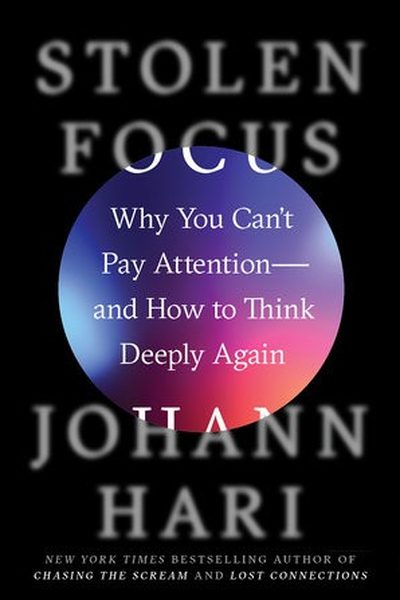
Why you can't pay attention — and how to think deeply again. The international bestseller that names the thieves of focus.
📖 OPEN THE FULL INTERACTIVE BREAKDOWN →🌐 Read it in Hindi, Hinglish, Gujarati, Tamil & 22 more languages — free, with audio.
💡 The Big Idea
After interviewing 200+ experts (including tech insiders), Hari concludes the attention crisis is not a personal failing — it's an environmental one. Twelve thieves steal our focus: switching costs, flow-killing work culture, the collapse of sustained reading, speed-obsessed culture, exhaustion, and the design of social media itself. The fix isn't more willpower — it's structural change.
🧠 The 6 Key Lessons
Lesson 1: The Switching Tax: Every Ping Costs 23 Minutes
The Switching
Every time you check your phone, your brain pays a switching cost: studies show it takes around 23 minutes to fully refocus after an interruption. Ten pings an hour = your entire day vanishes into re-entry. The device isn't just distracting — it's a tax on every thought.
📖 Example: Hari spent months tracking his own attention: he discovered 'checking' averaged every 3 minutes — meaning he was almost never fully in anything. When he removed his phone for a period, his reading and thinking depth visibly returned within days. Read the full example →
⚡ Do this: Count your phone checks for one hour today. Then try one 'batch hour': all notifications off, phone in another room, one task.
Lesson 2: Flow: The Peak of Human Attention
The Flow State
Flow — total absorption in meaningful work — is the deepest form of attention and a major source of happiness. But flow takes 15+ minutes of uninterrupted effort to enter, and one ping destroys it. The system is flow-hostile; you must defend entry conditions like a fortress.
📖 Example: Hari interviewed Csikszentmihalyi's students: flow correlates with life satisfaction more than money. Yet modern work — open offices, instant messaging, meetings — fragments the 20-minute runway flow needs. Read the full example →
⚡ Do this: Block one 90-minute flow window this week: no phone, no chat, one meaningful task. Guard the entrance like a meeting with your best client.
Lesson 3: Reading Deep: The Dying Muscle
The Reading Crisis
Sustained reading trains deep attention — the ability to follow a complex argument for an hour. Skimming and scrolling train the opposite: rapid context-switching. If you never read deeply, your brain loses the muscle for it — and deep thinking is built on deep reading.
📖 Example: Hari's data: sustained-reading time among young people has collapsed while screen-skimming dominates. When he forced himself to read books without interruption, his ability to think in long arcs returned. Read the full example →
⚡ Do this: Start with 20 minutes of physical-book reading daily — no skimming, no phone nearby. Rebuild the muscle, one page at a time.
Lesson 4: Exhaustion Is a Focus Thief
The Exhaustion
You can't pay attention when you're exhausted — but modern culture treats sleep as a weakness. The average person sleeps dramatically less than a century ago, and chronic sleep debt mimics ADHD: scattered, impulsive, unable to sustain focus.
📖 Example: Hari documents how corporate culture brags about 'no sleep', while the science shows sleep-deprived people make more errors, feel more anxious and focus worse. Rest isn't the reward for work — it's the fuel for it. Hari's example: the sleep-deprived brain… Read the full example →
⚡ Do this: Protect 7-8 hours like a hard deadline this week: fixed bedtime, phone out of the bedroom. Measure your focus difference in 5 days.
Lesson 5: Reclaim Boredom — It's the Incubator
The Boredom
Boredom is not an enemy — it's the state where your mind regenerates, daydreams and forms creative connections. The phone exists to eliminate boredom, which means it eliminates the incubation of ideas. Letting yourself be bored is a focus-recovery practice.
📖 Example: Some of Hari's best ideas in the book came during his phone-free walks — the unstructured minutes where the mind wandered and connected. The great scientists' 'shower moments' all required boredom first. Read the full example →
⚡ Do this: Do one screen-free, headphone-free walk this week — 20 minutes of genuine boredom. Keep a note nearby for what surfaces.
Lesson 6: Attention Is Being Harvested — Treat It Like a Resource
The Problem
Hari's investigation: our distraction is not a personal failure but an engineered outcome — platforms are designed by attention economists to maximize screen time. The fix is not just willpower but environment: remove apps, use blockers, protect boredom, and rebuild the capacity for deep attention. You can't out-will a system designed to win; you have to change the game.
📖 Example: Hari documents how former tech designers keep their own kids away from the products they built, and how researchers recover attention by switching to dumbphones or blocking entire categories of apps. The people who win back focus did not try harder — they… Read the full example →
⚡ Do this: Delete one attention-eating app from your phone for a week (or move it behind a blocker) and log your reclaimed time.
✅ 5-Step Action Plan
- Count your checks; batch your attention with a phone-free hour.
- Guard one 90-minute flow window weekly.
- Read 20 minutes of a physical book daily.
- Protect 7-8 hours of sleep like a deadline.
- Take one deliberately boring, screen-free walk.
⚠️ When This Doesn't Work
Hari's 'our attention is being stolen' is the most important media critique of the decade — and Yik Yak is the proof that the thieves sometimes get robbed: the anonymous app that stole thousands of students' attention and privacy with its relentless engagement loops collapsed in 18 months when the toxicity it engineered turned users away. Hari's point stands — but the caveat is that attention is not only stolen; it is also surrendered. The apps die when people decide they've had enough. The fix isn't just regulation — it's the boring, unglamorous act of choosing. The attention economy only works if we keep showing up to be harvested.
💀 The Graveyard Proves It
🗣️ Yik Yak — Anonymous, Local, Viral — and Toxic by Design. Burn: $400M valuation → $1M sale. Read the full case study →
💬 Best Quotes from Stolen Focus
- “Your attention didn't collapse. It was stolen.”
- “If you want to change your life, you have to change your environment.”
- “Boredom is where the self regenerates.”
Interactive version: mark lessons as read, listen in your language, share quote cards.