Library › Productivity
Deep Work — Summary & Key Lessons
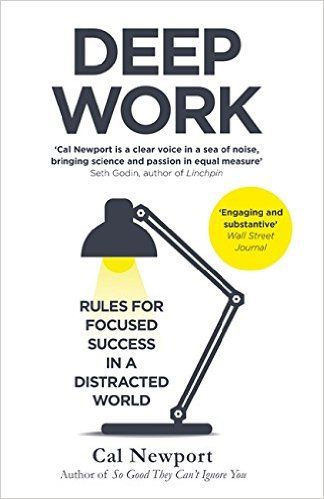
Rules for focused success in a distracted world — why concentration is the superpower of the 21st century.
📖 OPEN THE FULL INTERACTIVE BREAKDOWN →🌐 Read it in Hindi, Hinglish, Gujarati, Tamil & 22 more languages — free, with audio.
💡 The Big Idea
Deep work — professional activity performed in distraction-free concentration that pushes your cognitive limits — creates new value, improves skills, and is hard to replicate. Shallow work — logistics, email, meetings, Slack — is easy to replicate and creates little value. The economy increasingly rewards the former while our tools relentlessly train us for the latter. Newport's argument: the ability to focus deeply is becoming rarer at exactly the moment it's becoming more valuable, which makes it the career equivalent of a superpower. The book's four rules: work deeply, embrace boredom, quit social media (that doesn't serve you), and drain the shallows.
🧠 The 7 Key Lessons
Lesson 1: The Deep Work Hypothesis
Introduction & Chapter 1: Deep Work Is Valuable
Two abilities decide who thrives in the new economy: quickly mastering hard things, and producing at an elite level (quality × speed). Both depend on deep work — myelin-building, deliberate, distraction-free concentration. High-Quality Work Produced = Time Spent × Intensity of Focus: the intensity multiplier is what most knowledge workers have surrendered to notifications. Meanwhile three groups win big going forward: those who work well with intelligent machines, those who are the best at what they do, and those with capital. The first two are built almost entirely in deep work sessions.
📖 Example: Adam Grant, Wharton's youngest full professor, produces prolific top-journal research by batching: teaching stacked into one semester, then long stretches of near-monastic writing, email autoresponder on even to colleagues. Same hours as peers — radically… Read the full example →
⚡ Do this: Calculate your honest deep work hours from last week (unbroken 60+ minute blocks on cognitively demanding tasks). Most people find 0–4. Whatever the number, that's your baseline to double.
Lesson 2: Attention Residue: Why Multitasking Lies
Chapter 1: The Neuroscience of Focus
When you switch from Task A to check Task B — even for seconds — a residue of attention stays stuck on B when you return. Sophie Leroy's research shows performance drops measurably in this residue state, and the residue thickens when the glanced-at task is unresolved (which emails and feeds always are). The 'quick check' is therefore never quick: it taxes the next 20 minutes of cognition. People who work in a state of semi-distraction permanently underperform their own hardware — not because they lack intelligence, but because they never operate at full intensity for long enough to access it.
📖 Example: The experiment version: workers interrupted mid-task to 'briefly' look at something else performed significantly worse on subsequent tasks than the uninterrupted group — even when given equal time. Newport's translation for office life: the person who checks… Read the full example →
⚡ Do this: Institute check-blocks: email/messages at 3 fixed times daily, closed otherwise. Between blocks, when the itch hits, note it on paper and stay — the itch dies in about 90 seconds.
Lesson 3: Choose Your Deep Work Philosophy
Rule 1: Work Deeply
Willpower is a depleting resource; routines and rituals conserve it. Newport offers four scheduling philosophies: Monastic (eliminate shallow obligations almost entirely — rare, for writers/researchers), Bimodal (seasons or days of depth, e.g., Jung's tower retreats), Rhythmic (the same deep block every day — most practical for normal jobs), and Journalistic (drop into depth in any free gap — hardest, needs trained focus). Support the philosophy with rituals: same place, same time, defined rules (no internet, coffee ready, clear success metric), and a shutdown ritual that ends work cleanly so the mind actually rests.
📖 Example: Carl Jung built a stone tower at Bollingen with no electricity, retreating there for distraction-free thinking while maintaining a busy Zurich clinical practice — bimodal in action, producing work that redefined psychiatry. Newport himself (rhythmic): deep… Read the full example →
⚡ Do this: Pick your philosophy (probably rhythmic), then design the ritual: location, start time, duration, rules, and a literal shutdown phrase. Run it for 14 consecutive workdays.
Lesson 4: Execute Like a Business: The 4 Disciplines
Rule 1: The 4DX Framework
Knowing deep work matters doesn't produce it — execution systems do. Newport borrows the 4 Disciplines of Execution: (1) Focus on the wildly important — name the ONE outcome deep work serves, because vague intentions produce vague sessions; (2) Act on lead measures — track hours of deep work (which you control), not results (which lag); (3) Keep a compelling scoreboard — a visible tally of deep hours turns focus into a game your brain wants to win; (4) Create a cadence of accountability — a weekly review of the scoreboard, celebrating wins and diagnosing bad weeks. What gets measured and reviewed gets done; everything else remains a wish.
📖 Example: Newport's own scoreboard: a piece of paper by his desk tallying deep hours, with milestones circled at the hour-counts where academic papers historically got finished. The physical tally created a visceral aversion to zero-hour days — and he traces specific… Read the full example →
⚡ Do this: Put a visible tally (paper, whiteboard) at your workspace. Track deep hours daily, review every Friday: what killed the bad days? Protect next week accordingly.
Lesson 5: Embrace Boredom: Train the Focus Muscle
Rule 2: Embrace Boredom
Focus is a muscle, and constant phone-glancing is its anti-training: a brain taught that boredom always gets candy will never sustain concentration when it counts. The fix isn't scheduling breaks from distraction — it's scheduling breaks FROM focus: internet/phone use only in pre-decided blocks, boredom endured everywhere else (queues, commutes, elevators). Add productive meditation (work on one professional problem while walking) and structured recall to deepen the capacity. The uncomfortable truth: your ability to do deep work at 10 a.m. is determined by what you do with the 90-second waits at 8 a.m.
📖 Example: Newport's rule for a wired world: even with a job requiring constant email, you can schedule internet blocks — say, :00–:15 of each hour online, the rest offline — and the discipline of WAITING for the block (even 5 minutes away) retrains the dopamine loop.… Read the full example →
⚡ Do this: This week: zero phone in queues, lifts, and walks — endure every micro-boredom. Plus one 20-minute 'productive meditation' walk daily chewing a single work problem.
Lesson 6: Quit the Tools That Don't Pay Rent
Rule 3: Quit Social Media
The 'any-benefit' fallacy: we keep tools because they offer SOME benefit, ignoring the cost side — attention fragmentation, envy loops, and the colonization of every idle moment. Newport's craftsman approach: identify your core professional and personal goals, then keep only tools whose benefits SUBSTANTIALLY outweigh their costs for those goals. Run the 30-day test: quit all optional networks cold; after a month ask — did anything important collapse? Did anyone even notice? For most people, most networks fail both questions. The point isn't asceticism; it's that attention is your scarcest capital and most apps are negative-yield investments of it.
📖 Example: Newport (a computer science professor writing about technology) has never had a social media account — and his career thrived on exactly the deep output that abstinence funded. He cites farmer Forrest Pritchard evaluating a hay baler like a craftsman: not… Read the full example →
⚡ Do this: 30-day test starting Monday: deactivate every optional network. Track what you actually miss (list it). Reinstate only what earned its place against your top 2 goals.
Lesson 7: Drain the Shallows
Rule 4: Drain the Shallows
Shallow work is a weed: unmanaged, it fills every hour. Countermeasures: schedule every minute of your workday in blocks (revise freely when the day changes — the point is deciding on purpose, not rigidity); quantify the depth of each task ('how many months would it take a fresh graduate to do this?' — low number = shallow = minimize); get your shallow-work budget approved by your boss (most agree to 30–50%, which is itself a revelation); finish by 5:30 via fixed-schedule productivity — the hard deadline forces ruthless triage; and make yourself harder to reach: sender filters, non-comprehensive email answers, and the courage to not reply at all.
📖 Example: Newport's fixed-schedule proof: he refuses work after 5:30 pm and on weekends, yet out-published most peers while writing trade books — because the constraint forced him to decline committees, batch shallow tasks, and protect mornings like a fortress. The… Read the full example →
⚡ Do this: Tomorrow: block-schedule the whole day in 30–60 minute chunks before it starts. Label each block deep/shallow. At week's end, compute your shallow percentage — then set a hard budget for next week.
✅ 5-Step Action Plan
- Measure baseline deep hours; put the tally scoreboard on the wall.
- Choose your philosophy + design a start/shutdown ritual; run 14 days.
- Fixed check-blocks for email/messages; boredom endured everywhere else.
- Run the 30-day social media test; reinstate only what pays rent.
- Block-schedule daily, budget shallow work, and end at a fixed time.
⚠️ When This Doesn't Work
Deep work is a privilege, not a moral virtue. If your job is reactive — support, sales, emergency response — or you're the primary caregiver at home, 'block four hours daily' is simply not available. Start with micro-protocols: one 45-minute phone-away block, two days a week. And don't quit every tool: in India, WhatsApp is how work actually gets done — the skill is batching it, not abandoning it.
💀 The Graveyard Proves It
🏬 Sears — The Original 'Everything Store' That Forgot Itself. Burn: 132 years → bankruptcy. Read the full case study →
💬 Best Quotes from Deep Work
- “The ability to perform deep work is becoming increasingly rare at exactly the same time it is becoming increasingly valuable.”
- “Clarity about what matters provides clarity about what does not.”
- “Who you are, what you think, feel, and do, what you love — is the sum of what you focus on.”
Interactive version: mark lessons as read, listen in your language, share quote cards.