Library › Psychology & People
Influence: The Psychology of Persuasion — Summary & Key Lessons
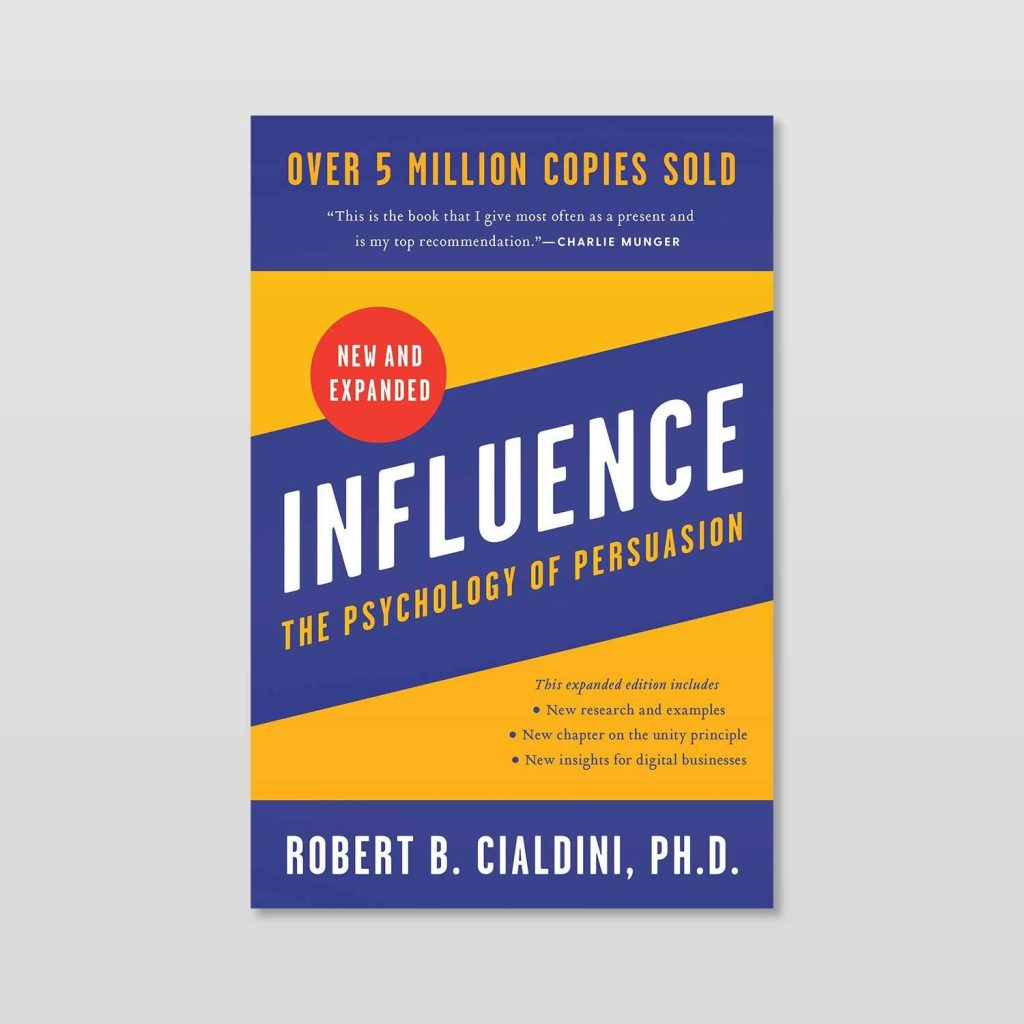
The classic on the seven weapons of influence — how compliance professionals get you to say yes, and how to defend yourself.
📖 OPEN THE FULL INTERACTIVE BREAKDOWN →🌐 Read it in Hindi, Hinglish, Gujarati, Tamil & 22 more languages — free, with audio.
💡 The Big Idea
Cialdini spent years undercover — training with car dealers, fundraisers, telemarketers, and recruiters — to catalog the psychology that makes people comply. His finding: humans run on automatic 'click-whirr' response patterns that served us well for millennia and are now systematically exploited. The principles (reciprocity, commitment/consistency, social proof, liking, authority, scarcity, and — added later — unity) function as shortcuts we can't afford to abandon, which makes recognizing their weaponized forms the only defense. The book is simultaneously an attack manual for ethical influencers and body armor for everyone else.
🧠 The 7 Key Lessons
Lesson 1: Click-Whirr: The Automatic Yes
Chapter 1: Weapons of Influence
Like the mother turkey who mothers anything that makes a 'cheep-cheep' sound — including a stuffed polecat with a recorder inside — humans run fixed-action patterns triggered by single features rather than full analysis. 'Expensive = good,' 'expert said so = true,' 'others are doing it = correct.' These shortcuts are usually right and always necessary (full analysis of everything is impossible), which is exactly why exploiters mimic the trigger without supplying the substance. The contrast principle compounds it: the same item seems cheaper after a pricier one, a request seems smaller after a larger one. Defense begins with hearing your own click-whirr.
📖 Example: Cialdini's jewelry store legend: turquoise pieces that wouldn't sell were accidentally priced at DOUBLE (a misread note) — and sold out immediately. Tourists, unable to judge quality, used price as the quality signal: expensive = good, click, whirr. Retail… Read the full example →
⚡ Do this: For one week, flag every purchase or agreement where you relied on a single cue (price, title, popularity). Ask once per flag: is the trigger backed by substance this time?
Lesson 2: Reciprocity: The Debt You Didn't Ask For
Chapter 2: Reciprocation
The reciprocity rule — repay what you receive — underwrites all human cooperation, and it fires even for UNINVITED gifts, tiny favors, and free samples: the discomfort of owing is so strong we overpay to discharge it. The weaponized versions: the free gift before the ask (address labels in charity mail triple response rates), the favor bank in office politics, and the deadliest variant — reciprocal CONCESSION: the rejection-then-retreat technique, where a large request is refused and the 'compromise' (the real target all along) feels like a concession you must match with a yes. Defense: accept gifts as gifts, but redefine tricks as tricks — a sales device owes you nothing.
📖 Example: The Hare Krishna Society's fundraising crisis was solved with a flower: members pressed one into travelers' hands ('a gift, ours to you') before asking for donations. Contributions exploded — from people who often threw the flower away steps later. The Boy… Read the full example →
⚡ Do this: Practice the redefinition defense: next unsolicited freebie followed by an ask, say internally 'gift OR device?' If device, decline without guilt. And in negotiation, use it ethically: make your real ask after a larger sincere one.
Lesson 3: Commitment & Consistency: The Foolish Hobgoblin
Chapter 3: Commitment and Consistency
Once we take a stand — especially actively, publicly, effortfully, and by 'free' choice — internal and external pressure drives us to behave consistently with it. Small commitments ratchet into large ones (the foot-in-the-door technique: agree to a tiny sign, later host a billboard); written commitments outlive their reasons (POW essay contests in Korea); and lowballing survives even the removal of the original incentive (the car price that 'falls through' after you've committed — you buy anyway, having grown your own new reasons). The drive is identity: each act updates the self-image, and the self-image directs future acts. Defense: listen for the stomach's 'I don't want this' and the heart's 'knowing what I know now, would I choose it again?'
📖 Example: The California homeowners study: 17% agreed to a huge ugly 'DRIVE CAREFULLY' billboard on their lawn — but 76% agreed if, two weeks earlier, they'd accepted a tiny 3-inch 'Be a safe driver' window sticker. The sticker rewrote their self-image ('I'm someone… Read the full example →
⚡ Do this: Use it on yourself: write down and share one goal (active, public, voluntary). Against others' use: before honoring any escalated commitment, re-ask the time-machine question — 'knowing what I know now, would I enter this again?'
Lesson 4: Social Proof: Truths Are Us
Chapter 4: Social Proof
When uncertain, we decide what's correct by watching what others do — a fine shortcut that fails catastrophically in two conditions: manufactured evidence (canned laughter works even though everyone despises it; bots and bought reviews are its descendants) and pluralistic ignorance, where everyone looks to everyone else, sees calm, and concludes nothing's wrong — the mechanism behind bystander non-intervention in emergencies. Social proof binds hardest under similarity (we copy people like us) and uncertainty. The famous defense for emergencies: single out one person — 'YOU, in the blue jacket, call an ambulance' — collapsing the diffusion of responsibility that keeps crowds frozen.
📖 Example: Cialdini's grim strongest case: after highly publicized suicides, suicide rates — and even fatal car and plane crashes — spike in the exposed regions (the Werther effect), concentrated among people SIMILAR to the reported victim. Marketing's daily version is… Read the full example →
⚡ Do this: In uncertainty, check the evidence's source: is this proof organic or staged? And memorize the emergency protocol — if you're ever the victim, point at ONE person and give ONE specific instruction.
Lesson 5: Liking & Authority: The Friendly Expert Problem
Chapters 5–6
Liking: we say yes to people we like, and liking is manufactured through physical attractiveness (halo effect — attractive defendants get half the fines), similarity (mirrored dress, claimed shared interests), compliments (flattery works even when we KNOW it's flattery), cooperation toward joint goals, and association (weathermen get hate mail for rain; sponsors buy the Olympic glow). Authority: we obey symbols — titles, uniforms, trappings — often without the substance behind them (Milgram's subjects delivered 'lethal' shocks on a lab coat's say-so; nurses executed absurd 'doctor's orders' phoned in by strangers). Defenses: separate the seller from the deal ('do I like the CAR or the salesman?'), and interrogate authority twice: is this expert genuinely expert HERE, and how truthful are they likely to be given their incentives?
📖 Example: Joe Girard — Guinness-certified greatest car salesman, 5+ cars sold per day for years — attributed his empire to two things: a fair price and being liked. His method included 13,000 monthly holiday cards to former customers, each reading only 'I like you.… Read the full example →
⚡ Do this: Before any significant yes, run the separation drill: list the merits with the person removed. And when 'experts' weigh in, ask the two questions — expert in THIS? incentivized how?
Lesson 6: Scarcity: The Psychology of Less
Chapter 7: Scarcity
Opportunities seem more valuable as they become less available — because losing access triggers psychological reactance (freedom threatened → freedom craved) and because scarcity historically correlated with quality. The amplifiers: NEW scarcity beats chronic scarcity (revolutions come after improvement then reversal — the taste of better makes worse intolerable), and COMPETITION for the scarce resource turns desire into frenzy (real estate agents' fictional 'other buyer'). Weaponized forms: limited numbers, deadlines, 'exclusive information' (data claimed scarce persuades doubly). Defense: the moment you feel the scarcity arousal — the adrenaline of 'last one!' — flag it, then ask the only question that matters: do I want this thing for its USE, or for the feeling of winning it?
📖 Example: The chocolate chip cookie study: identical cookies rated significantly more desirable from a jar of two than a jar of ten — and MOST desirable when the jar went from ten to two before the subject's eyes (new scarcity), especially when told other participants… Read the full example →
⚡ Do this: Install a 24-hour rule for any scarcity-flavored decision (deadline, last-one, exclusive). After the arousal fades, re-ask: do I want to USE it or to WIN it? Buy only for use.
Lesson 7: Unity: The 'We' Beyond Liking
Chapter 8 (New Edition): Unity
Cialdini's seventh principle, added decades later: beyond being liked, the deepest influence flows from shared IDENTITY — the categories where the other person is 'one of us': family, tribe, region, religion, political side, even co-created experiences. Unity works because 'we' relationships blur the self/other boundary: we agree with, help, and trust in-group members at rates mere liking never reaches. The builders: kinship language ('brothers,' 'family'), shared place and origins, acting in unison (singing, marching, rituals synchronize and bond), and co-creation (asking for ADVICE — not opinions — puts the person 'in it with you'). Defense and use are the same awareness: notice when 'we' is being manufactured, and build honest 'we' when the partnership is real.
📖 Example: Warren Buffett's shareholder letters, Cialdini's favorite case: at pivotal moments, Buffett frames guidance in family terms — 'what I would tell my sisters' — instantly relocating shareholders from clients to kin, with trust following. The advice-vs-opinion… Read the full example →
⚡ Do this: Where partnership is genuine, switch from feedback-seeking to advice-seeking ('what would you do here?') — it recruits allies, not critics. And when strangers deploy sudden kinship ('we're family here'), audit what the 'we' is about to cost you.
✅ 5-Step Action Plan
- Flag your click-whirr moments for a week — single-cue decisions especially.
- Redefine tricks as tricks: gifts owe warmth; devices owe nothing.
- Make your goals active, public commitments; time-machine-test others' escalations.
- Run the separation drill (person vs. deal) and the two authority questions.
- 24-hour rule on all scarcity; ask advice, not opinions, to build honest unity.
⚠️ When This Doesn't Work
The same persuasion principles that make this book brilliant are how people get manipulated into ruin — chit-fund schemes run on reciprocity and authority, political campaigns run on social proof, and Cambridge Analytica weaponised every chapter. Knowing the principles is not immunity; you still feel the pull after you name it. The real defence is slower decisions on anything involving money or commitments: if a 'once-in-a-lifetime offer' uses three principles at once, walk away.
💀 The Graveyard Proves It
🕵️ Cambridge Analytica — Harvested 87 Million Friends of Friends. Burn: The company, and Facebook's $5B fine. Read the full case study →
💬 Best Quotes from Influence: The Psychology of Persuasion
- “The way to love anything is to realize that it might be lost.”
- “We all fool ourselves from time to time in order to keep our thoughts and beliefs consistent with what we have already done or decided.”
- “Where all think alike, no one thinks very much.”
Interactive version: mark lessons as read, listen in your language, share quote cards.