Library › Business & Startups
Hooked — Summary & Key Lessons
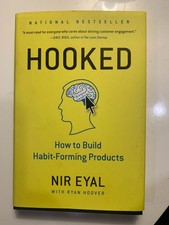
How to build habit-forming products — the four-step Hook Model behind the apps you can't stop opening.
📖 OPEN THE FULL INTERACTIVE BREAKDOWN →🌐 Read it in Hindi, Hinglish, Gujarati, Tamil & 22 more languages — free, with audio.
💡 The Big Idea
Why do some products command daily, unprompted use while better-funded rivals are forgotten? Eyal's answer is the Hook Model — a four-phase loop that converts occasional users into habituated ones: an external trigger starts the cycle; a dead-simple action is performed in anticipation of reward; the reward arrives VARIABLY (slot-machine psychology — the unpredictability is the addiction); and the user then INVESTS something (data, content, followers, effort) that loads the next trigger and makes the product better with use. Cycled enough, internal triggers take over: the product becomes the automatic response to an emotion — boredom opens Instagram, loneliness opens WhatsApp, uncertainty opens Google. It's a manual for builders — with a morality test included — and armor for users who'd rather not be the slot machine's patron.
🧠 The 6 Key Lessons
Lesson 1: The Habit Zone: Frequency Times Utility
Chapter 1: The Habit Zone
Habits are behaviors done with little or no conscious thought — and for companies, they're the deepest moat: habits increase lifetime value, allow pricing flexibility (habituated users are price-insensitive — see gamers and coffee drinkers), supercharge growth (daily users evangelize and create network effects), and blunt competition (a better product usually loses to an ingrained one — QWERTY outlived provably faster keyboard layouts by a century of finger-habit). Entry requires the HABIT ZONE: the behavior must occur frequently enough (roughly weekly or more) and carry enough perceived utility. Infrequent-use products (insurance, tax software) can thrive — but they run on marketing, not habit. The strategic question for any builder: is this a vitamin (nice-to-have, pleasure-driven) or a painkiller (need, itch-scratching)? Habit-forming products pull the trick of starting as vitamins and becoming painkillers — the 'pain' they treat is the itch of their own absence.
📖 Example: Eyal's QWERTY case anchors the chapter: the layout was designed to SLOW typists (preventing typewriter jams); superior alternatives like Dvorak demonstrably improved speed — and died, because millions of fingers had automated the inferior map. Switching… Read the full example →
⚡ Do this: Place your product (or the one consuming your life) in the matrix: how often is it used, and is it a vitamin or painkiller? Builders: if usage is naturally infrequent, stop chasing habit mechanics — you need marketing. Users: name the 'pain' your top app treats, and ask who created that pain.
Lesson 2: Triggers: From External Prompts to Internal Itches
Chapter 2: Trigger
Every habit begins with a trigger. EXTERNAL triggers carry information in the environment: paid (ads — expensive, unsustainable for habit-building), earned (press, viral moments — spiky), relationship (one person telling another — the most potent), and owned (icons on the home screen, notifications, newsletters — the persistent drumbeat that keeps users cycling until a habit forms). But the endgame is INTERNAL triggers: emotions and situations that fire the behavior with no prompt at all — and negative emotions are the heavyweights: boredom, loneliness, frustration, uncertainty, FOMO. When a product couples itself to an emotion through repeated relief, the user's own psyche becomes the notification system. Builders find them by asking 'why?' five times until an emotion surfaces; the design brief is then explicit: what itch does the user feel right before using us, and how do we become its automatic scratch?
📖 Example: Eyal's Instagram anatomy: the external triggers did the early lifting (icons, tags, friend invites), but the durable hook is emotional — the fear of losing a moment (FOMO's photographic strain) fires the camera-app reflex, and boredom's micro-twinge fires… Read the full example →
⚡ Do this: Builders: run five-whys on your user until you hit the emotion; write the internal-trigger sentence ('Every time the user feels X, they open us'). Users: for one day, note the FEELING that precedes each unprompted phone-grab — you're reverse-engineering your own trigger map.
Lesson 3: Action: Make It Easier Than Thinking
Chapter 3: Action
The trigger fires; now the behavior must happen — and Fogg's formula governs it: B = MAT (Behavior requires Motivation, Ability, and Trigger converging). Builders chronically over-invest in motivation (persuasion, copy, rewards) when ABILITY is the cheaper lever: make the action so simple that even weak motivation suffices. Fogg's six simplicity factors — time, money, physical effort, brain cycles, social deviance, non-routineness — are a friction audit: whichever is scarcest for your user at trigger-moment is the constraint to attack. The history of consumer tech is a history of removed steps: every simplification wave (one click, one scroll, one tap) opened the behavior to millions more cycles. Heuristics stack on top — scarcity, framing, anchoring, endowed progress — bending perceived value without changing the product at all.
📖 Example: Eyal's simplification tour: Twitter's genius was the 140-character LIMIT (composing a blog post takes minutes of brain cycles; a tweet takes seconds — the constraint WAS the usability); Instagram collapsed photography's time/skill cost into a filter-tap;… Read the full example →
⚡ Do this: Map your product's (or habit's) action path step by step and delete one: one field, one tap, one decision. For personal habits, apply B=MAT in reverse — to break a habit, add friction (log out, bury the icon, remove the app); to build one, make the first action under 30 seconds.
Lesson 4: Variable Reward: The Slot Machine in Everything
Chapter 4: Variable Reward
Predictable rewards create loyalty; VARIABLE rewards create cravings — the dopamine system spikes hardest under uncertainty of outcome (Skinner's pigeons pecked frantically on random schedules and casually on fixed ones). Eyal's taxonomy: rewards of the TRIBE (variable social validation — likes, comments, upvotes, replies: the who-and-how-much is the lottery), rewards of the HUNT (variable material/informational bounty — the infinite scroll is a slot machine where the next swipe might deliver the perfect post; the deal-hunt, the news refresh), and rewards of the SELF (variable mastery and completion — the inbox approaching zero, the level almost beaten, the puzzle nearly solved; no audience required). Critical design caveats: the reward must scratch the ORIGINAL itch (misaligned rewards feel manipulative), and autonomy must be preserved — users who feel controlled rebel ('reactance'); the craving works only when the user feels they chose it.
📖 Example: Eyal's exhibits by category — Tribe: Facebook's like counter turned every post into a social scratch-card; Stack Overflow's reputation system converts unpaid expert labor into a variable-status game so compelling that engineers moonlight for points. Hunt:… Read the full example →
⚡ Do this: Identify which reward type your product delivers and add variability to it deliberately — or diagnose your own top three apps by type (tribe/hunt/self). Users seeking freedom: make rewards PREDICTABLE again — turn off counters, sort feeds chronologically, batch notifications — and watch the craving deflate.
Lesson 5: Investment & the Morality of Manipulation
Chapters 5–6: Investment / What Are You Going to Do With This?
The hook's final phase inverts classical UX wisdom: ask the user for a bit of WORK — and the work pays the loop forward. Investments store value that makes the product better with use (playlists, followers, reputation, message history, filters learned) — raising switching costs not by lock-in but by accumulated worth — and they LOAD THE NEXT TRIGGER (the sent message summons the reply; the posted photo summons the likes; the followed account fills tomorrow's feed). Psychology assists: the IKEA effect (we overvalue what we've assembled), consistency bias (past effort justifies future use), and escalation of commitment. Eyal closes with the ethics he insists on: the MANIPULATION MATRIX — would the maker use the product, and does it materially improve users' lives? Facilitators (yes/yes) build with clean hands; peddlers (no/yes) ring hollow; entertainers (yes/no) build fireworks; dealers (no/no) — exploitation, full stop. The Hook Model is a power tool; the matrix is the license test.
📖 Example: Eyal's investment gallery: every Twitter follow is unpaid curation that makes ABANDONING the feed costlier each month; Duolingo streaks and language progress are sunk treasure no rival app can import; WhatsApp's years of family history hold users no feature… Read the full example →
⚡ Do this: Builders: after your reward, design one small ask that improves the user's next cycle (a follow, a save, a preference) — then take the matrix test honestly: would you use it, and does it improve lives? Users: tally what you've 'invested' in each sticky app (years of photos, streaks, followers) and ask which investments serve you — and which merely guard the exit.
Lesson 6: The Investment Phase: Getting Users to Put Something In
Part 2: The Habit Loop
The fourth and most underrated phase of Eyal's hook model: investment — when the user puts something of themselves into the product (data, content, followers, reputation), making the next cycle more likely. The investment is what turns a triggered habit into a lock-in: the more someone has invested, the harder it is to leave. It also makes the product better with each use (the uploaded photos, the written posts, the curated profile), which is why the investment phase fuels the trigger of the next loop. The lesson for products and careers alike: the best retention isn't the reward — it's the user's own accumulated contribution. What have you asked people to invest?
📖 Example: Eyal shows how Pinterest and Instagram grow stickier because users' boards and feeds ARE their investment — leaving means abandoning the collection they built. The product didn't need to hold them; their own investment did. Read the full example →
⚡ Do this: If you build a product (or a community, or a personal brand): design one small 'investment moment' — something users contribute that makes the experience better for them the more they add.
✅ 5-Step Action Plan
- Place your product in the Habit Zone matrix: frequency × utility, vitamin or painkiller.
- Five-whys to the internal trigger; write the emotion sentence.
- Delete one step from the action path; add friction to habits you want broken.
- Engineer (or defuse) variable rewards by type: tribe, hunt, self.
- Add an investment ask that loads the next trigger — then pass the manipulation matrix.
⚠️ When This Doesn't Work
The hook model is a tool, and this book never really asks what you're building the habit for. Juul executed the hook model flawlessly — triggers, variable rewards, investment — and built the fastest addiction epidemic of the decade. Not everything deserves a habit loop; some products shouldn't be habit-forming at all. Before you design the trigger, ask: if this succeeds and millions use it daily, does the world get better or just more hooked?
💀 The Graveyard Proves It
🚬 Juul — The $38B Vaping Empire That Vaporized to Zero. Burn: $38B peak valuation → nearly $0; company near-collapse, founder wealth wiped. Read the full case study →
💬 Best Quotes from Hooked
- “The products and services we use habitually alter our everyday behavior, just as their designers intended.”
- “Emotions, particularly negative ones, are powerful internal triggers.”
- “Users who continually find value in a product are more likely to tell their friends about it.”
Interactive version: mark lessons as read, listen in your language, share quote cards.