Library › Productivity
The Checklist Manifesto — Summary & Key Lessons
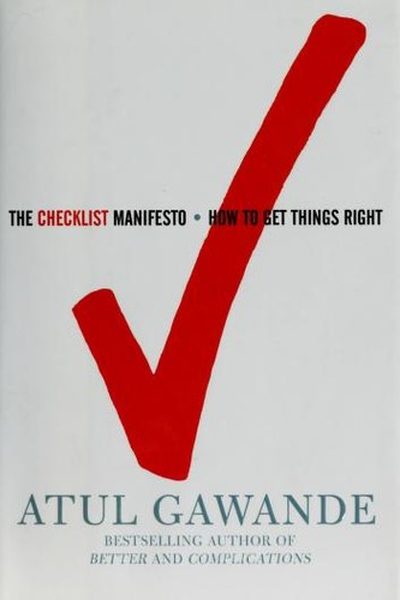
How to get things right — the surgeon who proved that a simple list saves more lives than genius.
📖 OPEN THE FULL INTERACTIVE BREAKDOWN →🌐 Read it in Hindi, Hinglish, Gujarati, Tamil & 22 more languages — free, with audio.
💡 The Big Idea
Surgeon Atul Gawande asked a strange question: why do experts still fail at complex tasks, from surgery to skyscrapers to airplane crashes? His answer: modern complexity exceeds any single human's memory — the failures aren't ignorance, they're the inevitable slips of brilliant people. The humble checklist — used by pilots for decades — catches those slips. His team tested a surgical checklist in 8 hospitals worldwide: major complications dropped 36%, deaths dropped 47%. A piece of paper beat genius.
🧠 The 6 Key Lessons
Lesson 1: The Problem of Extreme Complexity
The Problem
Gawande's diagnosis: modern work — medicine, aviation, construction, finance — has become too complex for any single expert to hold in their head. Failures in these fields are rarely ignorance; they're the predictable slips of capable people under complexity. The answer isn't more training; it's a different technology: the checklist.
📖 Example: An ICU patient gets 178 individual actions per day from the staff; a skyscraper involves thousands of subcontractors; a Boeing 777 has 3 million parts. In every one of these, the expert brain alone is not enough — which is why aviation made checklists… Read the full example →
⚡ Do this: Pick one complex recurring task in your work. Write down the steps you sometimes skip under pressure — that's your checklist's first draft.
Lesson 2: The Checklist Works: 36% Fewer Complications
The Checklist
Gawande's team created a 19-item surgical checklist — including 'confirm the patient's identity,' 'confirm everyone in the room knows each other's names.' It felt embarrassingly simple, even insulting to experts. Yet across 8 hospitals on 5 continents, complications dropped 36% and deaths 47% — the equivalent of a miracle drug, achieved by a piece of paper.
📖 Example: The checklist worked not because surgeons didn't know the steps, but because it forced the team to pause, communicate and catch slips — like the moment a nurse caught that the antibiotic had been forgotten, or an anesthesiologist noticed a critical allergy… Read the full example →
⚡ Do this: Test your checklist on your next complex task — even if you 'know it all.' Track what it catches in a week.
Lesson 3: Good Checklists Are Short and Precise
The Checklist
A good checklist is not a manual: it's a brief list of the critical steps — the 'killer items' that are most often skipped or most dangerous when missed. It should fit on one page, use simple language, and sit at the 'pause point' where it's actually used, not in a drawer. The art is in what you LEAVE OUT.
📖 Example: The pilot checklist is one card, not a book; the surgical checklist is 19 items, not the hospital's 200-page protocols. Gawande's team cut and refined until each item earned its place — every extra item dilutes the power. Read the full example →
⚡ Do this: Cut your checklist to 5–10 items — the ones whose absence would hurt most. Post it at the point of use, not in a file.
Lesson 4: Checklists Build Teams, Not Just Accuracy
The First Try
Gawande discovered the checklist's secret second power: it forces communication. The team briefing — everyone says their name, the surgeon says what might go wrong, the nurse flags concerns — flattens hierarchies and catches problems that silence hides. In the hospitals, the checklist's biggest wins came from this 'activation' effect: people spoke up.
📖 Example: In one hospital, a young nurse used the checklist moment to warn the famous surgeon about a patient's critical condition — something she'd never have dared say otherwise. The surgeon later said it saved the patient's life. Read the full example →
⚡ Do this: Add one 'communication item' to your next project kickoff: everyone states their name, their role, and the one thing they're worried about. Make it routine.
Lesson 5: Discipline Beats Heroics
The End of the Master Builder
Gawande's closing argument: we romanticize the lone genius and the heroic improviser, but the evidence says reliability comes from humble discipline. The checklist is the ultimate anti-hero tool: it makes excellence routine and repeatable for ordinary people. The master builder is dead; the disciplined team is the future.
📖 Example: The most reliable industries — aviation — are the most checklist-obsessed; the most heroic-romantic — medicine, finance, construction — were the ones with the most preventable disasters. The pattern is not a coincidence. Read the full example →
⚡ Do this: Where in your life are you 'being heroic' instead of disciplined? Pick one process and standardize it with a checklist this month.
Lesson 6: Checklists Catch the Failures of Memory and Attention
The Checklist
Gawande's finding from surgery and aviation: the most complex procedures fail not from ignorance but from the unavoidable fallibility of memory and attention under pressure. Simple checklists — short, focused, tested — catch the small steps that everyone 'knows' and no one reliably remembers. The humble checklist outperforms genius.
📖 Example: A five-step surgical checklist introduced across eight hospitals cut major complications by more than a third, in some sites by nearly half — despite every surgeon knowing the steps. The checklist didn't teach anything new; it made the known steps reliably… Read the full example →
⚡ Do this: Write a checklist for your most critical recurring process — the steps that are 'obvious' but occasionally missed — and use it for a month.
✅ 5-Step Action Plan
- Draft a checklist for your most complex recurring task.
- Test it for a week; log every slip it catches.
- Cut it to the 5–10 killer items; post it at the point of use.
- Add a team-briefing moment to your next project kickoff.
- Standardize one 'heroic' process into a disciplined routine.
⚠️ When This Doesn't Work
Gawande's 'checklists save lives' is the most important medical-adjacent book ever — and Rana Plaza is the proof that a checklist only works if someone is accountable to it: the building had inspections, permits and documented checks — every box ticked, every signature collected — and 1,134 people died when the certified-safe building collapsed, because the checklist had become a ritual of paperwork, not a ritual of truth. Gawande's method is powerful; its failure mode is the checklist as theatre. The checklist must end with a named person who goes to jail if it's faked.
💀 The Graveyard Proves It
🏚️ Rana Plaza — They Saw the Cracks on Tuesday. They Ordered Everyone In on Wednesday.. Burn: 1,134 lives; fashion's conscience. Read the full case study →
💬 Best Quotes from The Checklist Manifesto
- “The volume and complexity of what we know has exceeded our individual ability to deliver its benefits correctly, safely, or reliably.”
- “Checklists seem able to defend everyone, even the experienced, against failure.”
- “We need a different strategy for overcoming failure — one that builds on experience and takes advantage of the knowledge people have but somehow fail to use.”
Interactive version: mark lessons as read, listen in your language, share quote cards.