Library › Business & Startups
The Dip — Summary & Key Lessons
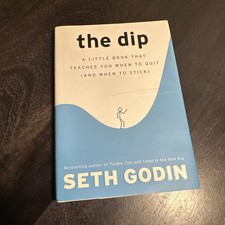
A little book that teaches you when to quit (and when to stick) — winners quit all the time; they just quit the right things.
📖 OPEN THE FULL INTERACTIVE BREAKDOWN →🌐 Read it in Hindi, Hinglish, Gujarati, Tamil & 22 more languages — free, with audio.
💡 The Big Idea
'Never quit' is terrible advice. Godin's model: every pursuit follows one of three curves — the DIP (starts fun, gets brutally hard, then pays off enormously for those who push through: the artificial barrier that creates scarcity and therefore value), the CUL-DE-SAC (dead end: more effort, same results, forever), and the CLIFF (feels fine until it collapses). Strategic quitting is the skill: quit cul-de-sacs and cliffs IMMEDIATELY and redeploy the resources into Dips worth crossing — because being the BEST in the world (as your customers define 'world') captures wildly disproportionate rewards (Zipf's law: #1 gets 10x #10's rewards), and the Dip is exactly what keeps the market uncrowded. The only unforgivable move: staying somewhere mediocre — surviving without committing to get through.
🧠 The 6 Key Lessons
Lesson 1: Best in the World Is Underrated (and 'World' Is Smaller Than You Think)
Part 1: The Best in the World
Rewards in most markets follow Zipf's law: #1 captures a multiple of #2, and #10 gets scraps — because customers with infinite choice and limited time don't want A good option; they want THE best one (the best doctor for THIS condition, the best pizza in THIS neighborhood, the best freelancer for THIS niche). The liberating fine print: 'world' means YOUR market's world — best in the world is best available and convenient for the customer doing the choosing, so the game is won as much by narrowing the definition of world as by improving. The strategic corollary: with scale economics rewarding #1 so heavily, being a wonderful #7 in a big market loses to being #1 in a focused one. Pick a world you can win; then the Dip becomes worth crossing, because the far side pays like a monopoly.
📖 Example: Godin's grocery shelf: nobody buys the third-best olive oil deliberately — they buy the best (per their taste, price, story), and shelf position compounds the winner's advantage. His vanilla example scales it: the best vanilla ice cream sells multiples of… Read the full example →
⚡ Do this: Define a 'world' you could plausibly be #1 in within 18 months — narrow by audience, geography, problem, or style until #1 is realistic. Write it as a sentence: 'The best ___ for ___.' If you can't, your current game may be a cul-de-sac wearing a Dip costume.
Lesson 2: The Three Curves: Dip, Cul-de-Sac, Cliff
Part 1: The Dip / The Cul-de-Sac / The Cliff
Every pursuit follows one of three shapes. THE DIP: the long stretch between beginner's fun and mastery's payoff — organic chemistry between wanting to be a doctor and being one, the years between starting a business and it working. Crucially, the Dip is a FEATURE: it's the barrier that keeps the market scarce (if it were easy, everyone would do it, and being through it would be worthless) — so the Dip is your friend IF the far side is real. THE CUL-DE-SAC: the dead-end job or strategy where effort in and results out have permanently flatlined — no amount of pushing changes the curve; every day spent there is theft from a winnable Dip. THE CLIFF (rarer): rides that feel fine until catastrophic collapse (Godin's example: smoking). The entire skill of strategic quitting is DIAGNOSIS: before and during any pursuit, name the curve — because sticking is only a virtue on curve one.
📖 Example: Godin's diagnostic gallery: medical school's brutal weed-out years (classic Dip — designed scarcity, enormous payoff), versus the job with the title that never changes and the raise that never comes (cul-de-sac — the treadmill that impersonates a career),… Read the full example →
⚡ Do this: Inventory your current major pursuits (job, side project, skill, key relationship investments) and label each: Dip, cul-de-sac, or cliff — using the test 'if I dramatically increase effort, does the payoff curve change?' Be brutal: mislabeled cul-de-sacs consume years.
Lesson 3: Quit Fast or Commit Hard — Never Coast
Part 2: If It's Worth Doing / Seven Reasons You Might Fail
The Dip's brutal corollary: if you're not prepared to get through it, quit NOW — because the worst position in any market is the mediocre middle: enough investment to cost you, not enough to pay you. 'Never start something you won't commit to finishing through the Dip' converts into a pre-start discipline: before entering, ask whether you have the resources (time, money, energy) for the whole crossing, whether the far side is worth it, and whether you're prepared to be measurably the best in your defined world. Godin's failure taxonomy explains most abandonments: running out of time/money (foreseeable — plan the crossing), settling for average (coasting — the silent killer), lack of focus (five Dips at once means zero crossings — serial mastery beats parallel dabbling), and quitting from momentary panic instead of strategy. The rule: never quit IN the moment — decide your quitting criteria BEFORE the pain, in writing, when you're calm.
📖 Example: Godin's marathon rule: you don't decide whether to finish during mile 22's agony — you decide before the race what would justify stopping (injury yes, discomfort no), and then the mile-22 voice gets no vote. The business mirror: the startup that budgets 18… Read the full example →
⚡ Do this: For your #1 Dip: write the crossing plan (what resources the whole Dip needs — honestly) and the quit criteria (the specific conditions under which quitting is right), both BEFORE the next hard moment. For everything you labeled cul-de-sac: pick one and quit it this month — fully — and redeploy its hours into the Dip.
Lesson 4: The Quitting Questions: Pride, Panic, and Who You're Really Quitting To
Part 3: Quitting
Godin closes with three questions for any quit decision. (1) AM I PANICKING? Never quit in the moment of maximum pain — panic quits abandon Dips at their steepest, exactly where the crowd thins and the value concentrates; schedule the decision for a calm day. (2) WHO AM I TRYING TO INFLUENCE? If it's one stubborn boss/client/market — one person can resist forever, and the cul-de-sac diagnosis may be right; but if it's a MARKET, persistent presence compounds: markets have many deciders, and reputation accretes even while individual doors stay closed. (3) WHAT MEASURABLE PROGRESS AM I MAKING? Not 'am I succeeding yet' but 'is the needle moving' — forward motion through a Dip looks like small gains in skill, audience, or access; zero measurable movement over honest intervals is the cul-de-sac's signature. The synthesis: quitting is a strategic tool, pride is not a reason to stay, sunk costs are not investments, and the sentence 'quit the wrong stuff, stick with the right stuff, have the guts to do one or the other' is the whole book.
📖 Example: The salesperson case runs all three questions: rejected by a prospect eight times (one person — maybe immovable), versus building presence in a TERRITORY where every call raises name recognition even without sales (market — compounding); same activity,… Read the full example →
⚡ Do this: Before your next quit-or-stick decision, answer the three in writing: panicking? (if maybe — decide in 72 hours, not now); influencing one person or a market? (one person = consider quitting; market = measure the compounding); what moved in the last 90 days? (something = Dip; nothing = cul-de-sac). Then have the guts to do one or the other — fully.
Lesson 5: The Dip Is the Barrier That Keeps Others Out
Part 2: The Dip
Godin's central insight: the Dip — the long, difficult slog between starting and mastery — is not a bug; it is the feature. The Dip exists precisely because most people quit there, which is what makes the reward at the end scarce and valuable. If the journey were easy, everyone would finish and the prize would be worthless. So when you hit the slog, remind yourself: this difficulty is the moat. Your competitors are quitting right here, which is exactly why continuing matters. The Dip is not the obstacle to your goal — it IS your goal's protective barrier.
📖 Example: Godin uses the example of every 'overnight success' — the actor, the company, the athlete — whose overnight win came after years in the Dip that everyone else had already abandoned. The audience sees the triumph; the Dip is what made it worth having. Read the full example →
⚡ Do this: Write down what's at the end of your current Dip — specifically, the scarcity it protects. Post it where you'll see it on the hard days.
Lesson 6: The One-Way Door: Choosing Which Quits Are Strategic
Part 3: Quitting and the System
Godin distinguishes the smart quit from the dumb one: quit when you're on a cul-de-sac (a dead end that will never reward you, no matter how long you stay), and persist when you're in a Dip (a hard stretch that leads somewhere). The trap is 'the system' — the quitting habit that makes quitting easy, the comfort zone that makes staying safe. Before every quit, ask: is this a door that opens the moment I walk through it (strategic), or a door that closes forever (wasteful)? The best quitters quit the wrong things fast and the right things never.
📖 Example: Godin explains why quitting a dead-end job to build a business is smart, while quitting the business six months in because it's hard is usually the same old habit of quitting — the difference is whether you're leaving a cul-de-sac or abandoning a Dip. Read the full example →
⚡ Do this: Map your current projects into three columns: Dip (keep going), Cul-de-sac (quit this week), Cliff (danger — rethink now). Act on column two immediately.
✅ 5-Step Action Plan
- Define the narrow 'world' where #1 is achievable in 18 months.
- Label every major pursuit: Dip, cul-de-sac, or cliff.
- Write crossing plans and quit criteria BEFORE the pain.
- Quit one cul-de-sac completely this month; redeploy the hours.
- Run the three questions on every quit decision — never decide mid-panic.
⚠️ When This Doesn't Work
Godin's 'quit the dip, not the cliff' is the sharpest career tool ever written — and it's used wrong by almost everyone who reads it. Pets.com had every sign of a temporary dip: famous brand, booming market, endless funding — and the dip was actually a cliff, because the unit economics were structurally impossible. Quitting correctly requires knowing which troughs are temporary, and that knowledge is the hardest judgment in business; the book makes it sound diagnosable from a flowchart. Most people use The Dip to justify quitting the hard work — the exact opposite of what Godin means.
💀 The Graveyard Proves It
🧦 Pets.com — The Sock Puppet That Ate $300 Million. Burn: $300M in 268 days post-IPO. Read the full case study →
💬 Best Quotes from The Dip
- “Winners quit all the time. They just quit the right stuff at the right time.”
- “Being the best in the world is seriously underrated.”
- “Never quit something with great long-term potential just because you can't deal with the stress of the moment.”
Interactive version: mark lessons as read, listen in your language, share quote cards.