Library › Business & Startups
Steve Jobs — Summary & Key Lessons
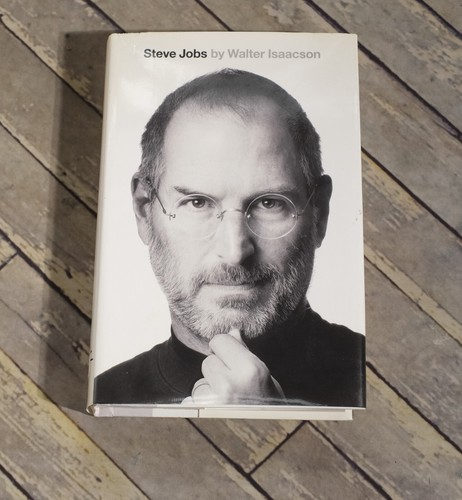
The authorized biography — 40+ interviews with Jobs himself: genius, cruelty, reality distortion, and the greatest second act in business history.
📖 OPEN THE FULL INTERACTIVE BREAKDOWN →🌐 Read it in Hindi, Hinglish, Gujarati, Tamil & 22 more languages — free, with audio.
💡 The Big Idea
Isaacson interviewed Jobs over forty times — plus a hundred friends, enemies, and colleagues — with no topic off limits and no approval rights. The result is the definitive portrait of tech's most consequential founder: adopted kid and counterculture seeker; co-creator of the personal computer; exiled from his own company at 30; builder of Pixar and NeXT in the wilderness; and author of the greatest comeback in corporate history — iMac, iPod, iPhone, iPad — before dying at 56. The threads that matter for builders: end-to-end control in service of user experience, focus as the art of saying no, the 'reality distortion field' that pushed people past their known limits, taste as strategy ('we make the buttons look so good you'll want to lick them'), and the price — human and personal — that his methods exacted.
🧠 The 6 Key Lessons
Lesson 1: The Intersection: Technology Alone Is Not Enough
Childhood / Reed College / Atari
Jobs's singular edge was positional: he stood where the humanities meet engineering — deep enough in technology to push it, steeped enough in design, calligraphy, Zen, and music to know what it should FEEL like. The famous causal chain: dropping out of Reed freed him to drop IN on a calligraphy course (serif fonts, letter spacing, 'beautiful in a way science can't capture'), useless for a decade — until the Mac became the first computer with beautiful typography. His father's craftsman lesson ran deeper: Paul Jobs made the BACKS of cabinets beautiful though no one would see them — and Steve applied it to circuit boards users would never open. The lesson isn't 'study calligraphy'; it's that your weird, unmonetizable interests are unassembled competitive advantages — 'you can't connect the dots looking forward; you can only connect them looking backwards.'
📖 Example: The Stanford commencement speech (which Isaacson unpacks with the life behind it) makes the case with three dots: calligraphy → Mac typography; getting fired → Pixar and renewal; death sentence → clarity. But the biography adds the texture: Jobs auditing… Read the full example →
⚡ Do this: List your three 'useless' passions. Then force one collision this quarter: apply an aesthetic, principle, or method from that passion to your day job. The intersection is where your unfair advantage lives.
Lesson 2: The Reality Distortion Field
The Mac Years
Coined by engineer Bud Tribble (borrowing Star Trek), the Reality Distortion Field was Jobs's signature weapon: a blend of charisma, certainty, and willful disregard for facts that convinced people impossible things were possible — and, unnervingly often, made them so. The mechanics Isaacson documents: Jobs didn't ask if a deadline was possible; he asserted a new reality ('you can do it') with such conviction that engineers exceeded their own known limits. The costs were equally real: binary judgments (everything was 'the best thing ever' or 'total shit,' sometimes the same idea on consecutive days), claimed credit for others' ideas he'd initially trashed, and burned-out casualties. The nuance for practitioners: the RDF worked because it was attached to a mission people believed in ('make a dent in the universe') and standards that were genuinely about the product — distortion in service of excellence reads as leadership; in service of ego, as abuse.
📖 Example: The canonical case: Jobs demanded the Mac's boot time be cut. Engineer Larry Kenyon explained why it was impossible; Jobs asked, 'If it would save a person's life, could you find a way?' Then he did the math on the whiteboard: 5 million users × 10 seconds a… Read the full example →
⚡ Do this: Steal the ethical core: next time your team says 'impossible,' reframe the stakes in human terms (time saved × users, pain removed × customers) and ask for the version that would exist if it mattered enough. Set the bar unreasonably; provide the mission that makes unreasonable feel meaningful.
Lesson 3: Focus Means Saying No
The Return / iCEO
Apple in 1997 was dying — 90 days from bankruptcy, drowning in a product line so bloated (dozens of Macintosh versions with meaningless numbers, printers, PDAs) that even insiders couldn't recommend a model. Jobs's rescue began with subtraction: he drew a 2x2 grid — Consumer/Pro, Desktop/Portable — and killed everything that didn't fit: 70% of products, gone in one meeting. 'Deciding what not to do is as important as deciding what to do.' The philosophy scaled: annual 'Top 100' retreats ended with ten priorities on a whiteboard, and Jobs would slash the bottom seven — 'we can only do three.' He measured focus by refusals: turning down 'a thousand things' to protect the few that mattered. The same blade shaped products: no keyboard on the iPhone, no Flash, one button — saying no ON BEHALF of users who were never asked to configure what they shouldn't have to think about.
📖 Example: The grid meeting is the stuff of legend: executives defending pet projects watched Jobs erase them from the whiteboard; engineers wept for cancelled products (including the Newton). Within a year, the four-quadrant lineup produced the iMac — and Apple's… Read the full example →
⚡ Do this: Draw your own 2x2 this week — for your product line, your projects, or your commitments. Everything outside the four boxes gets killed or scheduled for killing. Then adopt the retreat ritual: list your top 10 priorities, and formally cross out the bottom 7.
Lesson 4: End-to-End: Own the Whole Experience
iPod / iTunes / iPhone
Jobs's deepest strategic conviction — the one that lost the PC wars to Microsoft's licensing model and then won everything after — was end-to-end control: hardware, software, and services designed as one thing, because 'people are busy; they have better things to do than think about how to integrate their computers and devices.' The iPod proved it (device + iTunes software + iTunes Store + label deals = an experience no component-maker could match); the iPhone perfected it. Corollaries: the whole widget means responsibility for the whole experience, including the unboxing (Apple patented packaging; opening the box was designed as theater), the store (Apple Stores put the experience under Apple's roof when retailers shelved Macs like commodities), and the parts nobody sees — rejecting internal circuit layouts that offended him, per his father's cabinet-back principle. The trade-off is real (closed vs. open remains tech's great debate) — but Jobs's bet was that integration serves users and fragmentation serves engineers, and users outnumber engineers.
📖 Example: The music industry case study: while Sony — which owned BOTH a music label and the Walkman legacy — fumbled with fragmented divisions protecting their own P&Ls, Jobs assembled the impossible: every major label agreeing to sell songs for 99 cents through one… Read the full example →
⚡ Do this: Map your customer's END-TO-END experience — from first hearing of you to daily use to support call. Find the two ugliest seams where responsibilities are handed off (and dropped). Own one of those seams completely this quarter, even if 'it's not your department.'
Lesson 5: The Price of the Dent: Genius, Cruelty & the Ledger
Family / Illness / Legacy
Isaacson refuses the hagiography: the same man who demanded beauty abandoned his first daughter Lisa for years (while naming a computer after her), parked in handicapped spots, denied Apple's earliest employees equity, cried in meetings, and delayed his cancer surgery for nine months to try diets and spiritualists — a decision that likely cost him his life. The biography's honest accounting matters because it dismantles the copy-the-monster fallacy: thousands of managers imitated the yelling and skipped the taste; the yelling was the bug, not the feature. What actually built Apple: the standards, the focus, the intersection, the mission-worthiness that made A-players tolerate the storms ('A players like to work with A players'). Jobs's own final synthesis, dictated for the book's last chapter: the products mattered because 'making an enduring company... is both far harder and more important than making a great product' — and the company was his real product. His regret ledger, spoken plainly to Isaacson: he wanted his kids to know him, and the book was partly for them — 'I wasn't always there for them, and I wanted them to know why.'
📖 Example: Two scenes hold the whole ledger: Jobs, dying, spending his limited energy designing the yacht he'd never sail and reviewing plans for Apple's new campus — unable to stop making things; and the garden conversation where Isaacson asked about God, and Jobs —… Read the full example →
⚡ Do this: Separate the transferable from the toxic in every hero you study — write two columns for Jobs (or your own idol): 'practices that built the work' vs. 'behaviors the work survived.' Adopt from column one only. And do the kids-ledger honestly, while the clicking is still years away.
Lesson 6: The Bicycle for the Mind: Leverage Multiplies Talent
The Macintosh Launch
Isaacson documents Jobs's belief that computers were 'bicycles for the mind' — tools that amplify human capability the way a bicycle amplifies speed. His obsession was building tools that multiply creativity, and his teams attracted talent precisely because they worked on leverage, not incrementalism. Choose the platform and the problem where your effort compounds.
📖 Example: The Macintosh team worked obsessively because they believed they were building a tool that would amplify millions of minds, not just another machine. That conviction — that leverage, not hours, is the real product — is why the team endured impossible… Read the full example →
⚡ Do this: Ask of your current project: does this multiply human capability? If not, find the version that does.
✅ 5-Step Action Plan
- Collide one 'useless' passion with your work this quarter.
- Reframe one 'impossible' in human stakes; raise the bar with the mission attached.
- Draw the 2x2; kill everything outside it. Cross out priorities 4–10.
- Own one broken seam in your end-to-end customer experience.
- Two-column your heroes: copy the standards, discard the cruelty.
⚠️ When This Doesn't Work
Isaacson's biography makes the brilliant-jerk founder look like a formula: be ruthless, humiliate people, get magic. The formula is survivorship bias at its most seductive — for every Jobs, a thousand abrasive founders produce nothing but enemies. Musk followed the Jobs playbook into Twitter and turned a $44 billion asset into a lesson in what the magic actually costs. Copy the product obsession and the taste; skip the cruelty. It was never the cause of the genius.
💀 The Graveyard Proves It
🐦 Twitter's $44B Haircut — Bought for $44B, Marked Down 70% in a Year. Burn: ~$30B of value marked away. Read the full case study →
💬 Best Quotes from Steve Jobs
- “The people who are crazy enough to think they can change the world are the ones who do.”
- “Deciding what not to do is as important as deciding what to do.”
- “Stay hungry. Stay foolish.”
Interactive version: mark lessons as read, listen in your language, share quote cards.