Library › Money & Finance
Same as Ever — Summary & Key Lessons
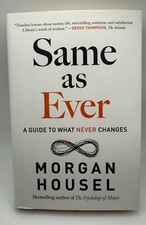
A guide to what never changes — stop forecasting the future and start banking on permanent human behavior.
📖 OPEN THE FULL INTERACTIVE BREAKDOWN →🌐 Read it in Hindi, Hinglish, Gujarati, Tamil & 22 more languages — free, with audio.
💡 The Big Idea
Everyone obsesses over predicting change — markets, elections, technology — and the track record is a graveyard. Housel inverts the telescope: the highest-return knowledge is what STAYS THE SAME. People will always overreact to risk (and underprepare for the unimaginable), best story wins (not best answer), envy will always scale faster than wealth, calm plants the seeds of crazy (stability is destabilizing), and compounding's magic will always be underestimated because 'a lot of little things' never feels like an answer. Twenty-three timeless chapters, each a permanent pattern — because as Bezos framed it, 'what's NOT going to change in the next ten years' is the only question you can build on. The future is unknowable; people, blessedly, are not.
🧠 The 6 Key Lessons
Lesson 1: Risk Is What You Don't See
Chapters: Hanging by a Thread / Risk Is What You Don't See
The biggest events in history — depressions, pandemics, wars, 9/11 — shared one trait: virtually nobody saw them coming; the risk that wrecks you is by definition the one absent from the forecasts. Housel's corollaries: the news covers named risks (which markets have already priced) while the unnamed monsters gestate quietly; history hinges on absurdly small contingencies ('hanging by a thread' — a wrong turn delivers the assassination that delivers the century); and therefore preparation beats prediction: calibrate savings, buffers, and room for error not to your imagined risks but to the certainty that something unimagined is coming on schedule. The stance: expect surprise itself. 'Invest in preparedness, not in prediction' — the person with six months' cash never needs to know WHICH crisis it was for.
📖 Example: Housel's exhibit list: the Great Depression was predicted by essentially no mainstream economist in 1929 (days before the crash, Irving Fisher famously declared a 'permanently high plateau'); COVID appeared in zero of the annual 'biggest risks for 2020'… Read the full example →
⚡ Do this: Stop forecasting; start armoring: size your emergency buffer for the unnamed risk (if your plan only survives the risks you can list, it isn't a plan). Once a year, run the 'what would ruin me?' audit — then de-fragilize the top answer without needing to predict its trigger.
Lesson 2: Expectations: The First Rule of Happiness
Chapters: Expectations & Reality / Wild Minds
Happiness is the gap between results and expectations — and modernity relentlessly inflates the denominator: every rise in living standards is instantly absorbed into the baseline, while social media broadcasts everyone's highlight reel as the new normal. Housel's permanent pattern: today's average life outstrips a 1950s millionaire's on nearly every material axis — yet satisfaction hasn't budged, because expectations rose in lockstep; the gap, not the goods, is the experience. The management principle: you have more control over expectations than over outcomes, so the neglected lever is the powerful one — savor before adaptation erases, benchmark backwards (your past, not their present), and treat every 'need' acquired this decade with suspicion. Charlie Munger's line anchors the chapter: 'The world isn't driven by greed; it's driven by envy' — and envy is just expectations imported from someone else's life.
📖 Example: Housel's centerpiece comparison: the average American family today versus the Rockefellers of a century ago — antibiotics, air conditioning, Novocain, video calls, safe surgery, global food. By any objective inventory, the middle class out-consumes history's… Read the full example →
⚡ Do this: Manage the denominator deliberately: keep a 'past-self benchmark' — quarterly, list five things your 10-years-ago self would call luxury in your current life. And run one expectation fast: pick a domain (house, car, phone) and freeze the reference point for two years — enjoy the absurd surplus that appears.
Lesson 3: Best Story Wins
Chapter: Best Story Wins
The best idea doesn't win; the best STORY does — always has, always will. Housel's permanent law: humans are narrative machines — data persuades the already-convinced, but stories move money, votes, and history, because a story compresses complexity into feeling and feeling into action. Implications: in any field, the person who can articulate wins resources over the person who is merely right (the visionary with a story out-raises the engineer with a spreadsheet); complex truths lose to simple falsehoods unless the truth finds a storyteller; and your own decisions are story-driven too — the market's price is the aggregate story, and bubbles are just great stories with compounding audiences. The career takeaway is uncomfortable and liberating: presentation is not decoration on the work; it is half the work. If you have the right answer AND the best story, you're unstoppable; with only the answer, you're a footnote to whoever tells it better.
📖 Example: Housel's showcase: Ken Burns making hours of Civil War documentary — the underlying facts available free in any library for a century — into a national phenomenon, purely through storytelling craft ('the good stories always beat the best data'). The… Read the full example →
⚡ Do this: Audit your best work: does it have a story or just evidence? Rewrite your current most important pitch/report as a narrative (character, tension, resolution) and A/B it against the data version. And when consuming: flag every compelling story for the question its beauty is hiding — 'what would I think of this claim if it were told badly?'
Lesson 4: Calm Plants Crazy: Stability Is Destabilizing
Chapters: Crazy Is Normal / Calm Plants the Seeds of Crazy
Minsky's insight, Housel-ified into permanence: stability itself breeds instability — long calm convinces people risk is gone, which licenses the leverage, valuations, and complacency that manufacture the next crisis; the absence of recessions CAUSES recessions. The pattern is fractal and eternal: markets (bull years fund the excesses the bear years punish), careers (comfortable stretches erode the vigilance that created them), nations (long peace breeds the confidence that walks into wars). Twin chapter 'Crazy Is Normal' completes it: the appropriate baseline expectation for markets, politics, and people is periodic madness — crazy isn't the system breaking; it IS the system, and anyone shocked by recurring manias and panics hasn't read enough history. The stance: never extrapolate calm, keep the armor on during peace (that's precisely when it's cheap), and treat 'this time is different' as the most expensive sentence in every language.
📖 Example: The Minsky arc, run repeatedly: the Great Moderation's decades of smooth growth convinced a generation that central banks had solved volatility — funding the leverage that produced 2008; the 'death of equities' pessimism of 1979 preceded history's greatest… Read the full example →
⚡ Do this: Invert your comfort response: when things have been good for a long stretch (portfolio, career, business), that's your trigger to CHECK the armor — leverage, dependencies, skills, buffers — not to relax it. Write the rule where future-you will see it: 'The longer the calm, the closer the crazy — audit now.'
Lesson 5: Compounding's Quiet Miracles — and the Price of Everything
Chapters: Overnight Tragedies / Tiny and Magnificent / Wild Numbers
Two asymmetries run the world forever. First: TRAGEDY IS FAST, PROGRESS IS SLOW — catastrophes arrive overnight (crashes, collapses, scandals) while miracles compound invisibly (medical progress, wealth, skills), which is why pessimism always sounds smarter and optimism always pays better; growth is 'tiny gains never worth noticing' until decades stack them into transformation. Second: EVERYTHING WORTH HAVING HAS A PRICE, AND THE PRICE IS USUALLY HIDDEN — market returns charge volatility and fear; career success charges hours and uncertainty; the mistake is treating the price as a fine to dodge rather than a fee to pay. Housel's closing permanences: the man who does 'the little things right' compounds past the genius chasing big wins; unsustainable things stop (however long they run); and the best financial plan is the one that lets you sleep — because 'enough' was always the actual finish line, same as ever.
📖 Example: The asymmetry in numbers: heart-disease death rates fell so gradually (~1.5% a year) that no newspaper ever headlined it — yet the compound result saved tens of millions of lives, invisible precisely because it was slow; meanwhile a single plane crash owns a… Read the full example →
⚡ Do this: Recalibrate your feeds: for every fast tragedy consumed, deliberately look up one slow miracle's data (disease, poverty, safety trends). And reprice your goals honestly: write the hidden fee of each big ambition (volatility, hours, rejection) — then decide, once, that the fee is worth it, so daily payment stops feeling like theft.
Lesson 6: The Best Way to Predict the Future Is to Study the Past
The Tyranny of the Present
Housel argues that while specific events surprise us, human behavior repeats: greed, fear, envy, optimism and panic have driven markets and empires for centuries. Instead of forecasting the next crisis, study how people behave in crises and you'll recognize the pattern when it arrives. The details change; the psychology doesn't.
📖 Example: Every bubble in history — tulips, railways, dot-coms, crypto — followed the same arc of euphoria, denial and panic, yet each generation believes 'this time is different'. Housel's point: the story changes, the music stays the same, and the person who… Read the full example →
⚡ Do this: Read about one historical crisis (e.g., the 1929 or 2008 crash) and list three behaviors from then that you see around you today.
✅ 5-Step Action Plan
- Armor for unnamed risks; run the annual 'what would ruin me?' audit.
- Benchmark against your past self; freeze one reference point for two years.
- Give your best work a story; interrogate beautiful stories for hidden claims.
- Treat long calm as the audit trigger, never the relaxation signal.
- Track one slow miracle; pre-pay the hidden fee on your biggest goal.
⚠️ When This Doesn't Work
'Things don't change' is comforting and, used as a doctrine, blinding. Housel's point is that behaviour repeats — greed, fear, overconfidence — but the VEHICLES change, and people who insist 'it's all the same as ever' end up Wirecard's auditors, missing a €1.9 billion hole because they were sure fraud was a 2001 problem. The eternal patterns are real; the lesson is not to relax but to check harder, because the pattern will return in a costume you haven't seen.
💀 The Graveyard Proves It
💳 Wirecard — €1.9 Billion That Never Existed. Burn: €24B market cap → insolvency. Read the full case study →
💬 Best Quotes from Same as Ever
- “The first rule of happiness is low expectations.”
- “Best story wins — not the best idea, not the right answer.”
- “Every current event — big or small — has parents, grandparents, siblings, and cousins.”
Interactive version: mark lessons as read, listen in your language, share quote cards.