Library › Money & Finance
A Random Walk Down Wall Street — Summary & Key Lessons
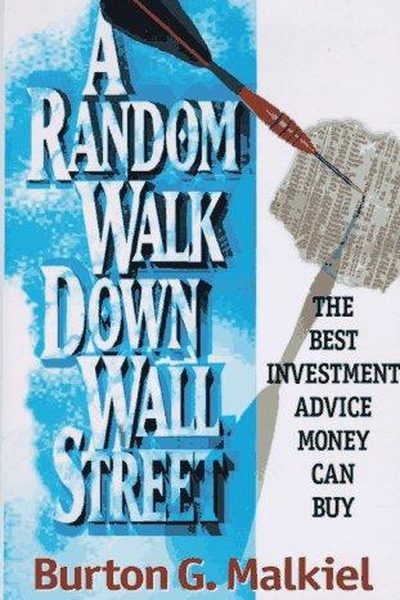
The time-tested strategy for successful investing — the classic that proved you can't beat the market, so join it.
📖 OPEN THE FULL INTERACTIVE BREAKDOWN →🌐 Read it in Hindi, Hinglish, Gujarati, Tamil & 22 more languages — free, with audio.
💡 The Big Idea
Princeton economist Burton Malkiel wrote the most enduring investing book ever published, arguing with 50 years of data that stock prices are essentially unpredictable — a 'random walk' — because all known information is already priced in. The implications are liberating: no analyst, fund manager or hot tip can reliably beat the market. The winning strategy is embarrassingly simple: buy broad index funds, hold them for decades, rebalance, and ignore the noise. Time in the market beats timing the market.
🧠 The 6 Key Lessons
Lesson 1: The Random Walk: Prices Can't Be Predicted
The Random Walk
Malkiel's central claim: stock prices already reflect everything knowable, so future movements are driven by new information — which is, by definition, unpredictable. Chart patterns, analyst forecasts and 'expert' calls are noise: studies consistently show professional stock pickers don't beat the market average, especially after fees.
📖 Example: The famous dartboard tests: Wall Street Journal experts picked stocks by dart throw — and the darts tied or beat the pros. Decades of data show 75–90% of active fund managers underperform their index over any 10-year stretch. Read the full example →
⚡ Do this: Before your next 'hot tip' or stock pick, ask: 'What do I know that the millions of professionals don't?' If nothing, you're gambling, not investing.
Lesson 2: The Efficient Market: It's Already Priced In
The Efficient Market
The theory behind the walk: markets are efficient — thousands of smart, well-funded professionals are competing to price every stock, so the price already reflects all known information. This doesn't mean prices are always 'right' (bubbles happen) — it means they're unpredictable, which is what matters for your strategy.
📖 Example: Malkiel walks through the dot-com bubble and the 2008 crash as proof that markets get irrational — but also as proof that nobody reliably predicted either. Even the professionals who 'called' 2008 missed the years before it and the recovery after. Read the full example →
⚡ Do this: When you feel sure about a stock's direction, write down your prediction with a date. Revisit it in 6 months. The log will teach you humility — and save you money.
Lesson 3: The Index Solution: Buy the Whole Haystack
The Index Solution
If you can't beat the market, join it: buy the entire market through low-cost index funds. Over any long period, the market's average return beats the majority of professionals — and index funds cost almost nothing, so more of the return stays yours. Malkiel's advice: index the broad market (like the S&P 500 or a global index) and hold.
📖 Example: The book's math: an investor who put money into the S&P 500 index in 1970 and never sold — through crashes, wars and recessions — multiplied it many times over, while the average active investor, jumping in and out, captured only a fraction of that return. Read the full example →
⚡ Do this: Check what your investments cost in fees. If any fund charges more than ~0.3%, compare it to a broad index fund's long-term record — and consider the switch.
Lesson 4: Asset Allocation: The 4 Rules of Life
The Life-Cycle Guide
Malkiel's practical rules: (1) save a fixed portion of income automatically — pay yourself first; (2) the split between stocks and bonds is YOUR most important decision (stocks for growth, bonds for stability, weighted by age and risk tolerance); (3) rebalance annually back to your target split — it forces you to sell high and buy low automatically; (4) diversify globally and across asset classes.
📖 Example: Malkiel's classic framework: a simple rule like 'stocks = 110 minus your age' gives a sensible allocation that only needs a yearly rebalance — and rebalancing alone has been shown to add meaningful return over a lifetime by disciplining the buy-low/sell-high… Read the full example →
⚡ Do this: Write your target split (e.g., 70% stocks / 30% bonds). Set a calendar reminder to rebalance to it every January.
Lesson 5: The Psychology of Money: Tame Your Impulses
Firm Beliefs
The market's worst enemy is you: investors systematically sell at bottoms, buy at tops, chase what's gone up and flee what's fallen. Malkiel's antidotes: dollar-cost averaging (invest a fixed amount monthly — you buy more when prices are low automatically), ignore the noise (news, tips, predictions), and remember the market's long history: it has always recovered, and time in the market is the only free lunch.
📖 Example: The data on investor behavior is brutal: the average investor's actual returns lag the market by several percentage points per year — purely because of bad timing decisions. The investor who set automatic monthly investing and never looked beat the worried… Read the full example →
⚡ Do this: Set up automatic monthly investing into your index fund — same day every month. Then schedule a 'check-in' no more than quarterly. Let the system ignore the noise.
Lesson 6: Buy-and-Hold Beats Market Timing — Almost Always
A Random Walk
Malkiel's evidence: professional stock pickers and market timers consistently fail to beat a simple buy-and-hold index strategy over long periods, because price movements are too unpredictable to forecast. The winning strategy for most people is boring: diversify broadly, hold for decades, and ignore the noise. Time in the market beats timing the market.
📖 Example: Studies comparing professional fund managers with index funds over decades show the majority of managers underperform the index — before fees. Meanwhile, investors who held diversified portfolios through crashes and booms accumulated more than those who… Read the full example →
⚡ Do this: If you invest, compare your holdings against a low-cost index over a year; consider whether active trading is earning its complexity.
✅ 5-Step Action Plan
- Test your 'sure thing' predictions in writing — learn the humility.
- Check your fees; compare active funds to the index.
- Write your target stocks/bonds split and rebalance every January.
- Set up automatic monthly investing (dollar-cost averaging).
- Limit yourself to quarterly portfolio check-ins.
⚠️ When This Doesn't Work
Malkiel's 'markets are efficient, buy and hold' is the most evidence-backed finance book ever — and Terra/Luna is the modern reminder that efficiency has exceptions and they're always the same shape: an 'anchor' (the Luna/UST pair) that promised stability, adopted by millions who believed the market would always correct it — until the anchor wasn't an anchor and $40 billion evaporated in days. The random walk holds for the market as a whole; it fails spectacularly for instruments designed to look risk-free. Malkiel's advice — diversify, index, stay humble — is exactly the advice the Terra believers ignored.
💀 The Graveyard Proves It
🌕 Terra/Luna — The 'Stable'coin That Erased $60B in a Week. Burn: $60B in days. Read the full case study →
💬 Best Quotes from A Random Walk Down Wall Street
- “A blindfolded monkey throwing darts at a newspaper's financial pages could select a portfolio that would do just as well as one selected by the experts.”
- “The most important decision about your portfolio is how much you put in stocks and how much in bonds.”
- “Time is your friend; impulse is your enemy.”
Interactive version: mark lessons as read, listen in your language, share quote cards.