Library › Business & Startups
Radical Candor — Summary & Key Lessons
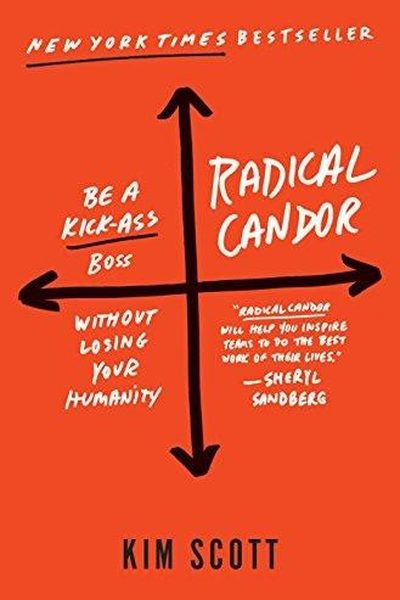
Be a kick-ass boss without losing your humanity — the feedback framework from a former Apple and Google exec.
📖 OPEN THE FULL INTERACTIVE BREAKDOWN →🌐 Read it in Hindi, Hinglish, Gujarati, Tamil & 22 more languages — free, with audio.
💡 The Big Idea
Kim Scott's framework is a 2×2: on one axis, care personally (genuinely know and like the humans you manage); on the other, challenge directly (say the hard thing clearly). Radical Candor = both high. The other three quadrants — Ruinous Empathy (care without challenge), Obnoxious Aggression (challenge without care), Manipulative Insincerity (neither) — quietly destroy teams. Her practices: praise in public, criticize in private, and make feedback a daily habit, not an annual event.
🧠 The 6 Key Lessons
Lesson 1: The 2×2: Four Ways to Be a Boss
The Framework
Plot your feedback style: Care personally (vertical) vs Challenge directly (horizontal). Radical Candor = high/high. Ruinous Empathy = high care, low challenge (you spare their feelings and let them fail). Obnoxious Aggression = low care, high challenge (you're right but brutal). Manipulative Insincerity = neither (politics, praise that means nothing).
📖 Example: Scott's story: her first boss praised her work for a year while quietly fixing her errors — until she asked and discovered her writing was being completely rewritten. That was Ruinous Empathy: kind in the moment, cruel in effect. Read the full example →
⚡ Do this: Identify your default quadrant with the people you manage. If you're in Ruinous Empathy (the most common), pick one person and say one hard truth kindly this week.
Lesson 2: Care Personally: Know the Human
Care Personally
You can't challenge someone effectively if you don't know them — their goals, their life, what drains them. 'Care personally' means being a whole person with your team: ask about their life, remember what matters to them, and treat them as people, not resources. It's not therapy; it's the foundation for feedback that lands.
📖 Example: Scott recommends 'getting to know each person's story' — where they're from, what they dream about. Her own team's '1:1s' covered career goals AND life context, which made every later challenge feel like it came from a friend. Read the full example →
⚡ Do this: In your next 1:1, spend the first 10 minutes on the person, not the project: their goals, their energy, their life. Just listen.
Lesson 3: Challenge Directly: Praise in Public, Criticize in Private
Challenge Directly
The mechanics: praise specifically and publicly ('this worked because...'), criticize privately and specifically ('when you did X, here's what happened; here's the fix'). Never let problems fester for the annual review — give feedback in the moment, in both directions, including to your own boss.
📖 Example: At Google and Apple, Scott's teams used 'it's kind of confusing when...' phrasing to give feedback upward without drama. The rule: the feedback should be helpful, not punitive — aimed at behavior, not identity. Read the full example →
⚡ Do this: Give one piece of specific public praise today, and one private, kind correction this week. Write both down before you say them.
Lesson 4: Get to Know What Motivates Each Person
Motivation
Three kinds of motivation: growth (getting better at the craft), impact (making a difference), and connection (working with people they love). Great bosses figure out which fuel drives each person and design work accordingly. Mismatch — putting an impact-driven person on maintenance — is a quiet talent killer.
📖 Example: Scott's example: a brilliant engineer who wanted impact was assigned bug fixes; he withered. Once given a customer-facing project, he flourished. One conversation about motivation fixed what no bonus could. Read the full example →
⚡ Do this: Ask each person you manage (or yourself): 'What makes you love a project — growth, impact, or people?' Match the next assignment to the answer.
Lesson 5: The Team Culture: Make Feedback a Habit
Culture
Radical candor only works as culture: everyone gives and receives feedback daily, mistakes are treated as learning, and 'the boss' also gets challenged. Scott's practice: end-of-meeting 'debrief' rounds where the team critiques the meeting itself. Feedback stops being scary when it's normal.
📖 Example: Scott's teams ran 'plus/delta' debriefs after every milestone — what went well, what to change — and the honesty spilled into everything else. Culture is just repeated behavior. Read the full example →
⚡ Do this: Start a 5-minute 'plus/delta' at the end of your next team meeting: what went well, what to change. Do it every time.
Lesson 6: Care Personally and Challenge Directly — Both, Not Either
The Framework
Scott's 2x2 of feedback: ruinous empathy (care without challenge), obnoxious aggression (challenge without care), manipulative insincerity (neither) — and radical candor (both). Most managers default to one failing quadrant. The skill is caring about the person as a human while telling them the hard truth directly. Both elements are required; either alone fails.
📖 Example: Scott's own story: a boss who praised her terrible presentation while quietly reassigning her work — ruinous empathy that damaged her career. The boss who would have said 'that was bad, here's how to fix it, I believe in you' practices radical candor. Read the full example →
⚡ Do this: Give one piece of honest, specific feedback this week — with genuine care stated explicitly — to someone who needs it.
✅ 5-Step Action Plan
- Map your default feedback quadrant; escape Ruinous Empathy.
- Spend 10 minutes of your next 1:1 on the person, not the project.
- Give specific public praise + private kind correction this week.
- Discover each teammate's motivation fuel and match work to it.
- Run a plus/delta debrief after every meeting.
⚠️ When This Doesn't Work
Scott's 'care personally, challenge directly' is the best feedback framework ever — and Ashneer Grover is its cautionary case: the BharatPe founder was radically candid to an extreme — brutally direct, publicly confrontational — and his 'candor' crossed into abuse, costing him the company and his reputation in a scandal that shredded the board's trust. The book's own definition saves it: radical candor is challenge WITH care. Challenge without care isn't candor — it's aggression wearing a productivity costume. Grover had the directness; the 'care personally' half was missing, and the missing half is the whole point.
💀 The Graveyard Proves It
🦈 BharatPe & Ashneer — The Shark Who Bit His Own Company. Burn: A $2.8B fintech's reputation + his own seat. Read the full case study →
💬 Best Quotes from Radical Candor
- “Radical Candor is humble, it's helpful, it's kind — and it's challenging.”
- “If you don't care personally, you can't challenge directly — you'll just sound like a jerk.”
- “The most important thing you can do is praise in public, criticize in private.”
Interactive version: mark lessons as read, listen in your language, share quote cards.