Library › Business & Startups
Only the Paranoid Survive — Summary & Key Lessons
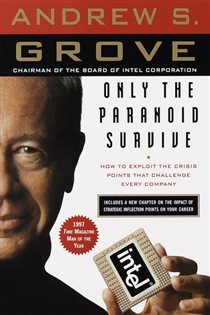
Intel's legendary CEO on strategic inflection points — the 10X forces that quietly kill giants, and how to cross them alive.
📖 OPEN THE FULL INTERACTIVE BREAKDOWN →🌐 Read it in Hindi, Hinglish, Gujarati, Tamil & 22 more languages — free, with audio.
💡 The Big Idea
Andy Grove ran Intel through the near-death experience that defines the book: Japanese manufacturers destroyed Intel's founding business — memory chips — and Grove had to abandon the company's identity to survive. His framework: businesses are governed by six competitive forces, and occasionally one shifts by an order of magnitude — a '10X force' — creating a STRATEGIC INFLECTION POINT (SIP): the moment the old strategy dissolves and the new rules haven't announced themselves. SIPs arrive disguised as noise; the data is always ambiguous while it matters and only obvious after it's too late. Survival tools: listen to the 'helpful Cassandras' (usually middle managers and salespeople who feel the wind change first), watch for when your 'silver bullet' question changes (who would you eliminate if you had one shot?), notice DISSONANCE between what the company says and what it does, and let 'strategic dissonance' resolve through experimentation at the edges before betting the center. Then — the hardest part — march decisively through the 'valley of death' with a clear picture of the other side.
🧠 The 6 Key Lessons
Lesson 1: Strategic Inflection Points: When the Rules Change 10X
Chapters 1-3: The 10X Force
A strategic inflection point is when the balance of forces shifts so fundamentally that the old strategy stops working — not a hard quarter or a tough competitor, but a change in the PHYSICS of the business: a 10X shift in competition, technology, customers, suppliers, regulation, or channels. The cruelty of SIPs: they're invisible on the way in. Revenue often keeps GROWING through the early inflection (the old business coasts on momentum) while the foundation is already gone; by the time the numbers confess, the cheap responses are all expired. Grove's telltale signs: key customers change behavior in ways that seem irrational; scrappy competitors you dismissed start winning deals that were 'yours'; the people closest to the field grow anxious while headquarters stays serene; and the answer to 'who's our biggest threat?' suddenly has no consensus. When trend and noise are indistinguishable, Grove's test: does this change alter the way the INDUSTRY works, or just the way we work? The first is an inflection; act structurally.
📖 Example: Intel's own near-death: memory chips WERE Intel — they invented the market, and 'memory' was the company's identity. Through the early 1980s Japanese competitors achieved 10X manufacturing quality and cost advantages; Intel's share collapsed while internal… Read the full example →
⚡ Do this: Run Grove's revolving-door test on your biggest commitment (business line, career path, key skill): if a brutally objective outsider replaced you today with no attachment to your history, what would they do in the first 90 days? Write it down — then ask what's really stopping you from doing it yourself.
Lesson 2: Helpful Cassandras: The Warning System You're Ignoring
Chapter 6: Signal or Noise?
In Greek myth, Cassandra saw the future truly and was cursed to be disbelieved. Every organization has them: usually middle managers, salespeople, and customer-facing staff who sense the 10X wind FIRST — because they live where the company meets reality, while executives live where the company meets its own reports. Grove's rule: when a Cassandra brings alarming news, the instinct to explain it away ('one lost deal,' 'a difficult customer,' 'they don't see the big picture') is precisely the reflex that kills companies — senior management is always the LAST to know, protected by layers of people softening the message on its way up. The practice: seek Cassandras out, thank them, and treat their anxiety as sensor data. Ask the frontline regularly: 'What are customers asking about that we don't sell? Who almost beat us last quarter and why?' The signal-to-noise problem never resolves cleanly — but the debate itself, engaged early and honestly with the people who FEEL the change, is what converts ambiguity into action while action is still affordable.
📖 Example: Grove's own learning: Intel's field sales force and factory planners knew memory was lost YEARS before the executive suite acted — orders shrinking, customers politely evasive, Japanese quality reports circulating. The information existed in the building; it… Read the full example →
⚡ Do this: This month, interview three frontline people (sales, support, ops) with one question: 'What's changing out there that leadership doesn't seem worried about?' Don't defend, don't explain — just write it down. If two answers rhyme, you've found your Cassandra signal.
Lesson 3: Strategic Dissonance: When Words and Actions Diverge
Chapter 7: Let Chaos Reign
Approaching an inflection point, a telltale gap opens between a company's STATEMENTS and its ACTIONS: the official strategy says one thing while resource allocation quietly says another — sales pushes what customers actually buy, planners route capacity to what actually earns, ambitious people drift toward projects with actual futures. Grove calls this strategic dissonance, and his counterintuitive advice is to USE it: don't suppress the chaos with premature clarity — let experimentation reign at the edges. Fund the deviant projects, tolerate the unofficial initiatives, watch where your best people and best margins WANT to go. The organization's aggregate behavior contains knowledge that no single executive possesses. Then, once the new direction earns its evidence, snap from 'let chaos reign' to 'rein in chaos': a clear, total, repeated declaration of the new strategy — because crossing the valley of death requires everyone marching, and a hedge at the top becomes paralysis at the bottom.
📖 Example: The dissonance at Intel was measurable in silicon: while executives spent years debating the sanctity of the memory business, production planners — following a neutral, margin-based allocation formula nobody had strategically blessed — had shifted the… Read the full example →
⚡ Do this: Audit your own dissonance: list what you SAY your top priority is, then pull the receipts — calendar hours, money spent, energy allocated over the last month. Where actions and words diverge, believe the actions — then either fix the allocation or officially change the priority.
Lesson 4: Crossing the Valley of Death
Chapters 8-9: Rein In Chaos
Once you commit to the far side of an inflection point, you enter what Grove calls the valley of death: the old business is being dismantled, the new one isn't yet paying, morale wobbles, critics (internal and external) have their best quarter ever, and the temptation to hedge — to keep a foot in the old world 'just in case' — becomes overwhelming. Grove's rules for the crossing: first, leadership must paint a vivid, simple picture of the other side ('what will this company BE?') and repeat it past the point of personal embarrassment — in the valley, people navigate by the leader's clarity, not the terrain's. Second, no hedging: resources split between old and new guarantee both starve; the hardest managerial act is starving what still generates cash to feed what doesn't yet. Third, the leader must visibly commit — Grove notes people watch the boss's FEET, not lips: where you spend time, who you promote, what you kill. And the timing paradox that gives the book its title: you must move when the data is incomplete, because when it's complete, the moment has passed. Fear — institutionalized, productive paranoia — is what keeps you moving early.
📖 Example: Intel's crossing was brutal and instructive: exiting memory meant closing plants, laying off 7,200 people, and abandoning the identity on the founders' business cards — while microprocessors were not yet obviously a colossal market. Grove repeated one… Read the full example →
⚡ Do this: If you're mid-transition (career pivot, business model change), write the one-sentence picture of your far side ('In 18 months, I am ___'). Say it daily, kill one hedge that splits your resources this week, and set a 'valley budget' — how long you can march — so fear has a schedule instead of a veto.
Lesson 5: The Warning Signs: Reading the Signals Before the Inflection
Part 2: The Signals
Grove's guide to detecting a strategic inflection point before it kills you: the signals are everywhere, but they're quiet. Key questions he prescribes: Are your key competitors changing? Your complementors (the ecosystem around you) shifting? Your own people leaving for strange reasons? Are the people who matter most to you starting to say the same thing in different words? The paradox: by the time the inflection is visible in the numbers, it's too late to respond cheaply. The paranoid leader builds early-warning systems — regular honest conversations with frontline employees, attention to 'small' competitor moves, and the discipline to ask 'what would this look like if we were about to be disrupted?'
📖 Example: Grove recounts how Intel's near-death in the memory business was signaled early by a subtle observation: his team kept losing internal design reviews to Japanese competitors' products. The signal wasn't in the quarterly numbers yet — but the people closest… Read the full example →
⚡ Do this: This week, ask three frontline people (employees, customers, partners): 'What's changing that we're not talking about?' Write down every answer without defending.
Lesson 6: The Wagon Train Analogy: Why Middle Managers Matter Most
Part 3: The Response
Grove's famous analogy: a company crossing a strategic change is like a wagon train crossing the prairie — the pioneers at the front (early adopters) scout ahead, but the middle of the train (the mainstream, middle management) is what actually determines whether the whole wagon train makes it. If the middle doesn't believe in the new direction, the front's enthusiasm means nothing. Leaders underestimate the middle's power to resist change — quietly, through inaction rather than rebellion. The lesson: when changing direction, you don't need to convince the pioneers (they're already there); you need to bring the middle along — with clear communication, training, and honest answers about what changes for them.
📖 Example: Grove explains how Intel's shift from memory to microprocessors almost failed not because the vision was wrong but because middle managers kept quietly allocating resources to the old business. The turnaround required deliberately converting and re-educating… Read the full example →
⚡ Do this: If you're leading any change, identify the 'middle' — the people who execute daily. Schedule one-on-one time with the three most influential of them this week to hear and address their real concerns.
✅ 5-Step Action Plan
- Run the revolving-door test quarterly: what would a no-history outsider do in your seat?
- Cultivate Cassandras: monthly frontline conversations hunting for the change HQ can't see.
- Audit words vs. resource flows — believe the calendar and the budget, not the mission statement.
- When inflection is confirmed: no hedging — starve the old to feed the new, and repeat the destination daily.
- Institutionalize paranoia: assume your biggest advantage is being disrupted NOW, and go find where.
⚠️ When This Doesn't Work
Grove's 'only the paranoid survive' is the most famous business warning ever — and BlackBerry was the most paranoid company of its generation: they saw the iPhone threat early, built a touchscreen response, and still died, because paranoia without the willingness to cannibalise your own cash cow is just anxiety with a strategy deck. BlackBerry's paranoia was real; its courage was not. Grove's book underweights that survival requires not just fear of the threat, but the pain of destroying what you love.
💀 The Graveyard Proves It
⌨️ BlackBerry — The Keyboard Kings Who Laughed at Glass. Burn: 50% smartphone share → ~0%. Read the full case study →
💬 Best Quotes from Only the Paranoid Survive
- “Success breeds complacency. Complacency breeds failure. Only the paranoid survive.”
- “If we got kicked out and the board brought in a new CEO, what do you think he would do?”
- “The person who is the star of a previous era is often the last one to adapt to change.”
Interactive version: mark lessons as read, listen in your language, share quote cards.