Library › Business & Startups
Multipliers — Summary & Key Lessons
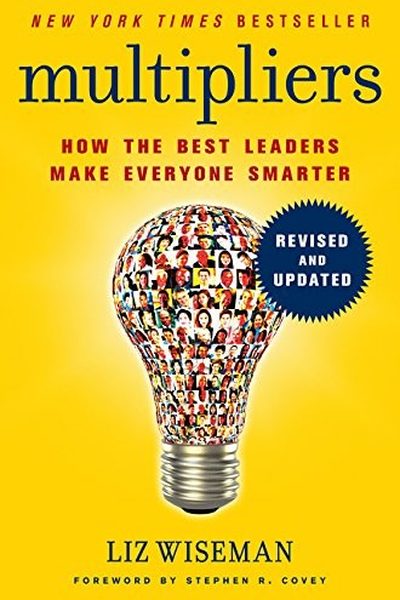
How the best leaders make everyone smarter — versus the diminishers who drain the room of intelligence.
📖 OPEN THE FULL INTERACTIVE BREAKDOWN →🌐 Read it in Hindi, Hinglish, Gujarati, Tamil & 22 more languages — free, with audio.
💡 The Big Idea
Wiseman studied 150+ leaders and found two types: Multipliers, who get more than 100% from their teams (people 'work harder and smarter' around them), and Diminishers, who get less than 50% (people 'wait to be told'). Multipliers ask questions instead of giving answers, build genuine stretch into roles, debate rigorously, and give ownership of the whole problem. Intelligence is a resource — Multipliers harvest it, Diminishers waste it.
🧠 The 6 Key Lessons
Lesson 1: The Multiplier Effect: 2x or 0.5x
The Multiplier Effect
The same team performs at radically different levels under different leaders: Multipliers double output, Diminishers halve it — not by changing the people, but by changing how much intelligence gets used. The leader's own intelligence matters less than their ability to harvest the room's.
📖 Example: Wiseman's study: a factory manager who was 'a genius at operations' left; his replacement asked questions instead of giving orders — and the same workforce hit new records. Same people, different multiplier. Read the full example →
⚡ Do this: In your next team discussion, ask ONE question you genuinely don't know the answer to — and let the room answer. Watch the energy shift.
Lesson 2: The Diminisher's Trap: The Smartest Person in the Room
The Diminisher
Diminishers often got promoted for being brilliant — so they answer before others can think, decide before others can contribute, and rescue failing tasks personally. The effect: people stop thinking, stop offering, and wait for instructions. The genius becomes the bottleneck.
📖 Example: Wiseman describes a CEO who solved every problem himself; his executives stopped bringing problems — they brought nothing. The company's intelligence went unused because it was never needed. Read the full example →
⚡ Do this: Catch yourself 'rescuing' a task this week. Instead of solving it, ask the person: 'What would you do?' Then let them do it.
Lesson 3: Ask Big Questions, Don't Give Big Answers
The Multiplier
Multipliers lead with questions: 'What would it take to 10x this?' 'What are we missing?' They set the challenge, then let the team stretch to meet it. People around Multipliers report feeling smarter — because they're the ones doing the thinking.
📖 Example: A tech CEO Wiseman studied framed a 'stretch goal' as a question and left it with the team; they invented a solution none of them — including the CEO — had imagined. The question, not the answer, was the gift. Read the full example →
⚡ Do this: Reframe your next assignment as a big question: 'How could we make this 10x better?' Give the team 48 hours before you share your own idea.
Lesson 4: Debate: The Heat That Hardens Ideas
The Debate
Multipliers create forums where ideas are challenged hard — then commit to the winner. Debate is not conflict; it's the fastest way to find the flaw early. Diminishers avoid debate (or make it personal); Multipliers make it safe and rigorous: 'attack the idea, never the person'.
📖 Example: Wiseman's examples: teams where the CEO plays devil's advocate deliberately — ideas that survive get 10x stronger, and people stop hiding weak plans. Wiseman's example: a product team at war over a design decision — and the multiplier leader didn't calm the… Read the full example →
⚡ Do this: Appoint a devil's advocate in your next decision meeting — someone whose job is to attack the plan. Thank them publicly for it.
Lesson 5: Give the Whole Problem, Not the Chore
The Investor
Diminishers hand out tasks; Multipliers hand out whole problems with context and trust — then stay available as a resource. When people own the entire outcome (not a piece), they think like owners, catch problems early, and grow. Ownership is the ultimate multiplier.
📖 Example: A manager Wiseman studied handed a junior lead the full client account — results, relationship, budget — and told her 'I'm here if you need me'. She ran it like it was hers, and it outperformed every account before it. Read the full example →
⚡ Do this: Pick one task you usually delegate in pieces. Hand over the WHOLE thing with context, a deadline and an open door. Don't touch it for two weeks.
Lesson 6: The Best Leaders Make Others Smarter — the Multiplier Effect
The Multiplier
Wiseman's research: 'multipliers' — leaders who amplify the intelligence of those around them — get 2x more from their teams than 'diminishers', who drain capability by hoarding decisions and micromanaging. The multiplier's tools are asking questions instead of giving answers, and treating people's best ideas as the organization's best ideas. Leadership is a force multiplier.
📖 Example: Teams studied under a multiplier leader contributed more ideas, took more initiative and solved problems faster than identical teams under a diminisher — the same people, different amplifier. The multiplier's restraint ('what do you think?') unlocked what… Read the full example →
⚡ Do this: In your next meeting, ask three questions before giving one answer — and let the team's answer stand when it's good.
✅ 5-Step Action Plan
- Ask one question you don't know the answer to, daily.
- Stop rescuing — ask 'what would you do?' first.
- Reframe one goal as a 10x question for the team.
- Run one devil's-advocate debate this week.
- Hand over one whole problem, with trust and context.
⚠️ When This Doesn't Work
Wiseman's 'multipliers amplify others, diminishers drain them' is the cleanest leadership framework ever — and IBM's MS-DOS deal is the proof that a multiplier can multiply the wrong thing: IBM was the world's greatest company, its leaders were celebrated multipliers, and they outsourced the operating system for their own PC to a 24-year-old — creating Microsoft — because they couldn't imagine software was the future. They multiplied everyone except their own ambition. The book's blind spot: multiplying your people is not the same as multiplying your relevance. Amplify your team, and also amplify your willingness to cannibalize your own model.
💀 The Graveyard Proves It
🖥️ IBM's PC Deal — Handed Microsoft the Throne for Pocket Change. Burn: The most valuable industry in history. Read the full case study →
💬 Best Quotes from Multipliers
- “Multipliers get 2x more from their people — not by working them harder, but by making them smarter.”
- “The best way to multiply is to ask questions you don't know the answer to.”
- “Diminishers are often the smartest person in the room — which is exactly the problem.”
Interactive version: mark lessons as read, listen in your language, share quote cards.