Library › Business & Startups
India in the Age of Ideas — Summary & Key Lessons
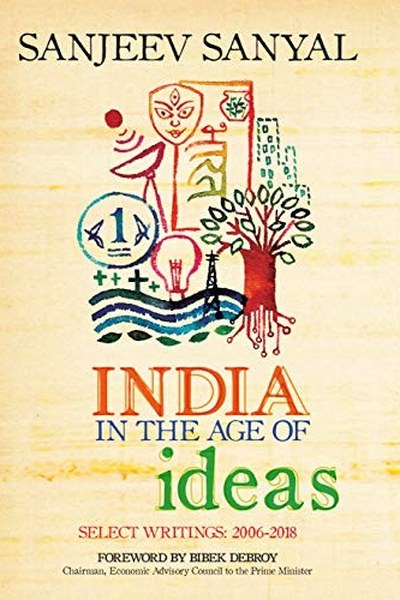
A contrarian economist's history of how ideas shaped — and can reshape — India.
📖 OPEN THE FULL INTERACTIVE BREAKDOWN →🌐 Read it in Hindi, Hinglish, Gujarati, Tamil & 22 more languages — free, with audio.
💡 The Big Idea
Conventional histories see India as a victim of geography and conquest. Sanyal argues the opposite: India was often at the centre of the world — an export powerhouse with sophisticated institutions — and its decline came from bad ideas and decaying institutions, not bad luck. The lesson for today: nations, companies and people rise and fall on the quality of their ideas and the institutions that carry them.
🧠 The 6 Key Lessons
Lesson 1: Ideas Move the World — Literally
Trade and Ideas
Sanyal traces how Indian ideas — mathematics, astronomy, textiles, religion — travelled along monsoon trade routes to reshape the world. Indian numerals reached Europe via Arab scholars; Indian fabrics defined global fashion for centuries. The lesson: exportable ideas are the ultimate product. The nations and people who create frameworks — not just goods — set the agenda for everyone else.
📖 Example: The zero, decimal notation and trigonometry crossed the Indian Ocean and eventually powered European science — India's greatest export was intellectual. The practical edge: 'ideas move the world' is not a one-time decision — it's a habit that compounds with… Read the full example →
⚡ Do this: What idea could you 'export' from your field — a framework, a method, a perspective? Write one down and share it somewhere this month.
Lesson 2: Institutions Are Memory — Build Them Well
The Institutional Skeleton
Sanyal shows how India's great periods — the Mauryas, the Cholas, the Mughals — were built on institutions: revenue systems, navies, courts, market networks. When institutions decayed, empires collapsed despite having the same territory and people. The lesson: individuals are powerful, but institutions make results durable. A great idea without an institution is a firework; with one, it's a furnace.
📖 Example: The Chola navy and the Mughal revenue system outlived their founders and powered centuries of prosperity — until decay from within undid them. Here's the part that usually gets missed: 'institutions are memory' works quietly. You won't see it working in a… Read the full example →
⚡ Do this: Identify one 'institution' in your life — a team process, a family ritual, a personal system. Strengthen one element of it this month.
Lesson 3: Geography Is a Starting Point, Not a Sentence
Geography and Destiny
Sanyal rejects geographic determinism: the same coasts and monsoons that made India prosperous were later blamed for its poverty. Geography sets the board; ideas play the game. The lesson: your starting conditions matter less than your response to them. Every person and company has a 'geography' — industry, background, location — but the ones who win are those who stop treating it as destiny.
📖 Example: India's long coastline was an economic superhighway for millennia; the same coastline became an 'obstacle' only after ideas about trade turned inward. The real test of this lesson is a bad day: the principle that survives a crisis, a tight deadline and a… Read the full example →
⚡ Do this: Write down your 'geography': your industry, location, background. List one way you can turn each from an excuse into a platform.
Lesson 4: Cities Are Idea Engines
The Urban Core
Sanyal's history is largely urban: ports, capitals and temple towns were where ideas collided and wealth concentrated. The lesson: density creates creativity — proximity, mixing and argument produce breakthroughs that scattered populations can't. For individuals: put yourself in rooms where ideas collide. The most important career move is often a city, a community or a conference — not a course.
📖 Example: Every Indian golden age had its engine city — Pataliputra, Thanjavur, Surat, Calcutta — where merchants, scholars and rulers argued and built together. In practice, 'cities are idea engines' shows up in tiny daily choices long before it shows up in outcomes… Read the full example →
⚡ Do this: Identify one 'collision zone' you can join — a meetup, a community, a workspace — and attend twice this month.
Lesson 5: Entrenched Ideas Outlast Armies
The Persistence of Dogma
Sanyal shows that bad ideas — economic self-sufficiency, suspicion of trade, caste rigidity — persisted for centuries even after their costs were obvious. The lesson: the hardest enemy to defeat is not a competitor but an entrenched belief. Changing minds requires more than facts; it requires new narratives, new incentives and patient persistence. Don't expect truth to win on its own — it needs advocates.
📖 Example: India's inward turn and the decay of its institutions took centuries to complete, driven by ideas that had become self-reinforcing dogma. Most people nod at this principle and change nothing. The gap between agreeing and acting is where the whole game is won… Read the full example →
⚡ Do this: Identify one outdated belief you hold that evidence contradicts. Find one counter-example and spend 10 minutes updating your mental model.
Lesson 6: History Is a Toolkit, Not a Museum
The Uses of the Past
Sanyal's method — using history to question present assumptions — is itself the lesson. He uses the past not for nostalgia but for alternatives: 'if India was once a trading superpower, what changed, and what can change again?' The lesson: the past is a laboratory of experiments you can learn from without paying their tuition. Study failures and successes — your own and others' — as data, not as identity.
📖 Example: By showing India's mercantile past, Sanyal reframes modern globalization as a return to form, not a foreign imposition. The uncomfortable truth about this lesson: it requires doing the boring version first — the unglamorous reps that nobody claps for. Read the full example →
⚡ Do this: Pick one past failure of yours and one past success. Extract one lesson from each and apply both to a current decision.
✅ 5-Step Action Plan
- Draft one idea from your field and share it publicly this month.
- Strengthen one institution you depend on — a team process or personal system.
- Turn one element of your 'geography' from excuse into platform.
- Join one idea-collision zone and attend twice this month.
- Update one outdated belief with evidence, deliberately.
⚠️ When This Doesn't Work
Sanyal's 'ideas and institutions, not geography, decide India's fate' is the most contrarian Indian history ever — and Dunzo is the modern case his framework predicts: the startup that India's most innovative ideas built — hyperlocal delivery before it was a category — collapsed because the institution (unit economics, capital discipline) couldn't carry the idea. Sanyal's book shows ideas need institutions; Dunzo shows the same in reverse — a great idea with a weak institution is a great idea with a short life. The caveat: the idea is the seed; the institution is the soil. India's next golden age needs both, and the institutions are the harder half.
💀 The Graveyard Proves It
🛵 Dunzo — Bengaluru's Beloved Delivery App That Delivered Itself to Ruin. Burn: Peak ~$775M valuation → unpaid salaries, near-zero; 80% layoffs. Read the full case study →
💬 Best Quotes from India in the Age of Ideas
- “The rise and fall of nations is ultimately a story of ideas and institutions.”
- “India was not a passive victim of history; it was often an active participant.”
- “An idea, once entrenched, is harder to dislodge than an army.”
Interactive version: mark lessons as read, listen in your language, share quote cards.