Library › Power & Strategy
Good Strategy Bad Strategy — Summary & Key Lessons
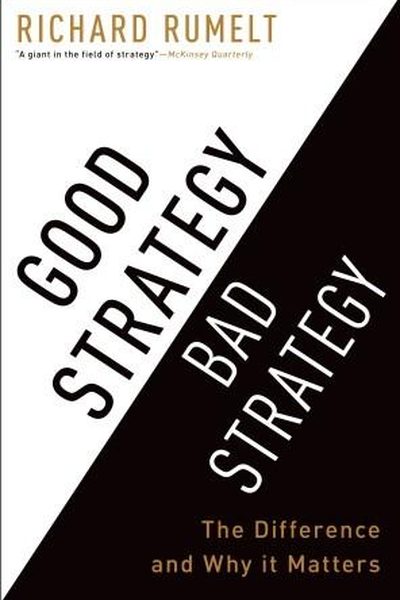
The UCLA professor who spent 40 years dissecting real strategy — and found that most 'strategy' is just fluff.
📖 OPEN THE FULL INTERACTIVE BREAKDOWN →🌐 Read it in Hindi, Hinglish, Gujarati, Tamil & 22 more languages — free, with audio.
💡 The Big Idea
Richard Rumelt — called 'the man who made strategy interesting' by McKinsey — analyzed thousands of real strategies and found most are empty: goals, budgets and vision statements dressed up as strategy. Real strategy has a structure he calls the kernel: a diagnosis of the true nature of the challenge, a guiding policy for dealing with it, and coherent actions that follow. Strategy is about focus, leverage and hard choices — not slogans.
🧠 The 6 Key Lessons
Lesson 1: The Kernel: Diagnosis → Policy → Action
Good Strategy
Every good strategy contains three elements: a diagnosis (what is really going on? what is the true nature of the challenge?), a guiding policy (the overall approach — what we will and won't do), and coherent actions (steps that actually follow from the policy). Miss any one and you have a slogan, not a strategy.
📖 Example: Rumelt's model case: a small auto parts company on the brink of collapse diagnosed its real problem (chaotic product line bleeding cash), chose a guiding policy (cut everything except the profitable core), and executed — surviving while bigger rivals failed. Read the full example →
⚡ Do this: Write your current strategy in three lines: 'The challenge is… Our approach is… Therefore we will…' If you can't, you don't have a strategy yet.
Lesson 2: Bad Strategy Is Fluff
Bad Strategy
Bad strategy wears disguises: grand visions ('we will be the global leader in X'), fluffy values, and wishful goals with no plan. Rumelt's diagnosis: these are not strategy but 'strategic decoration' — usually created to avoid the hard work of diagnosis and the pain of choice. If a strategy doesn't say what you will NOT do, it is not a strategy.
📖 Example: A Fortune 500 firm's 'strategy' Rumelt quotes: 'We will leverage our core competencies to maximize shareholder value.' It says nothing — no diagnosis, no policy, no action. Contrast with Toyota's early strategy: 'build small, reliable cars for a fuel-short… Read the full example →
⚡ Do this: Highlight every vague word in your plan (lever, synergize, world-class). Rewrite the plan with concrete nouns and numbers — or admit you don't have a plan.
Lesson 3: Find the Crux
Diagnosis
Complex problems are not solved wholesale — they are solved by finding the crux: the pivotal challenge whose solution unlocks everything else. Rumelt's advice: resist the urge to fix everything; spend the effort identifying which 20% of the problem, if solved, makes the rest tractable. Good diagnosticians think in hypotheses and test them.
📖 Example: When the US faced the polio crisis, the crux wasn't more clinics or public campaigns — it was a vaccine. Salk focused all energy there and the rest of the problem collapsed. Similarly, a struggling startup's crux is usually one thing: distribution, not… Read the full example →
⚡ Do this: List your top 10 problems. Ask of each: 'If this were solved, how many others would shrink?' Attack the problem that unlocks the most.
Lesson 4: Use Leverage
Leverage
Leverage means getting disproportionate results from focused effort: concentrating resources on a pivotal objective, using an advantage (position, technology, timing) to amplify effort, and creating chain reactions where one success feeds the next. Strategy is not about doing more — it is about doing the few things that multiply.
📖 Example: Rumelt's lever example: Southwest Airlines concentrated on one insight — fast turnarounds. Everything (standardized fleet, no meals, point-to-point routes) amplified that single advantage, producing cost per seat mile no rival matched for decades. Read the full example →
⚡ Do this: Find your one multiplier: the single advantage you can build that makes every other effort easier. Name it, and cut one activity that doesn't feed it.
Lesson 5: Think in Chains
Anticipation
Good strategists think several moves ahead — not because they can predict the future, but because they anticipate reactions. Rumelt calls it thinking in chains: if I do X, they will respond with Y, which enables Z. This second-order thinking is rare because it's slow and uncomfortable — but it's where the edge lives.
📖 Example: When one airline raises prices, rivals discount; when a startup enters a market, incumbents bundle. Rumelt's case: the company that launched a new product AND pre-emptively prepared its counter to the incumbent's inevitable price cut — winning the war before… Read the full example →
⚡ Do this: Before your next big move, write the chain: 'If we do X, then ___ will likely do Y, so we should prepare Z.' Repeat it twice.
Lesson 6: Strategy Is Diagnosis, Policy, and Action — Not Goals
The Kernel of Strategy
Rumelt defines real strategy as a kernel of three parts: a diagnosis of the challenge, a guiding policy for approaching it, and a set of coherent actions. Goals without this kernel ('we will grow 20%') are not strategy — they are wishes. The diagnosis is the hardest and most skipped part.
📖 Example: A struggling business that says 'we must increase sales' lacks strategy; one that diagnoses 'our distribution is dying, our product is fine' and policies 'double down on direct channels' with specific actions has a kernel. The first gets slogans; the second… Read the full example →
⚡ Do this: Write your current challenge as a one-sentence diagnosis, a one-sentence policy, and three concrete actions — and test whether all three fit together.
✅ 5-Step Action Plan
- Write your strategy in 3 lines: challenge, approach, action.
- Strip the fluff — replace every vague word with nouns and numbers.
- Find your crux: the one problem whose solution unlocks the rest.
- Name your single multiplier and cut what doesn't feed it.
- Think in chains: map the reaction to your next move, and pre-plan the counter.
⚠️ When This Doesn't Work
Rumelt's 'strategy is diagnosis, policy, action' is the best lens in business — and GE under Immelt is the perfect bad-strategy case study the book itself predicts: twenty years of 'strategic' decks, initiatives and portfolio moves, and a $500 billion evaporation because none of it was anchored to one honest diagnosis. The book's danger is that it makes you an excellent critic of others' strategy while your own remains a wish. Reading Rumelt and still running a strategy-free organisation is the most expensive form of self-deception.
💀 The Graveyard Proves It
⚙️ General Electric — The World's Most Valuable Company — Managed Into a Shadow. Burn: From $600B market cap to ~$100B and ejection from the Dow. Read the full case study →
💬 Best Quotes from Good Strategy Bad Strategy
- “Strategy is the craft of figuring out which purposes are worth pursuing and what is required to achieve them.”
- “Good strategy works by focusing energy and resources on one, or a very few, pivotal objectives.”
- “Fluff is a form of restatement of the obvious combined with a sprinkling of buzzwords.”
Interactive version: mark lessons as read, listen in your language, share quote cards.