Library › History
Gandhi: The Years That Changed the World — Summary & Key Lessons
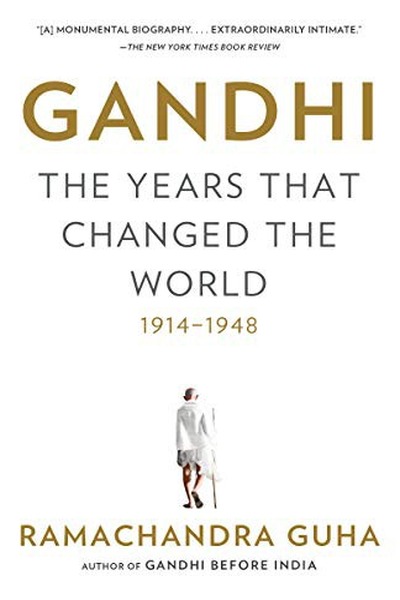
The final decades of the Mahatma — how one man's moral leadership bent the arc of an empire.
📖 OPEN THE FULL INTERACTIVE BREAKDOWN →🌐 Read it in Hindi, Hinglish, Gujarati, Tamil & 22 more languages — free, with audio.
💡 The Big Idea
Guha's second volume covers Gandhi from 1915 to 1948: the years he transformed Indian nationalism through non-violence, discipline and an unshakeable identification with the poorest. His power came not from office or wealth but from the consistency between his public demands and his private life. Institutions matter, but so does the person who embodies the cause — the two together bend history.
🧠 The 6 Key Lessons
Lesson 1: Personal Example Is the Strongest Weapon
Chapter 1: The Return
When Gandhi returned to India in 1915, he had no party, no money and no position — what he had was a reputation for living exactly what he preached: simple food, manual labor, no fear of prison. That consistency became his power source. Movements are won not by speeches but by leaders whose private lives match their public demands.
📖 Example: Gandhi's ashram members lived as he lived — spinning khadi, cleaning latrines, refusing luxury — so when he asked Indians to boycott foreign cloth and spin daily, the request carried the weight of a man who had already given up everything he asked others to… Read the full example →
⚡ Do this: Before asking anything of your team or family, ask: have I already done the harder version of this myself? If not, do it first.
Lesson 2: Know the People You Seek to Lead
Chapter 2: Champaran and Beyond
Gandhi's first campaigns succeeded because he went where the people were and learned their lives from the ground — the indigo farmers of Champaran, the mill workers of Ahmedabad, the peasants of Kheda. He spoke their language, shared their food and understood their grievances before designing solutions. Leadership begins with listening, not with plans.
📖 Example: In Champaran, Gandhi arrived with little knowledge of indigo cultivation and spent weeks interviewing farmers, recording their testimony in notebooks, until the injustice was undeniable and the authorities could not dismiss it. The movement grew from… Read the full example →
⚡ Do this: Spend one hour this week genuinely listening to the person your work affects most — no agenda, no solution yet — and let their reality shape your next step.
Lesson 3: Satyagraha: Turn Oppression Into a Public Question
Chapter 3: The Weapon of Truth
Gandhi's innovation was satyagraha — non-violent resistance that refuses both submission and retaliation. The method converts a conflict into a moral spectacle: you accept suffering without violence, forcing the opponent to confront the injustice publicly. Its power lies in making oppression costly to maintain and impossible to justify.
📖 Example: When Gandhi broke the salt law at Dandi in 1930, thousands followed him to the sea, and the arrests that followed turned British taxation into a global moral scandal. The empire could beat marchers, but it could not beat the question the marchers embodied:… Read the full example →
⚡ Do this: In your next conflict, ask: how could I make the injustice visible without escalating the violence? Reframe the confrontation as a question others can see.
Lesson 4: Discipline Is the Language of Seriousness
Chapter 4: Constructive Work
Gandhi paired every protest with 'constructive work' — spinning, village hygiene, education, uplift of Dalits and women. He understood that a movement that only protests never builds; a movement that builds while protesting becomes a government-in-waiting. Discipline in daily work is the proof that your cause is real.
📖 Example: Congress workers under Gandhi were expected to spin daily and serve villages between campaigns, so that when freedom came, the organization already had decades of practice in governance and service. The habit of constructive work turned protest energy into… Read the full example →
⚡ Do this: Attach one constructive, building activity to your cause this month — something that improves lives directly, not just protests the problem.
Lesson 5: Moral Authority Requires Accepting Unpopular Truths
Chapter 5: The Tests
Guha shows Gandhi repeatedly telling his own side what it didn't want to hear: criticizing Congress members, condemning violence by Indians, fasting against communal hatred even when his own followers objected. The leader who only flatters the crowd loses the moral capital that made the crowd follow him. Integrity includes inconvenient honesty.
📖 Example: When riots erupted and his followers demanded revenge, Gandhi fasted — threatening his own life — until the violence stopped. He held his own movement to the same standard as the empire, which is precisely why his moral authority survived where purely… Read the full example →
⚡ Do this: Identify one truth your own side doesn't want to hear, and say it this week — respectfully, factually, in the service of the shared goal.
Lesson 6: The Cost of Leadership Is Loneliness
Chapter 6: The Final Years
Gandhi's last years were marked by partition, violence and his own followers' rejection of his vision — yet he continued his walks, his prayers and his refusal to despair. Guha's portrait shows that moral leadership is often lonely: the compass points where the crowd won't go. The price of principle is sometimes standing alone, and paying it is what makes the principle real.
📖 Example: In the weeks before his assassination, Gandhi walked through riot-torn villages in Bengal and Delhi, fasting and praying amid communal madness while leaders on all sides ignored or mocked him. He never stopped; the man who had moved an empire died still… Read the full example →
⚡ Do this: Name one principle you'd hold even if everyone you respect disagreed, and take one small action that commits you to it this month.
✅ 5-Step Action Plan
- Do the harder version of what you ask others to do — before asking
- Spend one hour listening to the people your work affects most
- Reframe one conflict as a visible public question instead of an escalation
- Attach one constructive work project to your cause
- Speak one inconvenient truth to your own side this week
⚠️ When This Doesn't Work
⚠️ When this doesn't work: Gandhi's methods emerged from specific conditions — a literate adversary bound by law and press, and a population with extraordinary patience. Non-violent resistance is harder against regimes that simply kill, and fasting as protest can become coercion rather than conscience. Study the context before transplanting the tactics.
💀 The Graveyard Proves It
📜 The Emergency of 1975 — The 21 Months When India's Democracy Was Suspended. Burn: 21 months, thousands jailed, press gagged — and the system survived only by recovering its memory. Read the full case study →
💬 Best Quotes from Gandhi: The Years That Changed the World
- “Gandhi's genius was to make the personal political and the political personal.”
- “He treated the moral and the practical as one thing, which is why he was so hard to dismiss and so hard to defeat.”
- “The Mahatma's authority rested on one foundation: he never asked others to do what he would not do himself.”
Interactive version: mark lessons as read, listen in your language, share quote cards.