Library › Power & Strategy
An Era of Darkness — Summary & Key Lessons
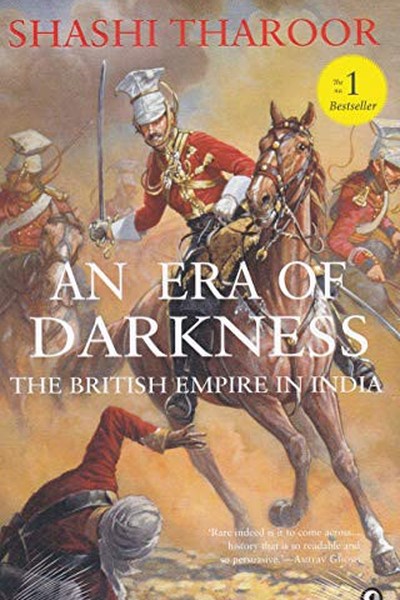
The Raj, told from the colonized's archives.
📖 OPEN THE FULL INTERACTIVE BREAKDOWN →🌐 Read it in Hindi, Hinglish, Gujarati, Tamil & 22 more languages — free, with audio.
💡 The Big Idea
Tharoor's devastating counter-history of the British Raj: far from the 'blessing' of imperial apologists, British rule systematically deindustrialized India, drained its wealth, engineered famines, and left a legacy of underdevelopment — all while claiming the civilizing mantle. Drawing on economists, historians and colonial records themselves, Tharoor argues that India's poverty in 1947 was not a starting condition but an outcome of colonial extraction. The book is a masterclass in re-reading history: whose story you hear depends on whose archives you open, and the past is a strategic asset that both rulers and the ruled fight to control.
🧠 The 6 Key Lessons
Lesson 1: The Storyteller's Power: Who Writes History Writes the Future
Part 1: The Frame
Tharoor opens by exposing how British history framed the Raj as a gift — railways, courts, English — while the costs were written out. The lesson: the narrative is a strategic asset, and whoever controls the telling controls the interpretation. This applies everywhere: the company that writes its own history controls its culture; the person who narrates their own story controls their opportunities. The defence is archival: check the records, read the other side, and never accept a flattering story without the receipts. History is not the past; it is the past being deployed for present purposes.
📖 Example: The British story of 'civilizing India' quietly omitted that India's textile industry — among the world's finest — was deliberately destroyed to serve Lancashire mills. The omission was the strategy. Read the full example →
⚡ Do this: Take one story you've been told (about your company, your country, yourself) and check the archival record this week — the receipts behind the narrative. Note what the story left out.
Lesson 2: The Wealth Drain: Extraction Is Invisible When Slow
Part 2: The Economics
Tharoor documents the 'drain': India's wealth flowed to Britain for two centuries through taxes, trade terms, interest on its own debt and the cost of its own conquest — an estimated $45 trillion in today's terms. The lesson: extraction is most dangerous when it's slow, legal and invisible — no invasion, just an engineered flow. The modern translation: check your own 'drains' — the fees, terms, structures and 'conveniences' that quietly transfer your value upward. The most expensive theft is the one that looks like a normal transaction. Audit the flows, not just the balances.
📖 Example: India paid Britain for its own administration, its own railways, and even the wars fought to conquer it — each rupee 'legitimate', each rupee part of the drain. The empire was funded by its own victim. Read the full example →
⚡ Do this: Audit one recurring 'drain' in your finances or business — the fee, the term, the structure that quietly transfers value out. Renegotiate or eliminate one this quarter.
Lesson 3: Famine as Policy Failure: The Cruelty of 'Correct' Economics
Part 3: The Famines
The book's most harrowing chapters: millions died in famines while grain was exported and laissez-faire ideology blocked relief — the famines were not natural disasters but policy outcomes. The lesson: an ideology applied without humanity is a weapon. The 'correct' economics that refused intervention cost millions of lives, because the model's assumptions mattered more than the people it failed. The universal warning: when your system tells you the numbers are fine while humans are suffering, the system is the problem. Compassion is not a deviation from good management; it is the check on it.
📖 Example: During the 1943 Bengal famine, the colonial government continued exports and denied the famine's existence — a million and a half died while officials defended the market. The policy was 'correct'; the people were collateral. Read the full example →
⚡ Do this: Find one place where your 'correct' process is causing human cost — a policy, a metric, a rule. Re-examine the rule against the people it touches, and revise one this month.
Lesson 4: The Deindustrialization Lesson: Protecting Your Production
Part 4: The Destruction
Tharoor shows how colonial trade policy systematically destroyed Indian industry — tariffs against Indian goods, free trade forced on India, and the collapse of its textile, shipping and craft sectors. The lesson: free trade is a weapon when the rules are set by one side. The modern translation: don't let 'openness' become one-way extraction — protect your production capability, your skills and your markets while engaging globally. The nation (or company) that can't make anything loses everything when the rules change. Capability is the ultimate tariff.
📖 Example: Indian calico was so superior that Britain banned its import — then forced India to buy British cloth. The 'free trade' the empire preached applied only when it served the empire's factories. Read the full example →
⚡ Do this: Identify your core capability that others would happily 'help you outsource'. Protect one piece of production — a skill, a process, a market — this quarter. Capability is sovereignty.
Lesson 5: The Colonial Mind: The Psychological Wound
Part 5: The Legacy
Beyond economics, Tharoor examines the psychological damage: the colonized internalized inferiority — the English language, the English aesthetic, the English standard as the measure of worth. The lesson: the deepest conquest is mental — when the conquered believe the conqueror's story about them. The modern translation: watch for the 'colonial mind' in yourself — the inherited belief that foreign equals superior, that your own tradition is backward, that your voice needs translation to be valid. Decolonize your own standards: judge your work, your culture, your self by your own measures.
📖 Example: Tharoor describes how Indians learned to value everything English — from accents to accents of thought — while devaluing their own. The mind had been conquered before the economy was rebuilt. Read the full example →
⚡ Do this: Identify one area where you default to 'foreign equals better' — a standard, an aesthetic, a judgment. Test it against your own values this week, and reclaim your measure.
Lesson 6: Reclaiming the Past: History as the Foundation of Confidence
Part 6: The Reckoning
Tharoor's purpose is not vengeance but restoration: a people who know their history — both its glories and its wounds — can build from truth instead of shame. His lesson: reckoning with the past is the foundation of confidence. The person (or nation) that denies its history is unstable; the one that understands it can choose what to carry forward. The reckoning is not about blame forever — it is about accuracy, and accuracy is the platform for a confident future. Understand where you came from, and you can decide where you're going — instead of being silently steered by a history you never examined.
📖 Example: Tharoor's book is itself the lesson: by documenting the extraction, he restores the possibility of an Indian future built on truth rather than colonial apology — the reckoning is the reclamation. Read the full example →
⚡ Do this: Write your own 'reckoning' — the honest history of one chapter of your life, including the parts you usually skip. Use it as the platform for your next confident decision.
✅ 5-Step Action Plan
- Check the receipts behind one story you've been told.
- Audit and eliminate one recurring 'drain' in your finances.
- Re-examine one 'correct' process against the people it touches.
- Protect one core capability from 'helpful' outsourcing.
- Reclaim one area where you default to 'foreign equals better'.
⚠️ When This Doesn't Work
Sanyal's 'colonialism deliberately destroyed India's institutions' is the most provocative Indian history ever — and Plassey is the case study his thesis rests on: Bengal, the richest province on earth, fell to a trading company in a single afternoon — not to superior force but to an inside betrayal that the company had engineered for years. Sanyal's argument is powerful; the caveat is what it implies for the present: empires fall through internal division, and the divisions are always being sold. The lesson of the era of darkness is not only 'the British were brutal' — it is that the Plassey pattern repeats wherever loyalty can be outbid. Guard the institutions; they are the only wall that has ever worked.
💀 The Graveyard Proves It
⚔️ The Battle of Plassey — The Betrayal That Gave India's Richest Province to a Trading Company. Burn: The Nawab's kingdom, Bengal's treasury, and 200 years of subjugation. Read the full case study →
💬 Best Quotes from An Era of Darkness
- “Whoever controls the narrative controls the interpretation — check the archives.”
- “The most expensive theft is the one that looks like a normal transaction.”
- “The deepest conquest is mental — decolonize your own standards.”
Interactive version: mark lessons as read, listen in your language, share quote cards.