Library › Business & Startups
The E-Myth Revisited — Summary & Key Lessons
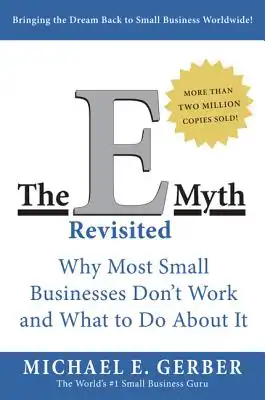
Why most small businesses don't work and what to do about it — work ON your business, not just IN it.
📖 OPEN THE FULL INTERACTIVE BREAKDOWN →🌐 Read it in Hindi, Hinglish, Gujarati, Tamil & 22 more languages — free, with audio.
💡 The Big Idea
The Entrepreneurial Myth: that businesses are started by entrepreneurs. Reality: they're started by TECHNICIANS having an 'entrepreneurial seizure' — the baker who assumes baking skill means bakery-running skill, the 'fatal assumption' that technical work and a business doing that work are the same thing. Result: the technician buys a job, becomes the business's most overworked employee, and burns out. Gerber's fix: balance three internal personalities (Entrepreneur/vision, Manager/order, Technician/craft), survive the three phases (infancy, adolescence, maturity), and above all adopt the FRANCHISE PROTOTYPE mindset: build your business as if you'd replicate it 5,000 times — documented systems, orchestrated processes, people-independent quality — working ON it, not just IN it, until it runs without you.
🧠 The 6 Key Lessons
Lesson 1: The Fatal Assumption & the Three-Personality War
Chapters 1–2: The Entrepreneurial Myth / The Entrepreneur, Manager, Technician
The fatal assumption — 'if you understand the technical work, you understand a business that does that technical work' — is why the master chef's restaurant, the great coder's agency, and the star stylist's salon fail identically: the technical work of a business and a business that does technical work are ENTIRELY different things. Inside every owner, three personalities war for control: the ENTREPRENEUR (lives in the future, craves change, sees opportunity — the visionary), the MANAGER (lives in the past, craves order, builds systems — the pragmatist), and the TECHNICIAN (lives in the present, craves doing — 'if you want it done right, do it yourself'). The typical small-business owner is 10% entrepreneur, 20% manager, 70% technician — and the technician's dominance means the business becomes a job with worse hours: the moment the owner stops working, revenue stops. Balance is the goal: vision setting direction, management building order, craft ensuring quality — each in its place.
📖 Example: Gerber's through-line student is Sarah, the pie shop owner: a woman who bakes transcendent pies (technician mastery), opened a shop in the seizure of enthusiasm, and three years later HATES pies — exhausted, broke, and trapped, doing everything because 'no… Read the full example →
⚡ Do this: Take the percentage test honestly: allocate your working week across E, M, and T activities. If T exceeds 50%, block four 'ON the business' hours weekly (systems, vision, hiring) — treated as unbreakable client meetings — starting this week.
Lesson 2: The Franchise Prototype: McDonald's as a Thinking Tool
Chapters 8–9: The Turn-Key Revolution / The Franchise Prototype
Ray Kroc's real product wasn't hamburgers — it was McDonald's ITSELF: a business so systematized it delivers identical results through 15-year-olds worldwide. Gerber's insight: you don't need to franchise; you need to think like a franchisor — build the FRANCHISE PROTOTYPE: pretend you'll replicate your business 5,000 times, and suddenly every question changes: How would the work get done WITHOUT you? What must be documented so a competent-but-ordinary person delivers excellence? The rules of the prototype: the system runs the business, people run the system; hire for the system's needs, not for irreplaceable genius (a business dependent on extraordinary people is unsellable and unscalable — 'great businesses are not built by extraordinary people but by ordinary people doing extraordinary things' via systems); value must be consistent, predictable, replicable. The model turns owner-dependence into an engineering problem with a known solution: documentation, standardization, orchestration.
📖 Example: The McDonald's arithmetic Gerber loves: fries cooked to the exact second, burgers with measured condiment quantities, stations engineered so precisely that a teenager on their third shift produces the same product as a veteran — across tens of thousands of… Read the full example →
⚡ Do this: Choose your single most owner-dependent process (the thing 'only you can do right'). Document it this week as if training a smart 15-year-old: steps, standards, checkpoints, photos if needed. Then actually hand it over and refine the document until the result matches yours.
Lesson 3: Work ON It: The Business Development Process
Chapters 10–15: Innovation, Quantification, Orchestration
The prototype is built through a perpetual three-step loop. INNOVATION: continuously test better ways — not product innovation but PROCESS innovation (the words your people say to customers, the color of the walls, how the phone is answered — small changes, measured effects). QUANTIFICATION: numbers on everything (calls, conversions, average sale, yield per process variant) — without numbers, innovation is opinion; with them, the business becomes a laboratory where improvements are proven, not argued. ORCHESTRATION: once a better way is proven, it becomes THE way — documented, trained, and done identically until a better way is proven (discretion is the enemy of consistency; consistency is what customers actually buy). The loop then repeats forever. Gerber's supporting structure: the Organization Chart built around FUNCTIONS, not people (draw the chart your company needs at scale, then fill every box — initially with your own name — and systematically replace yourself box by box, bottom-up, via documented systems).
📖 Example: Gerber's suit experiment: a salesman tests touching the customer's arm... no — his cleanest case is the words test: a store measures conversions when clerks say 'Hi, have you been in before?' versus the standard greeting — the scripted question lifts sales… Read the full example →
⚡ Do this: Start the loop on ONE customer touchpoint: script two versions of your greeting/pitch/follow-up, run each for two weeks, count the results, and orchestrate the winner as standard. Then draw your function chart, write your name where it belongs (everywhere, honestly), and pick the first box to systematize yourself out of.
Lesson 4: Your Primary Aim: The Business Serves the Life
Chapters 16–18: Your Primary Aim / Your Strategic Objective
Gerber's deepest reframe arrives late: the business is not your life — it's a VEHICLE for your life, and building one without first defining the life is building a ship with no destination. THE PRIMARY AIM: the owner's life questions answered in writing — what do I value, how do I want my days to feel, what money, freedom, and impact does my LIFE require? Only then the STRATEGIC OBJECTIVE: the business specification that serves it — revenue target, whether the business is sellable (an asset, not a job), the standards that make it 'an opportunity worth pursuing.' From there cascade the strategies (organizational, management, people, marketing, systems) — each engineered backward from the life. The book's closing challenge: most owners never ask what they want because the technician's busyness feels like an answer. It isn't. 'Great people have a vision of their lives that they practice emulating each day' — the business is just the practice field.
📖 Example: Sarah's ending is the model: her primary aim turns out not to be 'own a pie empire' but a life of craft, teaching, and mornings that begin unhurried — so her strategic objective becomes a modest, systematized, eventually sellable shop that funds that life… Read the full example →
⚡ Do this: Write the primary aim tonight — one page: the life, described concretely (days, money, freedom, relationships). Then write the strategic objective: what your business must become to fund THAT — including the sellability test: 'could someone buy this and run it without me?' Every ON-the-business hour now has a destination.
Lesson 5: The Turnkey Revolution: Systems Over Heroes
Part 2: The Franchise Prototype
The most successful businesses are 'turnkey' — designed so perfectly that they could be handed to a stranger and still run. Gerber's revolution: stop building a business that depends on YOU, and start building a business that is a system you happen to operate. Every process — from answering the phone to making the product — should be documented and standardized until a trained replacement can execute it. The hero-owner who is the only one who knows how things work has built a job, not a business. The turnkey owner has built an asset that runs on systems, not on heroics.
📖 Example: Gerber explains McDonald's: the franchisee is replaceable, but the system — the grill times, the script, the layout — is identical in every store. THAT is why McDonald's scales and a thousand 'better burger' joints with irreplaceable owners never do. Read the full example →
⚡ Do this: Pick your most critical business process. Write it down step-by-step as if teaching a stranger — then have someone follow your notes and fix every place they get stuck.
Lesson 6: Management by Exception: Run the Business, Don't Be It
Part 3: The Business Development Program
A business that requires the owner to approve every decision is a business that cannot grow. Gerber's cure is management by exception: define the standards and rules so clearly that employees only escalate what falls OUTSIDE the rules. The owner's role shifts from doing the work to monitoring exceptions — the unusual customer request, the broken process, the strategic decision. This is the difference between working IN the business (technician) and working ON it (manager and entrepreneur). Every policy you write is a piece of yourself you have cloned into the system — and cloning is the only way to scale.
📖 Example: Gerber shows how a restaurant owner who stops tasting every dish and instead trains staff to a written quality standard can finally open a second location. The owner who must be present for every dish is permanently capped at one store. Read the full example →
⚡ Do this: Write 3 clear 'exception rules' for your work — decisions you must personally see vs. everything else handled by the system. Delegate the rest this week.
✅ 5-Step Action Plan
- Take the E/M/T percentage test; book four ON-the-business hours weekly.
- Document your most owner-dependent process and hand it over.
- Run one innovate→quantify→orchestrate loop on a customer touchpoint.
- Draw the function chart; replace yourself one box at a time, bottom-up.
- Write the primary aim, then the strategic objective that serves it.
⚠️ When This Doesn't Work
Building systems and delegating is right — but the E-Myth's franchise dream has a debt-shaped trap: expand on borrowed money and the systems become a machine for losing more, faster. Subrata Roy's Sahara empire was systematised, branded, nationwide — and built on funds that were never legally his. Systems amplify whatever they're built on. Build the prototype, prove the unit economics, and only then scale the franchise. Systems are a multiplier, not a source.
💀 The Graveyard Proves It
🏦 Subrata Roy — The Empire That Fought the Referee. Burn: ₹24,000 crore ordered refunded, 2 years in jail. Read the full case study →
💬 Best Quotes from The E-Myth Revisited
- “If your business depends on you, you don't own a business — you have a job.”
- “The problem is not your business; the problem is you.”
- “Organize around business functions, not personalities.”
Interactive version: mark lessons as read, listen in your language, share quote cards.