Library › Psychology & People
Decisive — Summary & Key Lessons
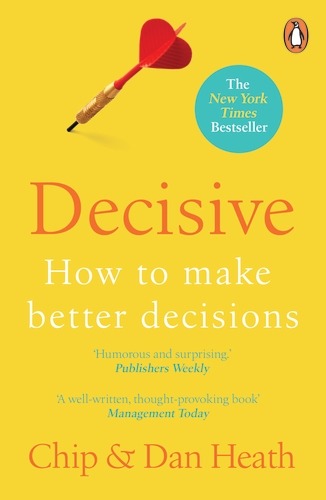
How to make better choices in life and work — the four villains of decision-making and the cure.
📖 OPEN THE FULL INTERACTIVE BREAKDOWN →🌐 Read it in Hindi, Hinglish, Gujarati, Tamil & 22 more languages — free, with audio.
💡 The Big Idea
The Heath brothers identify four villains that sabotage every decision: (1) narrow framing (you see only one or two options), (2) confirmation bias (you look for evidence that supports your choice), (3) short-term emotion (feelings hijack the decision), and (4) overconfidence (you're sure you'll be right). The cure — the WRAP process: Widen your options, Reality-test your assumptions, Attain distance before deciding, and Prepare to be wrong. Small process tweaks produce dramatically better choices.
🧠 The 6 Key Lessons
Lesson 1: The Four Villains
The Four Villains
Every decision is attacked by four villains: narrow framing (one or two options), confirmation bias (seeking supportive evidence), short-term emotion (feeling hijacks thinking), and overconfidence (assuming you'll be right). You can't eliminate them — but you can run a process that neutralizes each one.
📖 Example: A job offer 'yes or no' is narrow framing — the villain hides the real option: negotiate, wait, create a new role. Every villain quietly narrows your world. The practical edge: 'four villains' is not a one-time decision — it's a habit that compounds with… Read the full example →
⚡ Do this: Name the villain that most affects your current decision. Pick the WRAP step that counters it and use it this week.
Lesson 2: Widen Your Options: Multitrack
Widen Your Options
The cure for narrow framing: consider at least two options simultaneously (multitrack) — and if you're choosing between two, ask 'what about neither?' Even small decisions benefit: the 'vanishing options test' asks what you'd do if your current options disappeared. More options = better choices.
📖 Example: When choosing between two job candidates, interview both 'for' and ask who you'd hire if both declined — the answer often reveals a hidden third standard. Here's the part that usually gets missed: 'widen your options' works quietly. You won't see it working… Read the full example →
⚡ Do this: Force a third option onto your current decision. If deciding between two, write the 'neither' option and what it implies.
Lesson 3: Reality-Test: Kill Confirmation Bias
Reality-Test Your Assumptions
Once you lean toward an option, your brain hunts for evidence that supports it. The cure: actively seek disconfirmation — ask the question that would prove you wrong. Talk to people who chose differently, run a small experiment, and ask 'what would have to be true for the opposite choice to be right?'
📖 Example: Before buying a car, read reviews from owners who regret it. Before a hire, call a previous employer and ask about weaknesses. The information you avoid is the information you need. Read the full example →
⚡ Do this: Write the question that would prove your current lean wrong — and find the answer this week.
Lesson 4: Attain Distance: 10/10/10
Attain Distance
Short-term emotion distorts decisions — excitement, fear and anger all make you choose differently than you would with distance. The 10/10/10 test: how will you feel about this decision in 10 minutes, 10 months, and 10 years? Distance reveals what the emotion is hiding.
📖 Example: The couple tempted to quit their jobs in a rage, the buyer dazzled by a 'once-in-a-lifetime' deal — 10/10/10 calms both: the anger fades, the deal wasn't once-in-a-lifetime. Read the full example →
⚡ Do this: Run 10/10/10 on your current decision. Write all three answers before deciding.
Lesson 5: Attain Distance: Your Future Self
Attain Distance
Another distance tool: make the decision for someone else. When you advise a friend facing the same choice, you're clear-headed; when it's your own, you're tangled. The 'friend test' — 'what would I tell my best friend to do?' — separates the signal from the emotion.
📖 Example: The Heath brothers' research: people give wiser career, money and relationship advice to others than they follow themselves — because distance clears the emotion. Most people nod at this principle and change nothing. The gap between agreeing and acting is… Read the full example →
⚡ Do this: Write your decision as a letter to a friend facing the same choice. What would you advise? Follow that.
Lesson 6: Prepare to Be Wrong: Bookend the Future
Prepare to Be Wrong
Overconfidence is the final villain: we assume our plan will work. The cure: prepare for both success and failure. Set a 'premortem' (imagine the plan failed — why?) and a 'preparade' (imagine it succeeded wildly — what made it work?). Then build tripwires that force a re-check at defined moments.
📖 Example: Teams that run premortems catch fatal flaws before launch; tripwires ('if we haven't hit X in 30 days, we re-decide') prevent sinking months into a failing plan. The uncomfortable truth about this lesson: it requires doing the boring version first — the… Read the full example →
⚡ Do this: Run a 5-minute premortem on your plan: imagine it failed in 6 months — list the 3 likely causes. Add one tripwire to your calendar.
✅ 5-Step Action Plan
- Name your decision's main villain.
- Force a third option; run the vanishing-options test.
- Seek disconfirming evidence this week.
- Run 10/10/10 and the friend test before deciding.
- Premortem your plan and set one tripwire.
⚠️ When This Doesn't Work
Decisive's 'expand your options, test assumptions, prepare to be wrong' is the gold standard — and Daimler ran the gold standard on the Chrysler merger: four years of due diligence, multiple frameworks, every option examined. It still destroyed $36 billion, because great process cannot see the future, only question it. The uncomfortable truth the book underweights: after all the option-expanding and 10/10/10 thinking, you still bet on a guess. Process reduces the odds of a bad decision; it never removes the need for luck, and the confident feeling good process gives can be its own trap.
💀 The Graveyard Proves It
🚙 DaimlerChrysler — A $36B 'Merger of Equals' Where Nobody Was Equal. Burn: $36B merger sold off for ~$7B. Read the full case study →
💬 Best Quotes from Decisive
- “If you're deciding between two options, the answer is often 'neither'.”
- “The best way to kill confirmation bias is to actively seek disconfirmation.”
- “Never make a decision when you're feeling an intense emotion — give it ten minutes, or ten days.”
Interactive version: mark lessons as read, listen in your language, share quote cards.