Library › Business & Startups
Anything You Want — Summary & Key Lessons
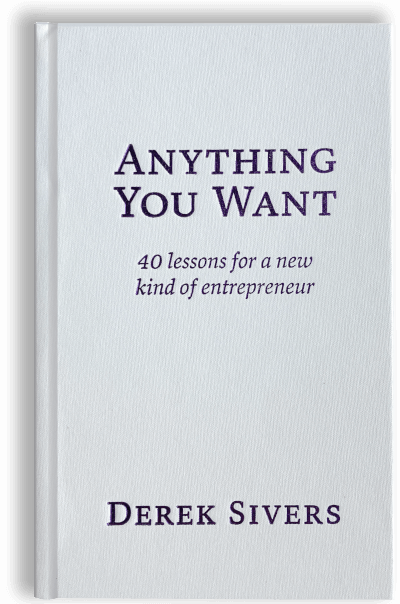
40 lessons for a new kind of entrepreneur — from the man who built CD Baby by accident and gave away $22 million.
📖 OPEN THE FULL INTERACTIVE BREAKDOWN →🌐 Read it in Hindi, Hinglish, Gujarati, Tamil & 22 more languages — free, with audio.
💡 The Big Idea
Sivers never meant to start a business: he was a musician who built a way to sell his own CD online in 1998, friends asked to use it, and CD Baby grew into the largest independent-music retailer — which he later sold for $22M and gave to charity. The book is his anti-manual: your business plan should serve YOUR ideal life, not investors' growth fantasies (he refused all funding and 'no' was his default); perfection isn't when there's nothing to add but nothing to remove; make your customers dream-come-true happy and ignore everyone else; ideas are multipliers of execution, worth nothing alone; delegate or die — but don't abdicate; and the whole game is optional: a business is a playground you invent, so make the rules ones you actually want to live under.
🧠 The 6 Key Lessons
Lesson 1: Business Is a Playground You Design
Lessons: Your Business Is Your Utopia / What's Your Compass?
Sivers' founding heresy: a business is your chance to build a little universe with YOUR rules — 'your utopia' — so every convention (grow fast, raise money, maximize revenue, exit big) is optional, and adopting it unexamined means living in someone else's utopia. His compass: does this decision make my LIFE better and my CUSTOMERS happier? Everything else — press, prestige, scale, investor enthusiasm — is noise. CD Baby's 'business plan' was one sentence and its policies were designed around delight, not extraction (paid weekly when the industry paid quarterly; no exclusivity when the industry demanded it). The proof of the philosophy: when he eventually got what founders supposedly dream of (acquisition offers, VC interest), he kept refusing — because the point was never the exit; it was the daily life the business created. Success that costs your utopia isn't success; it's a well-paid mistake.
📖 Example: The founding accident is the exhibit: Sivers built a 'buy now' button for his OWN album (banks required a merchant account, weeks of hassle — so friends begged to borrow it). Each friend's request got a yes; each yes grew the playground; and every rule was… Read the full example →
⚡ Do this: Write your one-sentence utopia: what daily life and customer feeling is your venture supposed to create? Then audit three 'standard' practices you've adopted (growth targets, pricing norms, hours) against it — and change the one that most betrays the sentence.
Lesson 2: Hell Yeah or No
Lesson: If It's Not a Hit, Switch / No Yes. Either HELL YEAH! or No.
The book's most exported idea: when deciding anything, if you don't feel 'HELL YEAH! that would be amazing' — say no. The math behind the mantra: saying yes to lukewarm opportunities consumes the time, energy, and attention that the occasional HELL YEAH requires; a calendar full of 6/10 commitments is precisely what makes you unavailable for the 9/10s. The filter compounds with Sivers' hit-detection principle: when something is a real hit, you'll KNOW — the market pulls, people spontaneously spread it, everything feels like pushing a rolling boulder; if instead you're endlessly pushing, explaining, and convincing, 'switch — don't persist in trying to make a non-hit work.' Together they form a decision economy: ruthless filtering on inputs (HELL YEAH or no) and honest reading of outputs (pull means go, permanent push means pivot).
📖 Example: CD Baby WAS the hell-yeah proof: Sivers never marketed it — musicians told musicians, growth arrived as pull, and his job was keeping up rather than convincing. Against it, his catalog of self-honest abandonments: projects he'd launched that required… Read the full example →
⚡ Do this: Apply the filter to your current commitments: list everything you've said yes to this month, mark each HELL YEAH or not — and exit (or decline the renewal of) two non-hell-yeahs. For your projects: label each 'pull' or 'push' honestly; anything that's been pure push for six months gets the switch conversation.
Lesson 3: Care Obsessively for Customers — the Rest Follows
Lessons: Care About Your Customers More Than Yourself / The Most Successful Email I Ever Wrote
Sivers' growth engine had one moving part: make every customer interaction so delightful that people can't help telling others. The mechanics: answer the phone in two rings with a human; make policies generous beyond reason (his direction to staff: 'if it costs under $100 to make a customer happy, just do it — don't ask'); inject personality and play into every touchpoint (the confirmation email as entertainment); and never scale away the intimacy that made you loved — 'it's a big world; you can be as unconventional as you want, because you only need to please the people who love what you do.' The inversion he insists on: most companies obsess over acquiring strangers while boring their existing lovers; flip it — astonish the existing, and acquisition becomes their word-of-mouth job, done free, with credibility no ad can buy.
📖 Example: The famous shipping email is the case study: bored of the standard 'your order has shipped,' Sivers spent twenty minutes writing an absurd fantasy — 'Your CD has been gently taken from our shelves with sterilized contamination-free gloves... a team of 50… Read the full example →
⚡ Do this: Find your most boring customer touchpoint (confirmation email, invoice, voicemail, packaging) and rewrite it this week to make someone smile. Then institute the delight budget: define the amount below which anyone (including you) fixes a customer's problem instantly, no approval needed.
Lesson 4: Delegate, Don't Abdicate — and Ideas Are Just Multipliers
Lessons: Delegate or Die / How I Knew I Was Done / Ideas Are Just a Multiplier of Execution
Two hard-won operating lessons. DELEGATION: trapped by 100-daily-questions dependence, Sivers ran a radical experiment — for every question employees brought, he gathered everyone, answered, explained the philosophy behind the answer, and had it documented in a manual; within two months the questions stopped and the company ran itself (he worked from home, then traveled, while CD Baby grew). But the sequel is the warning: delegation drifted into ABDICATION — fully absent, he returned to find employees had voted themselves a profit-sharing plan he couldn't afford; delegate decisions, never ownership of direction. IDEAS VS EXECUTION: his famous table — ideas are worth $-1 to $20; execution is worth $1,000 to $10,000,000; the business value is the MULTIPLE (brilliant idea × no execution = $0). Corollary: stop hoarding 'my big idea' behind NDAs; ten people with your idea will execute it ten different ways, and the execution IS the company.
📖 Example: The delegation experiment's numbers: from 8 a.m. interruption-hostage to working remotely entirely, via a two-month discipline of answer-publicly-then-document — the manual became the boss. The abdication bill: the surprise profit-sharing plan cost him real… Read the full example →
⚡ Do this: Run the Sivers delegation protocol for two weeks: every question you're asked gets answered to the GROUP with the reasoning, then documented. Watch the questions decay. Separately: take your most-protected 'big idea' and share it with three smart people this week — the feedback is worth more than the secrecy ever was.
Lesson 5: Vulnerability Is the New Competitive Advantage
Part 2: The Mindset
Derek Sivers built CD Baby into a $22M company with an almost anti-business philosophy: be transparent, be generous, be vulnerable. His counterintuitive insight: admitting your weaknesses, sharing your numbers, and even telling customers when you mess up builds trust that slick marketing can never buy. When you hide your flaws, you force people to guess; when you reveal them, you give people a reason to believe everything else you say. In business and in life, the person with nothing to hide wins the long game — vulnerability is not weakness, it is the highest form of confidence.
📖 Example: Sivers famously published his company's finances and even his own salary openly, and once told customers to buy a competitor's product instead because it was better for them. Customers responded with fierce loyalty — they trusted a company that clearly… Read the full example →
⚡ Do this: Identify one small 'flaw' you usually hide — and reveal it honestly in your next relevant conversation. Notice how trust, not judgment, comes back.
Lesson 6: Success Comes From Solving Problems You Care About
Part 3: The Purpose
Sivers' bluntest lesson: you don't need a unique idea, you need genuine care for a real problem. His own business began not from a brilliant plan but from musicians telling him 'I wish someone would sell my CD online' — a boring problem he actually cared about solving. When you work on something you genuinely care about, the energy is self-renewing: you work longer, learn faster, and customers feel the difference. Chasing money directly usually fails; solving a problem you love usually brings the money as a side effect. The goal is not to be a great entrepreneur — it is to be deeply useful to people whose problem you understand.
📖 Example: Sivers recalls turning down a $200,000 offer to sell CD Baby early on because he loved what he was building — a decision that looked foolish and ended up being worth $22M. Care for the problem, not the exit, was the engine. Read the full example →
⚡ Do this: Write down three problems people around you complain about. Pick the one you'd happily work on for free — that's your signal.
✅ 5-Step Action Plan
- Write the one-sentence utopia; fix the practice that most betrays it.
- Exit two non-hell-yeahs; switch one permanent-push project.
- Rewrite your most boring touchpoint; set the no-approval delight budget.
- Answer publicly, document, repeat — until the questions stop.
- Share the guarded idea; invest the energy in execution instead.
⚠️ When This Doesn't Work
Sivers' 'simple, business-first, don't take funding' is the most humane business book ever written — and Quirky is its cautionary mirror: a company that took 'anyone can build anything' to its logical extreme, where the community designed everything and therefore nobody owned anything, and $180 million of funding later, it was bankrupt. Sivers' simplicity works at CD Baby's scale, where one person's judgment keeps the business coherent. The moment you scale participation beyond ownership, you get Quirky — a company that was everyone's and therefore no one's. Simplicity is a size-dependent virtue.
💀 The Graveyard Proves It
💡 Quirky — The Invention Machine That Invented Its Own Bankruptcy. Burn: $185M. Read the full case study →
💬 Best Quotes from Anything You Want
- “If you're not saying 'HELL YEAH!' about something, say no.”
- “Ideas are just a multiplier of execution.”
- “Never forget that absolutely everything you do is for your customers.”
Interactive version: mark lessons as read, listen in your language, share quote cards.