Library › Money & Finance
Antifragile — Summary & Key Lessons
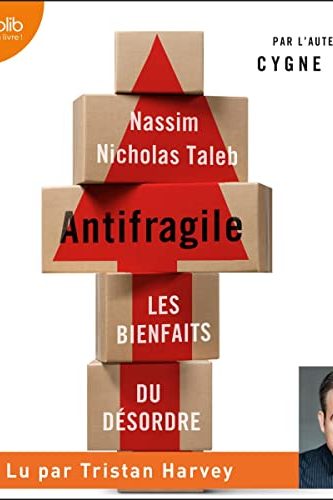
Things that gain from disorder — how to build a life, portfolio, and career that gets STRONGER when chaos hits.
📖 OPEN THE FULL INTERACTIVE BREAKDOWN →🌐 Read it in Hindi, Hinglish, Gujarati, Tamil & 22 more languages — free, with audio.
💡 The Big Idea
There is no word for the opposite of fragile — so Taleb invented one. Fragile things break under stress (a teacup); robust things resist it (a rock); ANTIFRAGILE things get BETTER from it (muscles, immune systems, evolution). Most of modern life is built fragile: single salaries, optimized supply chains, leveraged balance sheets, careers with one big client — smooth on calm days, catastrophic on wild ones. The antifragile alternative: the barbell (extreme safety on one side, aggressive small bets on the other), optionality (positions with small downside and huge upside), skin in the game (never trust advice from people who don't share the consequences), and via negativa (improvement by removal — subtract the fragilizers before adding anything). Volatility isn't the enemy; hiding from it until it arrives all at once is.
🧠 The 6 Key Lessons
Lesson 1: Fragile, Robust, Antifragile: Know Which One You Are
Book I: The Antifragile — An Introduction
Everything can be sorted into Taleb's triad. FRAGILE: harmed by volatility — it needs tranquility, predictability, and gets destroyed by surprises (a leveraged bank, a one-client freelancer, a glass vase labeled 'handle with care'). ROBUST: indifferent to volatility — shocks bounce off but don't improve it (a rock, a diversified index fund). ANTIFRAGILE: NEEDS volatility to thrive — stress makes it stronger, and protecting it from stress makes it weak (muscles atrophy without load, immune systems weaken in sterile rooms, children raised without any failure collapse at the first real one). The most important audit you'll ever run: go through your income, health, relationships, and skills and honestly label each one. Most people discover their life is a teacup that has simply been lucky about earthquakes.
📖 Example: The restaurant industry versus the banking industry. Individual restaurants fail constantly — and that constant failure makes the RESTAURANT ECOSYSTEM antifragile: every closure teaches the survivors, cuisine keeps improving, and no single bankruptcy… Read the full example →
⚡ Do this: Make three columns — Fragile / Robust / Antifragile — and place your top 5 life dependencies (income sources, key skills, health habits, main relationships) into them honestly. For every entry in the Fragile column, write one concrete step that moves it rightward this month.
Lesson 2: The Barbell: Extreme Safety + Wild Bets, Nothing in the Middle
Book IV: Optionality, Technology, and the Intelligence of Antifragility
The 'moderate risk' middle path is a lie — because moderate risk is usually mismeasured risk wearing a calm face. Taleb's barbell strategy: put 85-90% of your resources in things that are maximally safe (cash, treasury bills, an unglamorous stable skill) and 10-15% in things that are maximally aggressive with capped downside (startups, options, side projects, learning weird skills) — and NOTHING in the deceptive middle (like 'medium-risk' funds that quietly hide blow-up risk). The safe side guarantees you survive any disaster; the wild side exposes you to unlimited upside. Your worst case is known and survivable; your best case is unbounded. Compare that to the middle path, where the worst case is secretly fatal and the best case is mediocre.
📖 Example: A writer with a day job is a barbell: the boring job (safe side) means no bill can kill them, while nights spent writing novels (wild side) cost little but could produce a bestseller — capped downside, unlimited upside. Kafka worked at an insurance office;… Read the full example →
⚡ Do this: Restructure one domain as a barbell this week: in money (90% boring index/FD, 10% aggressive bets you can afford to lose to zero), or career (keep the stable job, but spend 5 hours a week on a high-upside side project). Kill one 'moderate risk' position that is neither safe nor explosive.
Lesson 3: Skin in the Game: Never Trust a Prophet Who's Not Exposed
Book VII: The Ethics of Fragility
The world's most dangerous people are those who get the upside of their advice while you get the downside: analysts who don't own the stock they push, consultants paid whether the strategy works or not, forecasters never audited on their forecasts, politicians whose wars are fought by other people's kids. Antifragility at someone else's expense is theft. Taleb's filter is brutal and clarifying: before taking ANY advice, ask what the advisor personally loses if they're wrong. If the answer is 'nothing,' their opinion is entertainment, not information. The ancients understood: Roman engineers had to sleep under the bridges they built. Hammurabi's code executed the builder if the house collapsed on its owner. Modern life removed the sleeping-under-the-bridge clause — you have to add it back yourself.
📖 Example: The 2008 crisis as a skin-in-the-game massacre: mortgage brokers earned commissions on loans they'd never hold, banks packaged the risk and sold it away within weeks, rating agencies were paid by the very issuers they graded AAA, and executives collected… Read the full example →
⚡ Do this: Audit your top 3 sources of advice (financial advisor, favorite guru, that confident friend). Write down what each one loses if their advice fails you. Fire — or heavily discount — anyone whose answer is 'nothing,' and find one advisor who eats their own cooking.
Lesson 4: Via Negativa: Get Rich by Subtraction
Book VI: Via Negativa
We're addicted to addition — new habits, new supplements, new apps, new strategies. But knowledge of what's WRONG is more durable than knowledge of what's right, so the most reliable improvement is removal: the smoker gains more by removing cigarettes than by adding any medicine on earth; the investor gains more by removing leverage than by finding better stock picks; the schedule gains more by removing three fake commitments than by adding a productivity system to survive them. Subtraction is antifragile because you can't be wrong about much — removing a harm has a known benefit, while adding an intervention has unknown side effects. The fastest way to improve almost any system is to find the fragilizing element and delete it.
📖 Example: Taleb's health heuristic: instead of adding the newest superfood or biohack, remove the new things evolution hasn't tested — added sugar, ultra-processed food, chronic sitting, doomscrolling — and keep the ancient stressors that make bodies antifragile:… Read the full example →
⚡ Do this: This week, improve by pure subtraction: remove ONE thing from each of three areas — one recurring expense that buys fragility, one commitment that exists only from guilt, and one daily digital habit that adds volatility to your mood. Add nothing for 30 days and watch what improves.
Lesson 5: The Turkey's Mistake: Avoid Fragility in Your Own Life
Part 3: The Applications
Taleb's turkey is fed for 1,000 days, growing fatter and more confident each day — until day 1,001, which is Thanksgiving. The turkey's mistake is mistaking the absence of evidence of danger for evidence of absence. The antifragile lesson for life: identify where you are a turkey — the situation that has gone smoothly so long that you've forgotten it can end — and build exposure-reduction before the calendar flips. This applies to single-income dependence, market positions that 'only go up', relationships taken for granted. Fragility hides in smoothness; the most dangerous place is where nothing has gone wrong lately.
📖 Example: Taleb points to people who spent decades in 'safe' careers and markets, then hit one event — an industry collapse, a health crisis, a downturn — that wiped out the accumulated confidence of all those smooth years. The smoothness itself was the signal. Read the full example →
⚡ Do this: Run a 'turkey audit' on your life: what has been going smoothly for years without you stress-testing it? Put one small protection in place this month.
Lesson 6: Optionality: The Secret of the Antifragile Operator
Part 4: The Practice
Taleb's most empowering concept: optionality is the ability to benefit from upside while limiting downside — the venture capitalist who backs 20 startups (19 fail cheaply, 1 returns the fund), the person who learns a new skill that might open doors (costs little, could change everything). Antifragile operators don't need to predict; they need asymmetry. Their strategy: take actions with small, known downsides and large, unknown upsides, and refuse actions with the reverse. The practical test for every decision: 'What's the worst case, and can I afford it? What's the best case, and would it matter?' If the answer is yes and yes — take the option.
📖 Example: Taleb notes how writers, investors and entrepreneurs who say yes to many small uncertain opportunities — talks, experiments, side projects — inevitably stumble into the one that changes everything. They didn't predict it; they were simply never fully exposed… Read the full example →
⚡ Do this: Before your next three decisions, write the worst case and best case. Take the decision with a survivable worst case and a life-changing best case — even if it's uncertain.
✅ 5-Step Action Plan
- Label your life's top dependencies Fragile / Robust / Antifragile — move one item rightward each month.
- Build the barbell: 85-90% maximum safety, 10-15% capped-downside wild bets, nothing in the muddy middle.
- Apply the skin-in-the-game filter: discount all advice from people who lose nothing when wrong.
- Practice via negativa monthly: remove one fragilizer (debt, commitment, habit) before adding anything new.
- Collect options: favor choices with small known downside and large open upside — then let volatility work for you.
⚠️ When This Doesn't Work
Taleb's antifragility is the most important risk concept of our time — and Three Arrows Capital is its perfect negative: a fund built to be antifragile — hedged, diversified, crisis-proof on paper — that used leverage so extreme it was fragile at every layer, and blew up the moment markets moved. You cannot be antifragile while being leveraged; leverage is the opposite of optionality. Taleb's own warning applies to readers of Taleb: don't mistake the vocabulary for the hedge.
💀 The Graveyard Proves It
🏹 Three Arrows Capital — $10B Crypto Fund, Zero Risk Management. Burn: $10B fund → bankruptcy; founders fled. Read the full case study →
💬 Best Quotes from Antifragile
- “Wind extinguishes a candle and energizes fire.”
- “The absence of evidence is not evidence of absence.”
- “If you see fraud and do not say fraud, you are a fraud.”
Interactive version: mark lessons as read, listen in your language, share quote cards.