Library › Business & Startups
The 10X Rule — Summary & Key Lessons
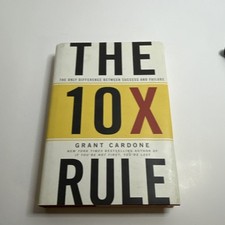
The only difference between success and failure — set targets 10 times bigger and take 10 times the action.
📖 OPEN THE FULL INTERACTIVE BREAKDOWN →🌐 Read it in Hindi, Hinglish, Gujarati, Tamil & 22 more languages — free, with audio.
💡 The Big Idea
Cardone's thesis is a double correction: people set targets too LOW (average goals produce average effort — and 'average' in Cardone's math is a failing formula because everyone underestimates the effort required), and then take too little ACTION (the real 10X is the effort side: whatever you think a goal requires, budget ten times the calls, attempts, follow-ups, and years). His framework: success is your DUTY (not a preference — treating it as optional is why it stays optional), there is no shortage of success (it's created, not competed for), take MASSIVE ACTION (the fourth degree of action, past 'doing nothing,' 'retreating,' and the most dangerous level — 'normal levels'), dominate your sector rather than compete in it, and treat fear as the signal to act faster. Controversial, hyperbolic, and — for the chronically under-aiming — exactly the calibration slap required.
🧠 The 6 Key Lessons
Lesson 1: The 10X Target: Aim Higher Because Low Aims Lie
Chapters 1–4: What Is the 10X Rule / Why Average Fails
Cardone's diagnosis of failure's root: not laziness but MIS-CALIBRATION — people set 'realistic' targets (calibrated to look achievable, to avoid disappointment, to fit others' expectations), then discover even those require far more effort than estimated, run out of fuel, and quit demoralized. The 10X correction attacks both ends: set targets TEN TIMES your instinct (the 10X goal excites enough to survive the grind — small goals can't generate big energy; and even 'failing' a 10X goal typically lands beyond the 1X target), and simultaneously budget TEN TIMES the effort your estimate suggests (the estimate is always wrong, always in the same direction). His supporting law: NEVER REDUCE THE TARGET — when progress stalls, the amateur shrinks the goal to protect feelings; the professional multiplies the actions. Average, he hammers, only looks safe: average marriages, savings, and businesses are all one surprise away from crisis — 'realistic' is just pre-negotiated surrender.
📖 Example: Cardone's own ledger supplies the exhibits: his first business took years longer and multiples more effort than every projection — the 10X effort estimate, he insists, wasn't philosophy but post-mortem arithmetic. His sales-floor version: the rep targeting 2… Read the full example →
⚡ Do this: Take your current #1 goal and write its 10X version (income, users, reach — whatever the metric). Don't commit to the number yet — commit to the QUESTION: 'what system would the 10X version force me to build?' Then build the first component of that system this week.
Lesson 2: Success Is Your Duty — and There's No Shortage of It
Chapters 5–7: Duty / No Shortage / Assume Control
Two mindset renovations. DUTY: treating success as optional — a preference, a 'nice to have' — guarantees under-investment; Cardone demands the ethical reframe: succeeding at your potential is a DUTY owed to your family, your future, and everyone your capability could serve — approached 'the way a mother approaches protecting her child': non-optional, non-negotiable, no fallback position entertained (fallback plans, he argues, are quiet instructions to fail toward). NO SHORTAGE: success isn't a limited commodity others deplete — it's CREATED, not competed for (a scarcity view breeds envy, copying, and permission-seeking; the abundance view breeds production). CONTROL: the companion habit is radical responsibility — treat everything that happens to you, including the 'unfair,' as yours to respond to ('I decide,' not 'it happened'): victims and creators, in Cardone's binary, are separated not by circumstances but by which sentence they rehearse.
📖 Example: Cardone's duty exhibit is his own origin: aimless and addicted at 25, the turnaround began — by his telling — with reclassifying success from wish to obligation, treating sales calls with the mother-and-child seriousness his previous self reserved for… Read the full example →
⚡ Do this: Write the duty statement: WHO specifically is owed your success (family, team, future self), and what it costs them when you under-aim. Post it where the snooze button lives. And run the control swap for one week: every 'it happened to me' sentence gets rewritten as 'here's my response.'
Lesson 3: The Four Degrees of Action — Choose Massive
Chapters 8–9: The Four Degrees / Massive Action
All people operate at one of four action levels: (1) DO NOTHING (obvious), (2) RETREAT (act in reverse — avoid, shrink, protect), (3) NORMAL LEVELS (the most dangerous — because it looks responsible: average effort producing average results, fully camouflaged as diligence; the level society trains, employers accept, and mediocrity requires), and (4) MASSIVE ACTION — the 10X native level: activity so far beyond normal that it creates 'new problems' (too many leads, too much demand, criticism from the normal-level crowd — problems Cardone calls the SIGN you're at level four). His operational rules: act despite fear (fear is the indicator of exactly what to do next, and it grows with delay — 'starve the fear of its favorite food: time'); make your presence UNAVOIDABLE in your market (omnipresence as strategy); and treat criticism as confirmation — 'when people start criticizing your level of action, you're on the right track': level-three people always attack level-four behavior, because it exposes the camouflage.
📖 Example: Cardone's real-estate arc demonstrates level four: while competitors sent occasional mailers, he called, mailed, visited, and followed up at rates the industry called excessive — building holdings through sheer contact volume during the exact years… Read the full example →
⚡ Do this: Grade yourself honestly (1–4) in each major domain: career, health, relationships, money. For your most important domain, define what LEVEL FOUR would look like this week (usually: 10X the outreach/attempts/reps) — and do one level-four day. Note both results and who criticizes; both are data.
Lesson 4: Obsession, Omnipresence & Burning the Excuse List
Chapters 10–23: Obsession / Expand, Never Contract / Excuses
The closing chapters install the operating culture. OBSESSION: society medicates what it should celebrate — being 'obsessed' with your mission is, in Cardone's frame, the only appropriate relationship to a 10X target ('until you become completely obsessed with your mission, no one will take you seriously'). EXPAND, NEVER CONTRACT: in fear cycles (recessions, setbacks), the herd retreats — cuts marketing, hoards, waits; the 10X move is counter-cyclical expansion, buying attention and market share at the exact moment they're cheapest. OMNIPRESENCE: the goal is to be EVERYWHERE your market looks — content, calls, mail, events — until your name is the category's wallpaper. And the EXCUSE demolition: Cardone's list of success myths ('I don't have time/money/connections,' 'the market's bad,' 'I'll do it later') gets one uniform answer — excuses are chosen narratives that always cost more than the effort they avoid; the excuse list and the 10X life cannot coexist, so one must be burned, publicly, today. The book's final calibration: whatever you're currently doing — 10X the target, 10X the action, and 10X the timeline patience.
📖 Example: The counter-cyclical exhibit Cardone rides hardest: 2008 — while competitors slashed marketing to survive, he multiplied output (content, seminars, calls), on the logic that attention was suddenly discounted and rivals voluntarily silent; the post-crisis… Read the full example →
⚡ Do this: Burn the list: write your five most-used excuses verbatim, then beside each, the action it has been protecting you from — do one of those actions within 48 hours. And pick your omnipresence lane: for 90 days, show up in your market DAILY (one post, one call batch, one appearance) — wallpaper is hung one sheet at a time.
Lesson 5: Massive Action: The Only Force That Overcomes Fear
Part 2: The Action
Cardone's law: fear and doubt are never conquered by thinking — they are drowned by action. When you take massive action, the anxiety that paralyses you at normal volume becomes irrelevant, because momentum takes over. The 10X principle applied to fear: whatever action you think is needed to overcome an obstacle, multiply it by ten — more calls, more outreach, more reps, more attempts — and the fear doesn't disappear, it simply gets outrun. People who appear fearless are not; they are just acting at a volume where fear can't keep up. Action is not the reward for confidence; confidence is the reward for action.
📖 Example: Cardone describes his early real estate days: while competitors made one follow-up call, he made twenty, even when terrified of rejection. The volume of action did what courage alone never could — it produced enough yeses to outweigh the pain of the noes. Read the full example →
⚡ Do this: Pick one fear-driven activity. Set a target of 10X your usual attempts this week (10 calls instead of 1, 10 drafts instead of 1) and just execute.
Lesson 6: The 10X Commitment: Quitting Is Not an Option on the List
Part 3: The Commitment
Cardone's most uncomfortable lesson: average people treat quitting as a legitimate option; 10X people remove it from the menu entirely. Not because they never fail — but because they've decided that failure is a step, not a destination. The 10X commitment means setting a goal so big it forces you to grow, then committing to it at a level that makes quitting as costly as continuing. This is the difference between 'trying' and 'doing': trying keeps the exit door open; doing locks it. When quitting is not an option, your brain stops spending energy on escape routes and starts finding solutions.
📖 Example: Cardone shares how committing publicly to huge sales goals — telling his team and his family the number — made retreat impossible, and the impossibility of retreat produced the creativity and drive that normal goal-setting never did. Read the full example →
⚡ Do this: Take one current goal and publicly commit to it — tell three people the specific target and deadline. Remove the quiet exit.
✅ 5-Step Action Plan
- Write the 10X version of your #1 goal; build its first system component.
- Post the duty statement; run the control-swap week.
- Grade your four degrees; execute one level-four day.
- Expand where others contract; start the 90-day omnipresence streak.
- Burn the excuse list — one protected action done in 48 hours.
⚠️ When This Doesn't Work
Cardone's '10x your goals, 10x your action' is rocket fuel — and Bird is its crash site: the fastest-growing startup in history, 10x expansion across 100+ cities in 12 months, $2 billion in funding — and unit economics that lost money on every single ride. 10x action on a broken model is 10x the burn. The book never asks the question that matters: 10x WHAT? Scale amplifies everything, including the flaw.
💀 The Graveyard Proves It
🛴 Bird Scooters — Fastest Startup to $1B — and to Penny Stock. Burn: $2.5B valuation → bankruptcy. Read the full case study →
💬 Best Quotes from The 10X Rule
- “Success is your duty, obligation, and responsibility.”
- “Never reduce a target. Instead, increase actions.”
- “Average is a failing formula.”
Interactive version: mark lessons as read, listen in your language, share quote cards.