Library › Business & Startups
$100M Offers — Summary & Key Lessons
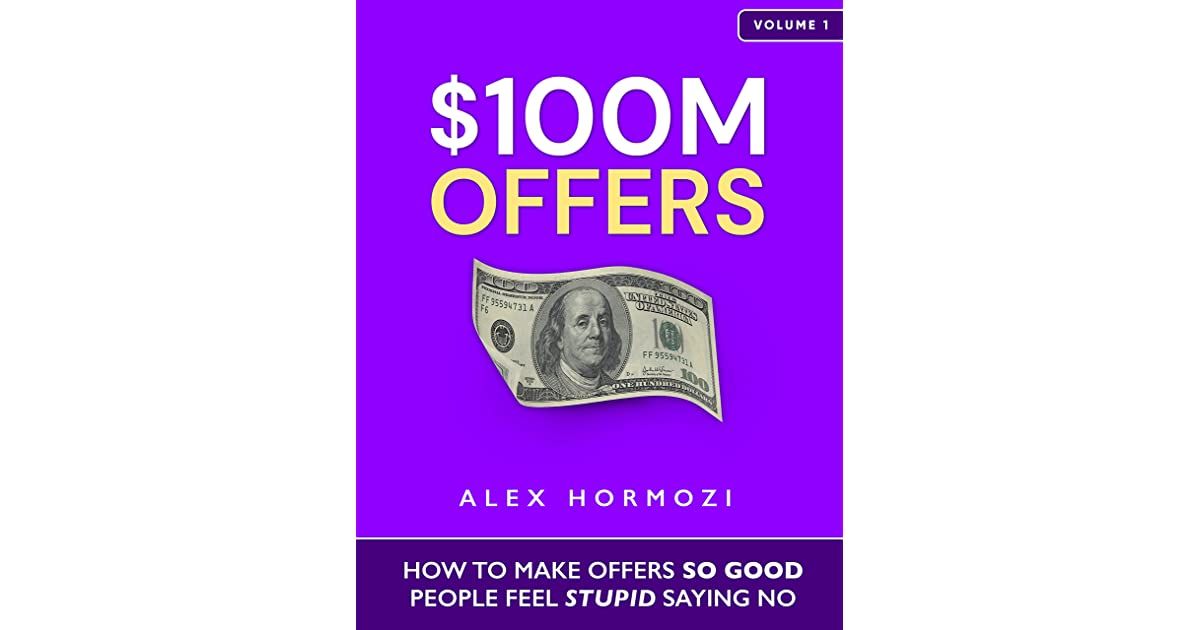
How to make offers so good people feel stupid saying no — the Grand Slam Offer playbook.
📖 OPEN THE FULL INTERACTIVE BREAKDOWN →🌐 Read it in Hindi, Hinglish, Gujarati, Tamil & 22 more languages — free, with audio.
💡 The Big Idea
Most businesses are commodities: comparable products in comparable markets, forced into price wars. Hormozi's escape is the Grand Slam Offer — a combination of promise, value stack, guarantee, scarcity, and naming so differentiated it creates a category of one. The value equation drives everything: Value = (Dream Outcome × Perceived Likelihood of Achievement) ÷ (Time Delay × Effort and Sacrifice). Raise the top, crush the bottom, charge premium prices — because price is what makes clients commit, businesses invest in delivery, and results actually happen. Sell to starving crowds, stack bonuses, reverse risk, and never be a commodity again.
🧠 The 6 Key Lessons
Lesson 1: Escape the Commodity Trap
Section I–II: How We Got Here / Pricing
A commodity is anything bought by comparison — and if prospects can compare you, they'll pick the cheapest. The Grand Slam Offer breaks comparison by bundling a differentiated promise, terms, guarantee, and experience nobody else offers: prospects face a 'category of one' decision (take this unique thing or leave their problem unsolved), not a price lineup. This flips the growth math: instead of winning slightly more of a price war, you sell at 5–10x market rates to fewer, better clients — with margins that fund real service, real ads, and real growth. Hormozi's rule: if your market can price-shop you in under a minute, you don't have an offer — you have a listing.
📖 Example: Hormozi's agency-era case: gym owners selling generic memberships at $99 competed with every gym on the block. His Gym Launch model repackaged the SAME fitness service as a '6-Week Challenge' with meal plans, accountability, guarantees, and financing —… Read the full example →
⚡ Do this: Answer honestly: can a prospect compare your offer to three competitors in five minutes? If yes, list the five components you could bundle to make comparison structurally impossible.
Lesson 2: Pick a Starving Crowd
Section II: The Right Market
The market beats the marketing: a great offer in a dying market drowns; an average offer in a ravenous one prints. Four indicators of a market worth entering: massive PAIN (they need it, not want it — painkillers beat vitamins), PURCHASING POWER (broke audiences with big problems still can't pay), easy to TARGET (findable in channels, groups, lists), and GROWING (tailwinds beat headwinds). Then niche down relentlessly: 'riches are in the niches' because the same product, renamed and repositioned for a specific avatar, commands multiples of the generic price. Commit to one avatar until you've proven the offer — serial niche-hopping resets learning to zero.
📖 Example: Hormozi's pricing ladder for identical content: a generic 'Time Management' course sells for $19; 'Time Management for Sales Professionals' for $99; 'Time Management for B2B Outbound Sales Reps' for $499; 'Time Management for Power Company B2B Outbound Reps'… Read the full example →
⚡ Do this: Score your current market 1–10 on pain, purchasing power, targetability, and growth. Below 28 total? Reposition. Then narrow your avatar one full level and rewrite your headline for exactly that person.
Lesson 3: The Value Equation
Section III: Value — Create Your Offer
Value = (Dream Outcome × Perceived Likelihood of Achievement) ÷ (Time Delay × Effort & Sacrifice). Most businesses only shout about the dream outcome — the weakest lever, since competitors promise the same dream. The pros work all four: raise perceived likelihood with proof, guarantees, and process transparency; crush time delay with fast wins engineered into week one (the client who sees results in 7 days stays for years); crush effort/sacrifice by doing more FOR the client (done-for-you beats done-with-you beats do-it-yourself). The theoretical endpoint: pay money, get outcome instantly, with zero effort — every step your offer takes toward that ideal multiplies what you can charge.
📖 Example: Why does liposuction cost 100x a gym membership? Same dream outcome (a lean body) — but surgery collapses the denominator: weeks not years (time), unconscious not sweating (effort). Hormozi's software analogy: 'meal plans' (effort required) versus 'we… Read the full example →
⚡ Do this: Write your offer's four variables on one page. For each: one concrete upgrade (one more proof element, one week-one quick win, one task you take off the client's plate). Reprice after.
Lesson 4: Stack the Offer: Problems → Solutions → Vehicles
Section III: The Offer Creation Process
Grand Slam construction, step by step: (1) List EVERY problem your client hits before, during, and after using your product — dozens, tiny included (each unsolved problem is a sale-killer hiding in the shadows). (2) Convert each problem into a solution statement ('how to X without Y'). (3) Brainstorm delivery vehicles for each solution (1-on-1, group, templates, software, done-for-you) and keep the ones balancing high value with low cost to you. (4) Bundle them into a named stack where each component gets its own price-anchor — so the total 'value' dwarfs the price. The psychology: one product is an offer; a stack of named solutions to every foreseeable obstacle is an EVENT.
📖 Example: The weight-loss stack Hormozi walks through: not 'a fitness program' but — custom meal plan ($497 value), grocery lists ($97), restaurant survival guide ($47), travel workout guide ($97), accountability coach ($997), weekly check-ins ($497), plateau-breaking… Read the full example →
⚡ Do this: Run the four steps this week: 30+ problems listed, each converted to a solution, each given a vehicle, all stacked with individual value-anchors and one collective name.
Lesson 5: Guarantees: Reverse the Risk
Section IV: Enhancing Your Offer — Guarantees
The biggest silent objection is risk — 'what if it doesn't work for ME?' Guarantees answer it structurally. Hormozi's menu: unconditional (any reason, money back — highest conversion lift, some abuse), conditional (money back IF you did the work — protects you, filters for committed clients), anti-guarantee ('all sales final — because this is that powerful' — for high-intimacy services), and performance-based (pay from results — the strongest possible signal). The advanced move: make the guarantee BIGGER than the price ('results or I pay for your flights home'), because the seller who bets on the outcome is the only one the buyer fully believes. Weak offers hide from risk; Grand Slam offers absorb it — profitably, since increased conversions outearn increased refunds.
📖 Example: Hormozi's gym guarantee: 'Complete the 6-week challenge, follow the steps, and if you don't hit your result, you get every dollar back — AND keep the bonuses.' Owners panicked about refund abuse; data showed conversions jumped far more than refunds did, and… Read the full example →
⚡ Do this: Draft the strongest guarantee you can survive: name the outcome, the timeframe, the conditions, and the payout. If saying it out loud scares you a little, it's probably calibrated right.
Lesson 6: Scarcity, Urgency & Naming
Section IV: Scarcity, Urgency, Bonuses, Naming
People want what they can't have and act only on deadlines. Scarcity limits QUANTITY (only 5 client slots monthly — honest, since your delivery capacity IS limited); urgency limits TIME (cohort starts Monday; price rises Friday; bonus expires at midnight). Both must be REAL — fake countdown timers train your market to ignore you. Bonuses beat discounts: never drop price; add named value instead (discounting teaches buyers to wait; bonusing teaches them to hurry). Finally, naming: the M-A-G-I-C formula — Magnetic reason why, Avatar called out, Goal stated, Interval defined, Container word ('The 6-Week Executive Shred Challenge' beats 'personal training packages' forever). Rename and relaunch the same offer seasonally, and it performs like new.
📖 Example: The economics of why bonuses beat discounts, per Hormozi: cutting a $500 price by $100 costs you $100 of pure margin and cheapens the brand; adding a $200-value template bundle that costs you $5 to deliver raises perceived value by $200 at 2.5% of the cost.… Read the full example →
⚡ Do this: Install one honest scarcity (real capacity limit) and one honest urgency (real start date) this month. Kill your next planned discount; replace it with two named, cheap-to-deliver, high-value bonuses. Rename your core offer with M-A-G-I-C.
✅ 5-Step Action Plan
- Break comparability: bundle until price-shopping you becomes impossible.
- Score and niche your market; rewrite the headline for one exact avatar.
- Upgrade all four value-equation variables; reprice upward.
- Build the full problem→solution→vehicle stack with a named guarantee.
- Add real scarcity/urgency; swap discounts for named bonuses.
⚠️ When This Doesn't Work
Hormozi's offer-stacking brilliance has a failure mode: a magnificent offer backed by delivery that can't keep the promise. Olive AI sold the most compelling offer in healthcare tech — 'AI that does your admin' — to the biggest buyers, and collapsed when the product couldn't deliver what the offer implied. A great offer is a promise; the business is the keeping. Stack value in the offer, then stack proof in the delivery, in that order.
💀 The Graveyard Proves It
🫒 Olive AI — $4B Healthcare 'AI' That Hospitals Quietly Returned. Burn: $850M raised → fire-sale shutdown. Read the full case study →
💬 Best Quotes from $100M Offers
- “Make people an offer so good they would feel stupid saying no.”
- “Charge as high a price as you can say out loud without cracking a smile.”
- “The market you're in will determine your success more than anything else.”
Interactive version: mark lessons as read, listen in your language, share quote cards.