Library › Self-Improvement
The Way of the Peaceful Warrior — Summary & Key Lessons
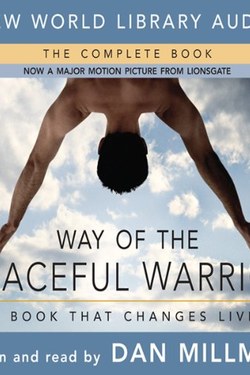
A champion gymnast meets a gas-station mystic — the classic parable of the present moment.
📖 OPEN THE FULL INTERACTIVE BREAKDOWN →🌐 Read it in Hindi, Hinglish, Gujarati, Tamil & 22 more languages — free, with audio.
💡 The Big Idea
Socrates, a mysterious mechanic, takes Dan — a talented, miserable gymnast — through a brutal curriculum: empty your mind, live in the present, eat and train deliberately, and let go of the need to win. The final teaching dissolves the search itself: there is never a moment when you are done becoming. The book is a fable, but its practices — presence, breathing, acceptance, the body as teacher — are real and famously effective.
🧠 The 9 Key Lessons
Lesson 1: The Mind Is Full of Garbage
Chapter 1: The Clearing
Socrates' first assignment is brutal: notice how much of your mental life is noise — replayed pasts, rehearsed futures, commentary on everything. His instruction: when you walk, only walk; when you lift, only lift. The compulsion to fill every moment with thought is the addiction; the practice is to let attention rest on one thing.
📖 Example: A walk with a phone in your ear is a rehearsal and a rerun; a walk where you only walk becomes oddly spacious. Read the full example →
⚡ Do this: One meal today with no phone, no book, no chatter — just the eating.
Lesson 2: The Present Is All There Is
Chapter 2: Now
The book's central reframe: neither past nor future exists — only now, and the quality of your now is the quality of your life. Regret and anxiety are both absences from the present. Socrates' test is physical: feel the soles of your feet, the breath, the weight — and the 'now' appears.
📖 Example: The best athletic performances are famously 'in the zone' — a state so present there is no self left to be nervous. Read the full example →
⚡ Do this: Set three alarms today labelled NOW: when they ring, one breath, feet on the floor, full presence.
Lesson 3: The Body Is the Teacher
Chapter 3: The Temple
Millman's curriculum is physical: the body is not a vehicle for the mind but a teacher of it. Training that is done attentively — feeling each movement — trains attention itself. This is why disciplines (martial arts, gymnastics, yoga) are spiritual paths: the body cannot fake presence; it demands it.
📖 Example: A gymnast who watches his hands during practice is meditating in motion; the same practice, daydreaming, builds nothing. Read the full example →
⚡ Do this: Choose one physical practice (walk, lift, swim) and do it weekly — feeling, not performing.
Lesson 4: Eat Like a Warrior
Chapter 4: The Discipline
Socrates gives Dan a weird, exacting diet — not for fashion, but for attention: food chosen and eaten deliberately, meals as meditation. The true discipline is not what you eat but whether you eat with awareness. Millman's point generalises: any habitual act done consciously becomes a training ground for the whole life.
📖 Example: The person who eats slowly and gratefully is training attention at the table; the autopilot eater is training absence. Read the full example →
⚡ Do this: Eat one meal per day slowly, savouring each bite — the warrior's table practice.
Lesson 5: The Search Ends in the Present
Chapter 5: No More Searchers
The book's famous ending: after years of seeking, Dan asks what comes next — and Socrates replies that he is the teacher now, and the search continues by being, not seeking. The ultimate lesson: there is no graduation; the peaceful warrior is a beginner forever, and the path is the destination.
📖 Example: People who 'find themselves' at retreats get lost again at the airport — the practice is the path. Read the full example →
⚡ Do this: Drop one 'I will be happy when…' and find one thing to fully inhabit now.
Lesson 6: The Dojo Is the Day
Part 3: The Warrior's Art
Millman's final teaching is that the whole curriculum — presence, breath, service, humility — becomes real only in ordinary life. Socrates' test was deliberately mundane: wash the dishes as if they were the most important task in the world; sweep the floor like a warrior. The dojo is not the gym; it is the day.
📖 Example: The student who meditated beautifully on the mat and snapped at the driver on the way home was doing posture, not practice. Read the full example →
⚡ Do this: Pick one daily chore and do it this week as your dojo — full attention, no phone, no rush, no audience.
Lesson 7: The Three Gates: What, When, How
Part 2: The Warrior's Training (The Gates)
Socrates' training famously passes Dan through gates — the doorways of the mind, the heart and the body. The first gate's lesson: you cannot think your way into feeling or act your way into being — the three must line up, and attention is the key that opens them in order. The mind gate (what you think), the heart gate (what you feel), the body gate (what you do) have to be in agreement, and the agreement is built one honest act at a time.
📖 Example: Dan could think the philosophy (mind), but his body had not yet done the work — the gates only opened upward from the body. Read the full example →
⚡ Do this: Tag one problem with three gates: what do I tell myself (mind), what do I feel (heart), what am I doing (body)? Fix the most neglected gate first.
Lesson 8: The Brick Wall: The Obstacle Course of the Self
Part 3: The Battle (The Wall)
The book's most famous physical metaphor: when Dan hits the brick wall, Socrates reminds him that the wall is not the obstacle — the wall is the point. Every practice, every failure, every boring repetition is mortar for the wall, and the warrior's relationship with it is not to smash it but to build with it. The obstacle is not in the way; the obstacle IS the way.
📖 Example: The gymnast stuck on the same routine for months is not blocked — she is building the exact strength the routine will need. Read the full example →
⚡ Do this: Name your brick wall: the one thing you keep avoiding or failing at. Reframe it for one week as your curriculum, not your enemy.
Lesson 9: The Sword: The Work Continues
Part 4: The Liberation
The book ends not with arrival but with the sword — and with the lesson that the peaceful warrior's peace is not the absence of struggle but the absence of resistance to it. Dan does not win; he becomes the kind of person who can keep going, and that is the liberation. The warrior is not the one who has no battles left — he is the one who meets the next battle without fear because his practice is indistinguishable from his life.
📖 Example: After everything — the accident, the training, the revelation — Dan's final scene is simply the next practice, the next morning. Read the full example →
⚡ Do this: Write your own closing scene: not winning, but the one practice you will keep no matter what. Then do it tomorrow at the same time.
✅ 5-Step Action Plan
- One phone-free meal daily.
- Three NOW alarms: breath, feet, presence.
- One weekly physical practice done with full feeling.
- One planned mindful meal a day for 30 days.
- Give up one 'when…' and inhabit one thing now.
⚠️ When This Doesn't Work
It is a novel — inspiring but not evidence; the surgery scenes and the guru are fiction, and some teachings are mystical rather than measurable. The presence practices are real; the mysticism is optional.
💀 The Graveyard Proves It
🐦 The Flappy Bird Removal — The Game That Made Its Creator Rich and Then Disappeared Overnight. Burn: $50,000 a day in revenue, abandoned — one creator's guilt over what he had built Read the full case study →
💬 Best Quotes from The Way of the Peaceful Warrior
- “The warrior is not someone who wins; the warrior is someone who is awake.”
- “There are no ordinary moments.”
- “The past is like a dream; the future is a vision — the present is all there is.”
Interactive version: mark lessons as read, listen in your language, share quote cards.