Library › Psychology & People
My Experiments with Truth — Summary & Key Lessons
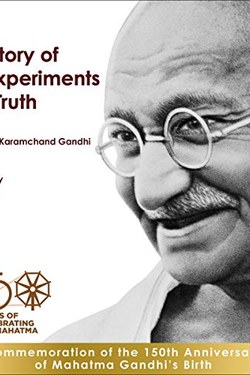
Gandhi's autobiography — not of a saint, but of a man testing truth in diet, family, politics and power.
📖 OPEN THE FULL INTERACTIVE BREAKDOWN →🌐 Read it in Hindi, Hinglish, Gujarati, Tamil & 22 more languages — free, with audio.
💡 The Big Idea
Gandhi called this book 'an autobiography of my experiments with truth' — nothing less, because he genuinely treated life as a laboratory: diet experiments, celibacy experiments, simplicity experiments, non-violence experiments. Its radical power is the refusal to separate the personal from the political — he reformed his own kitchen, his household and his pride before he reformed a nation. The book is not a saint's story; it is a scientist's diary of self-transformation, full of admitted failures, which is exactly why it still teaches.
🧠 The 10 Key Lessons
Lesson 1: Truth Is a Laboratory Practice
Part 1: The Experiments
Gandhi's method was startlingly modern: state a hypothesis, act, observe, record, revise. His experiments were moral (ownership of possessions, eating to live vs living to eat, promises kept) and his failures are written in as honestly as his successes. The lesson: integrity is not a fixed state but an ongoing experiment — and self-observation is its first instrument.
📖 Example: He gave up milk after watching the way it was obtained — an experiment in compassion that changed his health and his household. Read the full example →
⚡ Do this: Treat one of your principles as a hypothesis this month: state it, test it in a real situation, record what happened.
Lesson 2: The Small Is the Political
Part 2: Self-Rule
Swaraj (self-rule) for Gandhi began at home: he cleaned his own toilets, spun his own cloth, and put his own family under the same rules as the nation. The profound teaching: you cannot demand of the world what you do not practise yourself. Personal reform is the precondition — not the decoration — of social change.
📖 Example: A leader who preaches austerity and lives lavishly has, in Gandhi's frame, already lost the argument. Read the full example →
⚡ Do this: Pick one domain where you hold a public standard — and bring your own behaviour up to it this month.
Lesson 3: Fear and Its Antidotes
Part 3: Courage
Gandhi repeatedly faced violence, imprisonment and personal risk — and defined his method as the conquest of fear, not its absence. He was explicit: fearlessness is the first requirement of spirituality, and the practice is to act rightly while afraid. His non-violence was not passivity; it was the disciplined refusal to be governed by fear or by retaliation.
📖 Example: In South Africa, facing mobs and prison, he wrote that the Truth force (satyagraha) works only when the fear of consequence has been surrendered. Read the full example →
⚡ Do this: Identify one action you avoid out of fear of consequence — and take one small step toward it today.
Lesson 4: Simplicity as Discipline
Part 4: The Plain Life
Gandhi's famous austerity was not performance — it was a system for preserving energy for what mattered. Each complexity he shed (foreign clothes, servants, spices, milk) returned time and attention to his work. The teaching is economic as much as moral: luxuries tax you in attention, and attention is the scarcest resource.
📖 Example: The fewer choices a monk makes about food, dress and schedule, the more capacity remains for the real work — the same reason modern focus warriors minimise decisions. Read the full example →
⚡ Do this: Remove one unnecessary complexity from your week (a subscription, a commitment, a thing) and spend the reclaimed hour on your core work.
Lesson 5: The Means Are the Ends
Part 5: The Method
Gandhi's most radical teaching: means and ends are inseparable — the path becomes the destination. His insistence on truthful means was not idealism; it was strategy, because methods determine the kind of world you build while building it. A nation won by lies is run by liars; a career built on shortcuts is lived in short cuts.
📖 Example: The Indian independence he won through non-violence produced a movement culture — whereas violent revolutions often reproduce their violence in the state. Read the full example →
⚡ Do this: For one goal, audit your methods: would the world you are building with these means be the world you actually want?
Lesson 6: The Family as Laboratory
Part 4: The Home Experiments
Gandhi's most honest pages are about his own household: experiments with diet, with his children's education, with his temper and with Kasturba's consent — many of which, he admits, did not succeed. Ahimsa begins where power is closest, and the failures closest to home are the humblest teachers of all.
📖 Example: Gandhi wrote frankly that he could not win his sons fully to his ideals — the most personal experiments fail first and teach most. Read the full example →
⚡ Do this: Run one experiment in your own family this month: apply your public principle at home, and record honestly what happens.
Lesson 7: The Diet as Laboratory (and Its Limits)
Part 2: Experiments in Diet
Gandhi's food experiments — raw food, fruit-only, salt-free, fasting — were genuine science carried out on himself, but the book is honest about their failures and about the cost they imposed on his family. The deeper lesson stands: self-experimentation is a legitimate method of self-knowledge, and the experimenter must record results honestly, especially when the experiment was a mistake.
📖 Example: His salt-free diet almost killed him in London and he abandoned it — the honesty of the record is the lesson, not the diet. Read the full example →
⚡ Do this: Run one controlled week-long experiment on yourself — sleep, food, screen time — with a written before/after ledger. Trust only the data.
Lesson 8: Truth Under Pressure: The Public Confession
Part 3: Truth in Public Life
Gandhi's most radical practice was public accountability: when he made an error, he announced it — to readers, to colleagues, to the world. The admission was not weakness but strategy: a movement built on truth could not survive a leader who hid. The personal version: tell the truth to those affected, quickly and fully, and the blow becomes smaller than the cover-up.
📖 Example: He published his own failings — including his treatment of Kasturba and his sons — in the very pages where he preached ideals; readers trusted him precisely because nothing was hidden. Read the full example →
⚡ Do this: Is there a truth you are currently managing? Say it — to the one person affected — this week. Watch the weight lift.
Lesson 9: The Price of the Experiment
Part 4: The Personal Cost
The book does not hide the cost of the truth experiment: his family bore the brunt — Kasturba's sacrifices, the sons' deprivation and rebellion. Gandhi the public man and Gandhi the father were often in conflict, and he records the conflict. The honest lesson is that great commitments have collateral, and the ethical question is not 'did it work?' but 'was the price paid willingly — and by whom?'.
📖 Example: The famous episode where his insistence on truth and simplicity made his household a battleground; he admits his failures as a father without excuse. Read the full example →
⚡ Do this: Before your next big commitment, ask: who else pays for this? Ask THEM, directly, before you decide.
Lesson 10: The Power That Is Not in Power
Part 5: The Satyagraha Method
Gandhi's final teaching is a complete inversion of power: strength that needs no weapons, no secrecy, no coercion. Satyagraha succeeds by being willing to suffer rather than to inflict. The method's engine is self-purification — the campaigner's own discipline is the weapon. Applied privately, the same method works in every conflict: refuse to escalate, refuse to degrade, stand with the truth and pay the price.
📖 Example: The Salt March, which defeated an empire with no violence, no weapons and no hatred — only disciplined suffering. Read the full example →
⚡ Do this: In your next conflict, try the satyagraha move: state the truth once, calmly, and refuse the fight. Let the truth work.
✅ 5-Step Action Plan
- Turn one principle into a tested hypothesis this month.
- Bring one personal behaviour up to your own public standard.
- Take one small step today against a fear of consequence.
- Remove one complexity and reclaim one hour for core work.
- Audit your means to one goal — and align them with the end you want.
⚠️ When This Doesn't Work
Gandhi's own life had criticisms he addresses incompletely — his experiments often failed, his views on caste and sexuality evolved slowly, and his austerity sometimes burdened his family. Read it as an honest diary of a fallible man, not as a flawless saint's manual.
💀 The Graveyard Proves It
🐅 Ramalinga Raju — Riding a Tiger, Not Knowing How to Get Off. Burn: ₹7,000 crore fake cash Read the full case study →
💬 Best Quotes from My Experiments with Truth
- “I claim to be a simple individual liable to err like any other fellow mortal.”
- “The difference between what we do and what we are capable of doing would suffice to solve most of the world's problems.”
- “In the attitude of silence the soul finds the path in a clearer light.”
Interactive version: mark lessons as read, listen in your language, share quote cards.