Library › Self-Improvement
The Inner Game of Tennis — Summary & Key Lessons
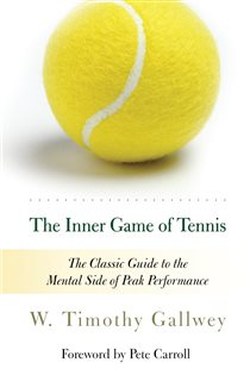
The Zen classic of performance: the opponent within you is tougher than the one across the net.
📖 OPEN THE FULL INTERACTIVE BREAKDOWN →🌐 Read it in Hindi, Hinglish, Gujarati, Tamil & 22 more languages — free, with audio.
💡 The Big Idea
Gallwey, a tennis coach, discovered that most performance gains come not from better technique but from stilling the inner dialogue — the Self 1 (judging, instructing, criticising) vs Self 2 (the body's natural, capable performer). His method is counter-intuitive: stop trying, watch rather than instruct, let the body learn by attention instead of command. The 'inner game' applies to any skill — writing, coding, music, sales — and its tools (awareness, non-judgemental observation, letting go of the result) are the direct ancestors of modern peak-performance coaching.
🧠 The 9 Key Lessons
Lesson 1: Self 1 vs Self 2
Chapter 1: The Inner Game
Gallwey names the two players inside you: Self 1 — the voice that judges, instructs, criticises and tenses; Self 2 — the natural, capable doer that learned to walk and talk without instruction. Performance drops when Self 1 talks too much. The game is not the opponent across the net; it is the conflict between the selves.
📖 Example: A player who thinks 'keep your wrist straight, bend your knees, follow through' at the serve is slower than one who just watches the ball and swings. Read the full example →
⚡ Do this: Name the inner critic: every time it instructs you mid-action, thank it and return attention to the task itself.
Lesson 2: Quiet the Mind, Not the Body
Chapter 2: Awareness
The primary tool is non-judgemental awareness: observe what is happening without labelling it good or bad. 'Watch the ball' — really see its seams, its bounce, the moment of contact. Attention, not effort, produces the correction: when the body sees clearly, it adjusts automatically. The moment you add 'don't miss!' the command itself creates the miss.
📖 Example: Players told to feel the exact moment of racket-ball contact improved their timing more than players given technique drills. Read the full example →
⚡ Do this: In your next practice session (tennis, code, cooking), pick one thing to observe purely — no evaluation, no instruction.
Lesson 3: Let the Body Learn
Chapter 3: Natural Learning
Gallwey's deepest discovery: the body learns fastest by experience, not instruction. He taught beginners to hit serves by having them swing while watching the ball — no verbal commands at all — and they learned faster than the instructed group. The method: picture the result, feel the stroke, let go, then observe the outcome without judging. Try vs trust: trying hard is Self 1's way; trusting is Self 2's way.
📖 Example: A student who simply mimicked Gallwey's swing rhythm (without being told its mechanics) advanced faster than one who learned step-by-step technique. Read the full example →
⚡ Do this: For one skill, replace 'how do I do this right?' with 'let me watch myself do it and feel the difference.'
Lesson 4: Let Go of the Result
Chapter 4: The Moment
Winning is the enemy of playing well. When you focus on the score, the body tenses and the mind splits — attention leaves the moment. Gallwey's paradox: the player who cares least about the outcome performs best, because they are fully present. The discipline is to accept whatever happens just happened, without penalty — then the next point is clean.
📖 Example: After a missed shot, the amateur replays it with a commentary ('I always miss these'), while the pro has already begun the next point — the same error, different mental cost. Read the full example →
⚡ Do this: After each mistake, give it one neutral sentence ('that one went long') and move on immediately.
Lesson 5: The Inner Game of Work
Chapter 5: Everywhere
The inner game generalises: the same Self 1/Self 2 fight runs in sales calls, public speaking, parenting and creative work. Gallwey's later books apply it to work and stress — the boss is the opponent within. Any environment that removes judgment and increases attention produces growth; any environment with constant criticism shrinks performance. The modern insight that psychological safety drives team performance is the inner game in a spreadsheet.
📖 Example: A team whose manager evaluates less and describes more reports lower stress and higher output — the inner game applied to leadership. Read the full example →
⚡ Do this: This week, give one feedback session in pure description ('I saw X, the effect was Y') with zero evaluation — and notice the response.
Lesson 6: The Quiet Eye
Part 2: The Second Inner Game
Gallwey's simplest technique is also the deepest: watch the ball's seams, its spin, the exact moment of contact. This kind of detail-observation leaves the inner critic nothing to say — attention to the object displaces commentary about the self. The eye teaches the hand; the mind gets out of the way.
📖 Example: Players told to watch the seams stopped overthinking their swing — the correction happened by itself, without a single instruction. Read the full example →
⚡ Do this: In your next practice session, pick one detail to observe purely — and forbid yourself any other instruction.
Lesson 7: The Opponent Is the Partner
Part 3: The Three Inner Games
Gallwey's reframe of competition: the opponent is not the enemy but the partner who shows you your weaknesses — lose to them and you have lost nothing; fail to learn from them and you have lost everything. The great players thank their fiercest rivals for the mirror.
📖 Example: A student who stopped trying to beat his rival and started studying him began winning — the rival had become the coach. Read the full example →
⚡ Do this: Name one 'rival' who mirrors your weakness, and extract one concrete lesson from your last loss to them.
Lesson 8: The Goldfish of Attention: The One-Second Unit
Part 3: The Inner Game (Concentration)
Gallwey's most useful technical trick: treat attention in one-second units — a rally is not a 90-second event, it is ninety one-second events, each one new. The player who drops the last point at once ('that was the last point') and gives the next second full attention resets continuously. In work, the same unit works: the meeting is a series of one-second choices, and each one is a fresh start.
📖 Example: The best tennis players have the shortest memories on court — the missed shot is closed in under a second, and the next second has no debt. Read the full example →
⚡ Do this: In your next difficult meeting or task, consciously split it into one-second units: drop the last one, give the next one everything.
Lesson 9: The Inner Game of the Critic
Part 3: The Inner Game (Self-Image)
Gallwey's diagnosis of the inner critic: Self 1's voice ('you're slow, you're clumsy') is not a fact — it is an old tape, and the inner game is learning to hear the tape without obeying it. The technique is radical acceptance of the present: 'I am hitting the ball badly right now' — no verdict, just observation, because a critic makes noise while an observer makes adjustments.
📖 Example: The player who says 'my serve is terrible' locks the bad serve in; the one who says 'my toss is drifting two inches left' fixes it in two points. Read the full example →
⚡ Do this: Translate one self-criticism into an observation today: swap 'I'm bad at X' for 'X is currently doing Y'. Observe, adjust, repeat.
✅ 5-Step Action Plan
- Notice and name the inner critic; return attention to the task.
- Practise one session of pure observation with no instruction.
- Let one skill be learned by feel and feedback — not commands.
- After each mistake: one neutral sentence, then next point.
- Give one evaluation-free feedback to someone this week.
⚠️ When This Doesn't Work
Gallwey's examples are anecdotal and largely untested scientifically; 'letting the body learn' works well for physical and practised skills but cannot replace deliberate practice, study or technique in complex domains. Use it as a complement to training, not a substitute.
💀 The Graveyard Proves It
🎸 Syd Barrett — The Creative Genius Who Burned Out Before His Band Made History. Burn: His mind, his career, and his place in the band he founded Read the full case study →
💬 Best Quotes from The Inner Game of Tennis
- “The opponent within one's own head is more formidable than the one on the other side of the net.”
- “Concentration is the essence of all excellence.”
- “When the mind is quiet, the body performs at its best — which is why the best players are described as being 'in the zone'.”
Interactive version: mark lessons as read, listen in your language, share quote cards.