Library › Psychology & People
Hooked: How to Build Habit-Forming Products — Summary & Key Lessons
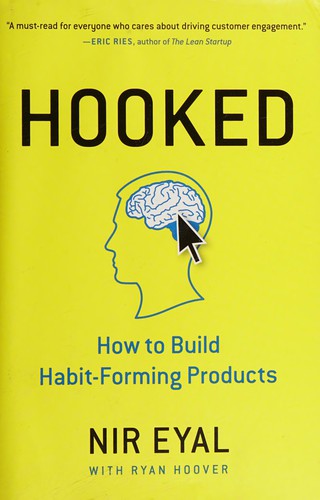
The mechanics of the habit loop that made Instagram and your email addictive, written by the man who designed it, with the ethics chapter everyone skips.
📖 OPEN THE FULL INTERACTIVE BREAKDOWN →🌐 Read it in Hindi, Hinglish, Gujarati, Tamil & 22 more languages — free, with audio.
💡 The Big Idea
Eyal codified how products create habits: TRIGGER (external cues, then internal ones: the emotion or situation that recalls the product unprompted), ACTION (the simplest behavior in anticipation of reward, designed for minimum friction, informed by Fogg's B=MAT: behavior = motivation x ability x trigger), VARIABLE REWARD (rewards of the tribe/social, the hunt/resources, the self/mastery, variable like a slot machine because predictability kills dopamine), and INVESTMENT (user inputs that improve the product next time: data, content, followers, reputation, loading the NEXT trigger). Case studies: Instagram, Pinterest, email, Twitter, Bible apps. The book's last chapter is its conscience: the manipulation question (would I use this if nobody paid me; does it materially improve users' lives) and the 'facilitator' test separating ethical habit design from addicting users against their interest. Post-2014 context (attention economy critiques, our linked case study) makes the ethics chapter mandatory, not optional.
🧠 The 8 Key Lessons
Lesson 1: Habits Are Loops, Not Loyalty Programs
The Habit Zone
Eyal defines habit as automatic behavior cued by context, distinct from frequency alone (searches are frequent but unhooked) and from loyalty (points programs are bribes, not habits). Products in the habit zone are cued by internal states (boredom, loneliness, anxiety) and happen 'without conscious thought'. The design question for founders: which internal emotion or situation should cue your product, and does your usage frequency actually cross the habit threshold?
📖 Example: Instagram succeeded because boredom and social curiosity (internal states) trigger the app unprompted; a banking app, however useful, operates in the conscious-tool zone and shouldn't pretend otherwise. Read the full example →
⚡ Do this: Write the internal trigger (emotion/situation) your product already rides. If you can't name one, your retention strategy is currently marketing spend, not habit.
Lesson 2: External Triggers Retire as Internal Ones Mature
Triggers
The design arc: external triggers (notifications, emails, word-of-mouth) bring users back until internal triggers (feelings) take over. Great products engineer this handoff deliberately; mediocre products stay dependent on ever-louder notifications, which breed resentment and OS-level suppression. The discipline: measure what fraction of sessions start from internal navigation (typing the URL, opening the app cold) versus external pings; that ratio IS your habit maturity.
📖 Example: Email's genius: the trigger (the 'new message' ding) was external, but the internal trigger (the check-for-something reflex) took over so completely that we open inboxes with no new mail: the handoff completed decades ago. Read the full example →
⚡ Do this: Compute your direct-traffic or cold-open session percentage this week. Design to raise it (rituals, positions, cues in the user's environment), not just notification volume.
Lesson 3: Reduce Friction Before You Increase Motivation
Action
Fogg's law: behavior happens when motivation, ability and trigger converge, and the cheapest lever is ability (making the action easier). Designers chase motivational persuasion (copy, onboarding hype) when removing one step, field, or decision would change outcomes more. The discipline: map the current action's every micro-step, delete or defer as many as possible, and never ask for investment (see next lesson) before the action is frictionless.
📖 Example: Twitter's famous signup collapse ended by simplifying to pick-five-accounts (the old flow demanded follow selection before value), the book's canonical ability-lever win. Read the full example →
⚡ Do this: Record (or write) every step of your signup or core action today. Delete or defer two steps this week; measure completion before touching any copy.
Lesson 4: Variability Is What Keeps the Loop Alive
Variable Rewards
Predictable rewards habituate (the dopamine response dies with repetition); variable rewards sustain seeking. Eyal's three types: rewards of the tribe (social validation: likes, comments), the hunt (resource acquisition: feeds, search results, deals), the self (mastery, completion, novelty). The craft: which variable type fits YOUR product's core value, and is the variability real (genuinely unpredictable, meaningful outcomes) or gimmicky (random badges)?
📖 Example: The feed's endless scroll works because every pull might deliver tribe (social proof), hunt (something interesting), and self (learning) rewards simultaneously: three slot machines in one gesture, the linked case study's exact engine. Read the full example →
⚡ Do this: Identify your product's reward type (tribe, hunt, or self). Redesign one moment to add genuine variability to it, and check: does the variability serve the user's goal or only your metrics?
Lesson 5: Investment Loads the Next Trigger
Investment
The loop's closing move: get users to invest (data, content, followers, preferences, reputation) so the product is better NEXT time and the next trigger fires itself. Investments exploit our bias to value what we build (IKEA effect) and raise switching costs honestly (the product genuinely improves with use). The design question: what does your user put IN that makes their next session better, and are you asking for it at the moment of stored value, not before first value?
📖 Example: Every follow on a social app, every saved preference, every playlist: each is an investment that makes leaving costlier AND returning better, the dual function that makes investment the loop's keystone. Read the full example →
⚡ Do this: List what users invest in your product (data, content, settings, history). Design one investment moment AFTER first value that visibly improves their next session.
Lesson 6: Where Is Your Manipulation Line?
The Ethics Chapter Everyone Skips
Eyal's own test: the facilitator test (would I use this product myself, and does it materially improve users' lives?), versus the peddler, entertainer, and dealer archetypes. Habit design without material user benefit is exploitation wearing a UX badge. Post-publication reality (attention-tragedy reporting, our linked case study) vindicates the chapter's warning: the techniques are neutral; the deployment is not. Every team running the Hook Model should run the ethics test FIRST, not as a post-hoc conscience wash.
📖 Example: The book distinguishes a meditation app's habit loop (serves the user's stated goal) from a feed's infinite loop (serves engagement metrics against the user's stated goals): identical mechanics, opposite ethics. Read the full example →
⚡ Do this: Run the facilitator test on your product in writing this week: does it materially improve users' lives, and do the founders use it at healthy levels? Answer honestly, date it, and revisit quarterly.
Lesson 7: Habit Design Starts From User Problems, Not Your Roadmap
The Prospect Discipline
Eyal's discovery method: find users' pain (internal triggers) by studying their existing workarounds (the frequent, poorly-solved behaviors), not by projecting your features. The hook that sticks attaches to an EXISTING emotional routine; the hook you invent from a feature list attaches to nothing. The discipline: observe the workaround before designing the loop.
📖 Example: Products that mapped real rituals (photographers' editing routine, shoppers' deal-checking compulsion) attached cleanly; feature-first competitors with identical mechanics bounced off because they cued no existing internal state. Read the full example →
⚡ Do this: Interview five of your best users about the moment BEFORE they open your product (what are they feeling, where are they, what did they just do?). Design from those answers.
Lesson 8: Measure the Loop, Not Just the Retention Curve
Hooked Metrics
Habit products need loop-level metrics: trigger-to-action conversion, action-to-reward latency, reward variability engagement, investment completion, and the internal-trigger ratio (sessions without external prompts). A flattening retention curve can hide a decaying loop (retained users grinding through obligation); a healthy loop predicts retention. The discipline: instrument all four phases or you're optimizing retention blindfolded.
📖 Example: Teams that tracked trigger-to-action latency (how fast users act after the cue) found the single biggest retention lever the retention curve had hidden: speed-to-reward, not feature count. Read the full example →
⚡ Do this: Pick one loop metric you don't track (internal-trigger ratio is the usual blind spot). Instrument it this sprint and put it next to retention on the same dashboard.
✅ 5-Step Action Plan
- Name your product's internal trigger; if you can't, retention is rented marketing.
- Delete two steps from your core action this week before touching copy.
- Add genuine variability to one core reward moment, serving the user's goal.
- Design one investment moment after first value that improves the next session.
- Run the facilitator ethics test in writing and revisit it quarterly.
⚠️ When This Doesn't Work
Eyal wrote as a design practitioner summarizing behavior-science classics (Fogg, operant conditioning research); the 2014 text predates the backlash, and its case studies (Instagram's algorithms, TikTok's emergence) have evolved far past the book's examples. Later critiques (Time Well Spent movement, our linked case study) argue the techniques skew exploitative at scale, which the author's own ethics chapter anticipated but the industry ignored. Read the mechanics and the conscience together, and note his follow-up (Indistractable) is the user-side defense.
💀 The Graveyard Proves It
📡 Facebook Beacon — The Default That Taught the World About Defaults. Burn: $9.5M settlement + a 200-strong alliance of angry users. Read the full case study →
💬 Best Quotes from Hooked: How to Build Habit-Forming Products
- “For new behaviors to really turn into habits, it needs to occur with high frequency and perceived utility.”
- “Variable rewards are among the most powerful tools for changing behavior.”
- “The hook model ends with investment, which loads the next trigger.”
Interactive version: mark lessons as read, listen in your language, share quote cards.