Library › Self-Improvement
Homo Deus — Summary & Key Lessons
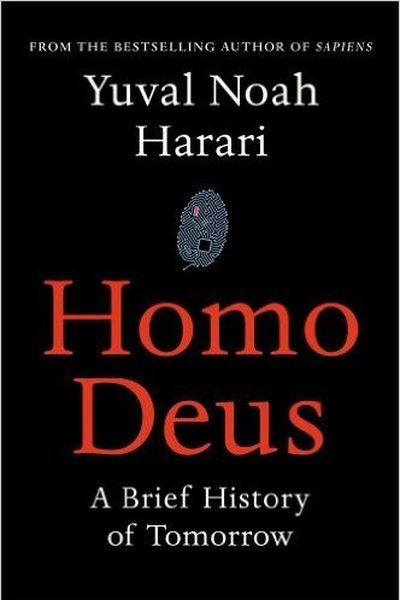
A brief history of tomorrow — from the Sapiens author: the thrilling and terrifying future of humanity in the age of data and AI.
📖 OPEN THE FULL INTERACTIVE BREAKDOWN →🌐 Read it in Hindi, Hinglish, Gujarati, Tamil & 22 more languages — free, with audio.
💡 The Big Idea
Harari continues Sapiens: humanity has nearly conquered the old killers (famine, plague, war). The new agenda: immortality, happiness and godlike power. As algorithms learn us better than we know ourselves, the biggest questions become: what happens to human meaning when machines know us better than we do — and who owns the data?
🧠 The 6 Key Lessons
Lesson 1: The Old Agenda Is Done — Here Comes the New One
The New Human Agenda
For millennia, humanity's agenda was famine, plague and war. In the 21st century these are largely beaten — deaths from starvation and war are at historic lows. The new agenda: conquering death (immortality), finding bliss (happiness) and upgrading humans into gods (augmentation).
📖 Example: Harari's data: more people now die from obesity than starvation, and from suicide than war. The old demons are fading — the new questions are about enhancement, not survival. Read the full example →
⚡ Do this: Notice the shift in your own life: your real problems are probably not survival — they're meaning, health-span and focus. Upgrade your goals accordingly.
Lesson 2: The Algorithm Knows You Better Than You Do
The Great Decoupling
As we hand our data to algorithms — searches, swipes, heartbeats — they begin predicting our desires, moods and choices better than we can. The terrifying endgame: authority shifts from human experience to external data processing. Who are 'you' when an algorithm knows your next mood before you do?
📖 Example: Harari points to dating apps, health trackers and recommendation engines: every choice feeds the model. The 'free market of ideas' quietly becomes an 'optimization for engagement' — shaping what we think, buy and vote. Read the full example →
⚡ Do this: Audit one algorithm in your life: what does your feed optimize for — your growth or your attention? Choose your inputs accordingly.
Lesson 3: Dataism: The New Religion
The Data Religion
Harari forecasts the rise of Dataism: the belief that information flow is the supreme value, and organisms are just biochemical algorithms. In the dataist worldview, human experiences are data-processing events, and the ultimate authority is the network.
📖 Example: We already outsource memory to Google, direction to GPS, taste to recommendations. Dataism is this trend becoming a philosophy — the flow of information treated as sacred. Read the full example →
⚡ Do this: Hold the line on one area: keep one skill, one memory, one decision completely human — no app involved. That's your sovereignty.
Lesson 4: Meaning Is a Story — So Choose It Wisely
The Human Gap
Humans run on stories: religions, nations, money, companies — all shared fictions that coordinate millions. Meaning doesn't come from 'objective reality'; it comes from the stories we believe and enact. The good news: since meaning is a story, YOU can edit yours.
📖 Example: Money is a story (a note has no value except shared belief); nations are stories; careers are stories. Realizing this doesn't make meaning fake — it makes it chosen. In practice, 'meaning is a story' shows up in tiny daily choices long before it shows up in… Read the full example →
⚡ Do this: Write your current life-story in 3 sentences. Then rewrite one sentence deliberately — you are the author, not the reader.
Lesson 5: The Knowledge Paradox: Know Thyself Is Getting Harder
The Great Unknown
Historically, knowing yourself gave you power. But when algorithms can know you better, self-knowledge may lose its value — unless you keep your data and attention sovereign. The future rewards people who understand HOW their mind works more than those who just accumulate facts.
📖 Example: Harari's warning: 'In the 21st century, knowing yourself may be more important than ever — precisely because the algorithms are trying to know you.' Most people nod at this principle and change nothing. The gap between agreeing and acting is where the whole… Read the full example →
⚡ Do this: Learn one thing about your own cognitive machinery this week — a bias, a habit loop, an emotional trigger. That's 21st-century self-knowledge.
Lesson 6: The Rise of Dataism: When Algorithms Know You Better Than You Do
The Data Religion
Harari's provocative forecast: as technology gathers more data about us than we consciously hold, authority shifts from human intuition to algorithmic recommendation — your next partner, job or belief increasingly suggested by systems that know your patterns. The question is not whether the predictions work but who sets the values behind them. Awareness is the only counterweight.
📖 Example: Your streaming and shopping feeds already anticipate your choices better than your stated preferences; as health and finance apps grow, the same pattern extends to major life decisions. The convenience is real — so is the quiet transfer of agency. Read the full example →
⚡ Do this: This week, make one significant choice deliberately against the recommendation of your favorite algorithm — and notice how it feels.
✅ 5-Step Action Plan
- Upgrade your agenda: focus on meaning, health-span, focus.
- Audit what one algorithm is optimizing in your life.
- Keep one fully human skill/memory/decision — no app.
- Rewrite one sentence of your life-story deliberately.
- Learn one bias about your own mind this week.
⚠️ When This Doesn't Work
Harari's 'dataism will replace humanism' is a thrilling prophecy — and Deepwater Horizon is the counter-evidence: the rig was run by people who trusted the data models completely, and the models said the well was safe right up until it wasn't. Data is not truth; it's a map made by humans with blind spots, and the more we worship it, the more we stop questioning it. Harari's grand narratives are themselves stories — powerful, seductive, and exactly the kind of story he warns us to distrust. The book is best read as a mirror, not a prophecy.
💀 The Graveyard Proves It
🛢️ Deepwater Horizon — Saving Hours on a Safety Test Cost $65 Billion. Burn: $65B+, 11 lives, an ocean. Read the full case study →
💬 Best Quotes from Homo Deus
- “In the twenty-first century, the second great revolution will be the rise of the dataist worldview.”
- “The real question is not whether AI is conscious, but whether it matters to us.”
- “Homo sapiens conquered the world because it can cooperate flexibly in large numbers.”
Interactive version: mark lessons as read, listen in your language, share quote cards.