Library › Self-Improvement
Extreme Ownership — Summary & Key Lessons
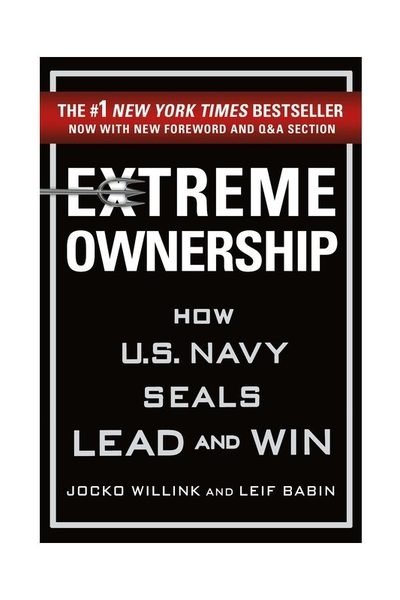
How U.S. Navy SEALs lead and win — starting with the hardest rule: everything is your fault, and that's your superpower.
📖 OPEN THE FULL INTERACTIVE BREAKDOWN →🌐 Read it in Hindi, Hinglish, Gujarati, Tamil & 22 more languages — free, with audio.
💡 The Big Idea
Written by two SEAL officers who led in Ramadi's brutal urban combat, the book's core is one uncomfortable rule: the leader owns EVERYTHING in their world — every failure, every miscommunication, every underperformer. Not as noble martyrdom, but as strategy: the moment you blame anyone or anything outside yourself, you surrender the power to fix it. From that root grow the laws of combat that transfer directly to business and life: believe in the mission or you can't lead it; keep plans simple because complexity dies on contact with chaos; prioritize and execute when everything goes wrong at once; decentralize command so everyone leads their piece; discipline equals freedom. The book's proof is its origin: it opens with Willink taking full ownership of a friendly-fire incident — the worst thing that can happen to a commander — and discovering that total ownership, not excuses, is what made his superiors trust him MORE.
🧠 The 6 Key Lessons
Lesson 1: Extreme Ownership: The Mirror Is the Only Place to Look
Chapter 1: Extreme Ownership
When anything fails in your world — a missed deadline, a confused team, a bad quarter — there is exactly one productive question: what did I do or fail to do that allowed this? Not because external factors don't exist, but because they're not levers you control. The subordinate who 'didn't listen'? You didn't communicate clearly enough, check understanding, or address the pattern earlier. The client who 'ghosted'? You didn't build the relationship or set the cadence. This isn't self-flagellation; it's a power grab: every failure you own becomes a variable you can change, while every failure you assign to others remains permanently out of your hands. Teams mirror this instantly — leaders who own problems create cultures where everyone fixes things; leaders who blame create cultures where everyone hides things.
📖 Example: The book opens with Willink's worst day: a chaotic Ramadi firefight where SEALs shot at friendly Iraqi soldiers — a fratricide incident with a dead ally soldier and wounded SEAL. Investigators arrived expecting to end careers. Willink assembled every… Read the full example →
⚡ Do this: Take your most annoying current problem — the one that is clearly someone else's fault — and write three sentences starting with 'I allowed this by...'. Then act on the strongest one within 48 hours.
Lesson 2: No Bad Teams, Only Bad Leaders
Chapter 2: No Bad Teams, Only Bad Leaders
In SEAL training's Hell Week, crews of exhausted men race rubber boats. Boat Crew II won almost every race; Boat Crew VI came in last almost every time — same ocean, same boats, same exhaustion. Then instructors swapped ONLY the two leaders. Boat Crew VI started WINNING with the same 'losers' — while Boat Crew II stayed competitive on the habits its old leader had installed. The lesson is merciless: team performance is a direct readout of leadership, not talent. 'It's not what you preach, it's what you tolerate' — the standard of any team is set by the worst behavior the leader walks past. Low performers aren't the cause of a weak team; they're the evidence of a leader who accepted them.
📖 Example: Babin's translation to business: a CEO complains her engineering and sales VPs are 'just political people who can't collaborate.' The authors' diagnosis: the CEO had never clearly made collaboration a mission requirement with consequences — she preached… Read the full example →
⚡ Do this: Identify the lowest standard you currently tolerate (in your team, family, or yourself — a deadline habit, a quality bar, a behavior). This week, either enforce the real standard or consciously accept that the tolerated level IS your standard.
Lesson 3: Prioritize and Execute: When Everything Is on Fire
Chapter 7: Prioritize and Execute
In combat, multiple emergencies always arrive together — a wounded man, a building on fire, an unclear enemy position, dying radios. The human response is to freeze or try to solve everything simultaneously, which solves nothing. The SEAL protocol: Relax, look around, make a call. Detach from the chaos (physically step back, breathe), identify the SINGLE highest-priority problem, direct all resources at it, solve it, then move to the next. Even a wrong priority beats paralysis, because execution generates information while freezing generates casualties. The discipline is doing this OUT LOUD for your team — announcing the priority — because a team aligned on the wrong first step self-corrects faster than a team scattered across ten right ones.
📖 Example: On a Ramadi rooftop, Babin's element was hit simultaneously: a SEAL fell from a collapsed wall, enemy fire erupted, they were nearly out of ammunition, and a hostile crowd was forming. Instead of ten men reacting to ten problems, Babin detached — three… Read the full example →
⚡ Do this: Next time you feel overwhelmed (today, probably): stop, write every open fire on paper, circle the ONE whose failure is most catastrophic, and work only on it until it's stable. Then re-rank. Repeat.
Lesson 4: Discipline Equals Freedom
Chapter 12: Discipline Equals Freedom — The Dichotomy of Leadership
The book's most quoted paradox: freedom isn't the absence of structure — it's the product of it. The disciplined person who wakes at 5 AM owns free hours nobody can touch; the disciplined team with standard procedures for routine things has infinite capacity for creative things; the disciplined budget creates the freedom to seize opportunities. Meanwhile 'freedom' without discipline collapses into reaction — the undisciplined person is free only to respond to whatever the day throws. The same dichotomy runs through all leadership: be confident but not cocky, brave but not reckless, attentive to detail but not obsessed, a leader AND a follower. The masters aren't at one extreme; they hold the tension between both — and discipline is what buys the margin to hold it.
📖 Example: Willink's own routine became internet-famous: waking at 4:30 AM daily (posting the watch photo as proof), workout done before most people's alarms. Not for machismo — for margin: the pre-dawn hours are the only ones no crisis can claim, so the most important… Read the full example →
⚡ Do this: Install one keystone discipline for 30 days: same wake time daily (weekends included), with the first 60 minutes pre-scripted for your most important work. Track completion on a visible calendar — the goal is freedom, and this is its price.
Lesson 5: Cover and Move: Teams Win When Units Protect Each Other
Part 2: The Principles
The first leadership principle from the SEAL teams: everyone on the team is mutually responsible for each other's success — departments, like fire teams, must 'cover and move' for each other rather than compete. When sales blames marketing and engineering blames product, the team is fighting itself while the enemy (the market) advances. The leader's job is to break down silos, define how units support each other, and make cross-team success a metric, not a slogan. The military truth: a team that covers and moves can beat a more talented team that fragments. Internal competition is a luxury only losers can afford.
📖 Example: Willink describes a training evolution where one squad's failure cost the whole team — and the lesson stuck: no individual excellence could compensate for a unit that didn't protect its flank. Teams that treat each other's problems as their own win… Read the full example →
⚡ Do this: Identify one way your team or family 'fights itself' — a silo, a blame pattern. Initiate one act of cross-unit support this week without being asked.
Lesson 6: Decentralized Command: Give the Why, Let Them Run
Part 3: The Execution
The paradox of extreme ownership: leaders own everything, yet they must empower everyone. The mechanism is 'decentralized command' — communicate the strategic intent (the why) so clearly that subordinates can execute the how without checking in on every decision. Willink's rule: you don't need to tell your team WHAT to do at every step if you've trained them to understand WHY the mission matters. This unlocks speed (no approval bottlenecks) and initiative (people act because they understand, not because they're told). The leader who hoards decisions becomes the bottleneck; the leader who delegates with intent builds an organization that runs at the speed of its best people.
📖 Example: Willink describes how SEAL leaders brief the 'commander's intent' — the end state and the why — and then trust junior leaders to adapt tactics in real time. The result: units that outmaneuvered better-equipped enemies because decisions happened in seconds,… Read the full example →
⚡ Do this: For your next delegated task, write down the WHY (the end state and its importance) along with the task. Then resist every urge to micromanage the how.
✅ 5-Step Action Plan
- Run the ownership flip daily: for every frustration, ask 'what did I do or fail to do that allowed this?' — then act on it.
- Audit what you tolerate: enforce your real standard on one lowered bar this week.
- When overwhelmed: detach, list, circle ONE priority, execute, re-rank — never fight all fires at once.
- Simplify every plan until the most junior person can repeat it back perfectly.
- Adopt one keystone discipline (fixed wake time + scripted first hour) and hold it for 30 days.
⚠️ When This Doesn't Work
Willink's 'leaders own everything' is the most useful leadership doctrine in modern business — and Therac-25 shows its failure mode: every engineer and manager on the project took extreme ownership, signed off every module, owned every line of code — and six patients were killed by a radiation machine whose software bug they all owned collectively and therefore nobody owned individually. Total ownership of everything becomes ownership of nothing when the system lacks one person accountable for the specific risk. Extreme ownership works when it lands on a single named neck — not when it's a culture slogan everyone repeats.
💀 The Graveyard Proves It
☢️ Therac-25 — The Software Bug That Killed Four Patients — and Taught Medicine About Checklists. Burn: 4 patients killed, 2 seriously injured, a technology's trust destroyed. Read the full case study →
💬 Best Quotes from Extreme Ownership
- “There are no bad teams, only bad leaders.”
- “Discipline equals freedom.”
- “It's not what you preach, it's what you tolerate.”
Interactive version: mark lessons as read, listen in your language, share quote cards.