Library › Self-Improvement
The Essence of the Bhagavad Gita — Summary & Key Lessons
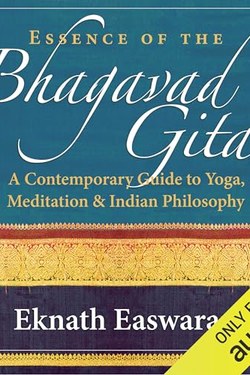
A modern master's line-by-line commentary: the Gita as a practical manual for everyday action.
📖 OPEN THE FULL INTERACTIVE BREAKDOWN →🌐 Read it in Hindi, Hinglish, Gujarati, Tamil & 22 more languages — free, with audio.
💡 The Big Idea
Easwaran's translation-and-commentary explains why the Gita belongs to everyone, not just monks: Arjuna's battlefield is your desk, your family and your inbox. His reading emphasises three accessible skills — concentration (the 'Gita strain'), detachment from results while giving total effort, and seeing the divine in the person in front of you. His rule for practice: attention trained daily becomes a spiritual muscle.
🧠 The 10 Key Lessons
Lesson 1: Arjuna Is You
Commentary 1: The Battlefield
Easwaran's first move is identification: Arjuna's moral collapse before the war is the universal moment of paralysis — career, marriage, health, meaning. The Gita's answer is not retreat; the battlefield is where the lessons are taught. You cannot skip the crisis; you can only meet it prepared.
📖 Example: The Sunday-night dread before a hard week is Arjuna's moment — the question is what you do with it. Read the full example →
⚡ Do this: Name your current battlefield in one sentence — then note that this is where the work is, not away from it.
Lesson 2: One-Pointed Attention
Commentary 2: The Mind
Easwaran calls the Gita 'the most practical book on the mind ever written'. Its psychology: the mind is restless and must be trained by steady practice — the 'one-pointed' mind is the Gita strain. His method: a repeated passage from the Gita the moment the mind wanders, plus meditation on a single word. The training is ordinary; the result is extraordinary.
📖 Example: Every time a spiritual teacher appears calm, there are years of one-pointed repetitions behind it — no shortcuts. Read the full example →
⚡ Do this: Choose one sacred line or goal phrase; repeat it slowly whenever your attention scatters today.
Lesson 3: Detach From Results, Not Effort
Commentary 3: Work
Easwaran clarifies the most misread verse: detachment is from the fruit, never from the work. The detached worker tries harder, not less — the anxiety grip is what caps effort. This is the Gita's gift to the workplace: full-heart engagement without agonising about outcome.
📖 Example: A scientist who cares about the question more than the Nobel does better science — and often wins the prize. Read the full example →
⚡ Do this: Take one high-stakes task and consciously shift your focus from outcome to quality of effort.
Lesson 4: See the Divine in the Person in Front of You
Commentary 4: Love
Easwaran's most modern note: 'seeing God in the person before you' is not mysticism — it is practicing undivided presence. The person who treats the cashier, the child and the rival with the same attention is practising the Gita without saying a word. Love in the Gita is not sentiment; it is a discipline of attention.
📖 Example: The Gita's famous command to act without hatred is experienced every time you deal with a difficult person with full fairness. Read the full example →
⚡ Do this: Today, give one person — the least convenient one — your complete, unhurried presence.
Lesson 5: Practice Is the Teacher
Commentary 5: The Method
Easwaran refuses abstract spirituality: the Gita is learned by doing. His prescription — morning meditation, a repeated mantra or passage, unselfish work, and a nightly review of attention — is the same structure every serious tradition has. Progress is measurable in one thing only: how you respond when you are provoked.
📖 Example: You cannot grade your meditation; you can grade yesterday's argument — did the training show up? Read the full example →
⚡ Do this: Set a 30-day trial: 10-minute morning practice + nightly attention review; grade yourself on responses only.
Lesson 6: Meditation: The Gita's Practice Made Plain
Chapter 6: The Practice of Meditation
Easwaran's reading of the Gita's sixth chapter turns meditation into a practical path: find a quiet place, sit with a steady posture, and train the mind on a single focus until it flows like a lamp in a windless place. His own addition — passage meditation — memorises a short sacred text and repeats it slowly, so the attention has rails to run on and distracting thoughts lose their pull.
📖 Example: Easwaran's students meditated on the Gita's own verses — the text became the tool, which is why he recommended memorising the words before trying to 'empty the mind'. Read the full example →
⚡ Do this: Memorise one short verse you love and use it as your focus point for five minutes a day — slow, silent, word by word.
Lesson 7: The Gita Is a Field Manual, Not a Sermon
Introduction: The Battlefield as Mind
The Gita is set on a battlefield — not as drama but as diagnosis. Arjuna's collapse is the collapse every conscientious person knows: the moment the stakes are real and the mind floods with 'should I?'. Krishna's answer is practical: the field is the mind, the battle is today, and the teaching that follows is an operating manual for action under moral pressure, not a philosophy for monks.
📖 Example: A founder before a layoff, a doctor before a hard diagnosis, a student before an exam that decides — all stand on the same field Arjuna stood on. Read the full example →
⚡ Do this: Name your current battlefield in one sentence. That is where the Gita's lessons apply this week.
Lesson 8: The Three Gunas: Know Your Operating System
Chapter 14: The Three Qualities
The Gita classifies every mind's default settings: tamas (inertia, sleep, confusion), rajas (passion, drive, restlessness), sattva (clarity, balance, light). The insight is that you do not choose your state directly — you feed it. What you eat, watch, read and surround yourself with tilts the dial. The path is not to demonise rajas but to use it to climb toward sattva, and then to climb past even sattva.
📖 Example: Phone-checking at midnight feeds tamas; a 6am workout with a clear plan feeds rajas; a quiet hour of honest reading feeds sattva. Read the full example →
⚡ Do this: Tonight, audit one input: the last thing you consume before sleep. Change it for a week and note the morning difference.
Lesson 9: Swadharma: Your Post, Not Someone Else's
Chapter 18: The Duty of One's Own Nature
Krishna's controversial line — better one's own duty badly than another's well — is a philosophy of fit, not of caste. The principle: excellence comes from doing the work your nature is shaped for; borrowing another's path, however glamorous, produces a hollow life. This is the Gita's anti-comparison engine: the benchmark of a good life is not the neighbour's career but the alignment between your gift and your work.
📖 Example: An accountant who forces himself into sales 'for growth' fails at his own game; the accountant who masters the numbers becomes the advisor everyone wants. Read the full example →
⚡ Do this: Write two lists: work you are good at, work you enjoy. The overlap is your swadharma — protect it.
Lesson 10: The Steady Mind: The Gita's Definition of Success
Chapter 2: The Stable Wisdom
The Gita never defines success as outcomes; it defines it as sthita-prajna — steady wisdom. The marks are concrete: no clinging to results, no elation at gain, no collapse at loss, desires quietened not by suppression but by satisfaction at a deeper level. This is the most testable claim in the book: the quality of your moment-to-moment mind is the real scoreboard, and every other score is a shadow of it.
📖 Example: Two investors make the same profit: one sleeps badly with greed, one sleeps well with process. The Gita asks which is richer. Read the full example →
⚡ Do this: For one day, score yourself on mind only: calm after good news? calm after bad? Mark it, don't judge it.
✅ 5-Step Action Plan
- Name your battlefield; work begins there, not away.
- Anchor one phrase; repeat it whenever attention scatters.
- Shift one high-stakes task from outcome-focus to effort-focus.
- Give one inconvenient person your full presence today.
- Run the 30-day trial: morning practice + nightly review.
⚠️ When This Doesn't Work
Easwaran's commentary carries his Hindu-Christian reading; the Gita can also be read politically or non-religiously, and its war setting has been used to justify violence. Take the psychology, question the metaphysics.
💀 The Graveyard Proves It
🎲 Duryodhana — The Prince Who Burned a Dynasty Because of Envy. Burn: The entire Kuru dynasty — every heir, every ally, a kingdom in ashes Read the full case study →
💬 Best Quotes from The Essence of the Bhagavad Gita
- “The Gita is not a book you read; it is a book you practise.”
- “We become what we attend to — attention is the whole of spiritual life.”
- “Unselfish action is the secret of joy.”
Interactive version: mark lessons as read, listen in your language, share quote cards.