Library › History
The Emperor of All Maladies — Summary & Key Lessons
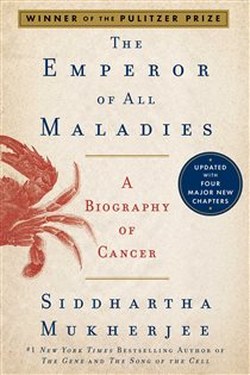
A biography of cancer — the disease's ancient history, its modern treatments and its unfinished war.
📖 OPEN THE FULL INTERACTIVE BREAKDOWN →🌐 Read it in Hindi, Hinglish, Gujarati, Tamil & 22 more languages — free, with audio.
💡 The Big Idea
Mukherjee's Pulitzer-winning history reads cancer as a biography: its first mention on Egyptian papyrus, its rise with industrial civilisation, the century of blind surgery, then chemotherapy, targeted drugs and immunotherapy. The deeper story is about how knowledge advances — by radical guesses, brutal failures, and the slow accumulation of evidence. Its ending is unsentimental: the war is not over; it is being transformed from a battle to a long negotiation.
🧠 The 9 Key Lessons
Lesson 1: The Disease Is Us
Chapter 1: The Biology
Cancer is not an invader; it is our own cells gone rogue — mutations that break the brakes on growth. That is why it resists 'war' metaphors: you cannot distinguish enemy from self without collateral damage. Mukherjee's framing teaches a bigger lesson: some battles are won by understanding the system, not by attacking it.
📖 Example: Modern targeted drugs work by diagnosing the exact mutation — precision over the shotgun that was chemotherapy. Read the full example →
⚡ Do this: For one problem that resists you, reframe it as part of the system you are in, not an invader.
Lesson 2: The Radical Guess
Chapter 2: The Discovery
The book's most human chapter: Sidney Farber's desperate gamble with antifolate drugs in 1947 — administering a poison to dying children — and the first flicker of remission. The pattern repeats through the book: progress comes from audacious hypotheses tested under terrible uncertainty, and from people who refuse the status quo.
📖 Example: Every breakthrough treatment looked reckless at first; every 'safe' orthodoxy was once a guess that worked. Read the full example →
⚡ Do this: For one stuck problem, generate the most audacious hypothesis you can test this month — then test it cheaply.
Lesson 3: The Two Wars
Chapter 3: The Crusade
The 1971 'War on Cancer' poured money into one assumption: find the cure. It produced chemotherapy triumphs and decades of slow progress — and a lesson: grand crusades against complex systems fail when they assume one magic weapon. Progress came instead from incremental, evidence-driven discovery. The general rule: love the problem and the patient grind more than the war cry.
📖 Example: The 'cure for cancer' headline never came; the mortality decline came from screening, better drugs and incremental trials. Read the full example →
⚡ Do this: Replace one grand resolution with a specific, measurable next step in the same direction.
Lesson 4: The Long Tail of Risk
Chapter 4: Prevention
Mukherjee is blunt about the most effective weapon: prevention — tobacco control, vaccines (HPV, hepatitis B), early screening. Population-level prevention outscored most cures. The lesson mirrors modern life: the interventions with the highest leverage are the boring, unglamorous ones done before the crisis.
📖 Example: The HPV vaccine prevents most cervical cancers — a single shot outranks decades of therapy. Read the full example →
⚡ Do this: Name your highest-leverage boring prevention (sleep, checkup, habit) — and prioritise it over a cure.
Lesson 5: The Endless Negotiation
Chapter 5: The Future
The book closes with a paradigm shift: from war to management. Cancer increasingly becomes a chronic condition — controlled, surveilled, negotiated with — rather than a conquest. The lesson for any hard problem: winning may mean learning to live with it well, not eradicating it. The goal shifts from victory to longevity with quality.
📖 Example: CML patients now live decades on targeted pills — the disease is managed, not cured, and that is a triumph. Read the full example →
⚡ Do this: For your hardest ongoing problem, write the 'management' version of success: not elimination but a workable, long-term balance.
Lesson 6: The Poison That Became a Cure
Part 2: The Chemotherapy Birth
Mukherjee's most dramatic chapter: nitrogen mustard — a chemical warfare agent from WWI — became the first chemotherapy when researchers saw soldiers' bone marrow collapse and guessed the same poison could pause cancer's growth. The lesson is counterintuitive and enormous: yesterday's weapon can become today's medicine, if you test it instead of fearing it.
📖 Example: Sidney Farber's antifolate drugs in 1947 produced the first fleeting remission in childhood leukemia — a crack in a wall that had never moved. Read the full example →
⚡ Do this: For your most stuck problem, ask: what 'poison' in my field — the discredited idea, the abandoned tool — might become the cure with the right dose and a fair test?
Lesson 7: The Anatomy of a Diagnosis
Part 1: The History (The Discovery)
Mukherjee's history of cancer is also a history of medical epistemology: how we know what we know. Each era's treatment — the radical mastectomy, the chemotherapy, the targeted therapy — reflected the era's theory of the disease, and the treatments followed the theories like children. The lesson for anyone in any field: your interventions are only as good as your model, and the model is always incomplete.
📖 Example: Halsted's radical mastectomy dominated for 75 years — not because it worked, but because the theory (cancer spreads locally) was accepted by an entire profession that never tested it. Read the full example →
⚡ Do this: In any domain, ask: what is my current 'radical mastectomy' — the established practice nobody has truly tested? Find one and question it this quarter.
Lesson 8: The War on Cancer: A Long War Is a Wrong War
Part 3: The War
The 1971 'War on Cancer' declared victory in a decade; Mukherjee's history shows the war metaphor itself failed — cancer is not an invader to be defeated in a battle but a shape-shifter to be managed over decades. The honest framing: chronic management, not eradication; a peace treaty with the disease, not a victory parade. The lesson generalises: the biggest problems are rarely solved by declaring wars on them.
📖 Example: When the war metaphor ruled, research chased a single 'cure'; when the frame shifted to biology, progress came from understanding subtypes — the enemy had a family tree, not a head. Read the full example →
⚡ Do this: Name one 'war' you are fighting — procrastination, debt, a habit. Reframe it as a long management problem and design for decades, not victory.
Lesson 9: The Endless Negotiation: The Patient in the Room
Part 5: The Future (The Patients)
The book's most human thread: every advance arrives through real people making unbearable choices — the patients in trials, the families in the corridors. Mukherjee insists the oncologist's real job is not just the science but the negotiation between hope and truth, and that the patient must be in the room when the decision is made. Medicine's lesson, repeated through the century: the treatment is never the only thing happening.
📖 Example: Sidney Farber's early patients — children with leukemia — were the first to receive chemotherapy; the 'miracle' was negotiated with their families, one dose at a time. Read the full example →
⚡ Do this: Wherever you make a decision for someone else, put them in the room — ask the patient, the user, the student, what they'll trade. The data never replaces the person.
✅ 5-Step Action Plan
- Reframe one resistant problem as system, not invader.
- Test one audacious hypothesis cheaply this month.
- Convert one grand resolution into a specific next step.
- Prioritise one boring high-leverage preventive habit.
- Write the management version of success for your hardest problem.
⚠️ When This Doesn't Work
Medical history shifts quickly; treatments described as state of the art in 2010 have evolved. The history lessons stand; the medical guidance should come from current clinicians, not this book.
💀 The Graveyard Proves It
🚬 Big Tobacco — The 50-Year Denial That Killed Millions. Burn: $206B Master Settlement; millions of premature deaths Read the full case study →
💬 Best Quotes from The Emperor of All Maladies
- “Cancer is a disease of the body, but it is also a disease of the mind — biology and story are inseparable.”
- “The history of cancer is not just a history of medicine; it is a history of our most profound fears and ambitions.”
- “Disease is the shadow of our biology: we cannot escape it, only outrun it.”
Interactive version: mark lessons as read, listen in your language, share quote cards.