Library › Self-Improvement
Ego Is the Enemy — Summary & Key Lessons
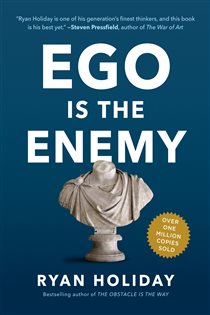
The fight to master our greatest opponent — ego sabotages you when you aspire, when you succeed, and when you fail.
📖 OPEN THE FULL INTERACTIVE BREAKDOWN →🌐 Read it in Hindi, Hinglish, Gujarati, Tamil & 22 more languages — free, with audio.
💡 The Big Idea
Ego — the unhealthy belief in your own importance — is not confidence; it's confidence's counterfeit, and it attacks at all three phases of any pursuit. ASPIRING: ego makes you talk instead of work, refuse the student's chair, and crave recognition before competence. SUCCESS: ego inflates the story ('I'm a genius'), breeds entitlement and control-mania, and disconnects you from the sobering feedback that got you there. FAILURE: ego converts setbacks into catastrophes, blames everyone, and doubles down on delusion. Holiday's counter-program, drawn from Sherman, Angelou, Marshall, and the Stoics: stay a student forever, do the work silently, hold purpose above passion, sweep the floor on the way in, and measure yourself against your own standards — not the crowd's applause.
🧠 The 6 Key Lessons
Lesson 1: Aspire: Talk Less, Be a Student, Beware Passion
Part 1: Aspire
In the aspiration phase, ego's first theft is via TALK: announcing goals delivers the identity-reward before the work exists, and the psyche, partially satisfied, works less (research confirms it: publicized intentions reduce follow-through). Holiday's rules: silence is strength — let the work make the announcements. Second: be a perpetual STUDENT — the moment you're too good for the apprentice's chair, growth stops; keep a master to learn from, a peer to spar with, and a student to teach (the Frank Shamrock 'plus, minus, equal' system). Third: beware raw PASSION — the aspiring phase's most flattered vice: passion is 'about' (excited, self-focused, boundless and vague), while PURPOSE is 'to and for' (directed, bounded, other-serving) — and history's wreckage is full of passionate people out-executed by purposeful ones. Finally, adopt the CANVAS STRATEGY: help others get what they want, clear paths, find the openings for your superiors — the apprentice who makes everyone better owns the network forever.
📖 Example: Sherman is the book's aspirational hero: repeatedly declining commands he felt unready for, mastering logistics in obscurity, refusing Washington politics — then delivering the war's decisive campaigns precisely because his self-assessment had stayed… Read the full example →
⚡ Do this: Institute a 30-day announcement fast: zero goal-talk, doubled goal-work. Fill your plus/minus/equal slots by name this week. And run one canvas move: make a superior or peer measurably better with no credit trail back to you.
Lesson 2: Success: Stay Sober, Kill the Narrative
Part 2: Success
Success detonates ego's second ambush: the NARRATIVE FALLACY — rewriting your messy, lucky, help-filled ascent as destiny's clean arc ('I always knew') — which corrupts the very decision-making that produced the win. Antidotes: stay a student (the moment you've 'arrived,' entropy begins — Genghis Khan's empire ran on perpetual learning from every conquered culture), guard SOBRIETY over swagger (Angela Merkel as Holiday's model: unglamorous, unreactive, boringly effective for a generation while flashier rivals combusted), fight entitlement/control/paranoia (the success triad: deserving everything, micromanaging everything, trusting no one), and manage yourself — as scale grows, the job changes from doing to designing systems and trusting delegates (Eisenhower's genius was organization, not heroics). Above all, protect WHY you started: the 'more' disease — more applause, more territory, more comparison — has no finish line, and unchecked it trades what matters for what glitters.
📖 Example: Howard Hughes is the cautionary spine: history's most gifted aviator-industrialist, destroyed not by competition but by ego's success-phase symptoms — paranoia, control-mania, narrative delusion — dying isolated in a darkened hotel room atop unmatched… Read the full example →
⚡ Do this: Write the honest origin story of your last success: list the luck, the help, and the timing alongside the skill — keep it where the clean narrative can't grow back. Then audit the triad: name one entitlement, one over-control, one paranoia currently operating, and surrender the easiest one this month.
Lesson 3: Failure: The Fight Club Moment
Part 3: Failure
Failure is ego's third ambush — and its finest teacher, if ego doesn't intercept the lesson. Holiday's failure-phase toolkit: expect ALIVE TIME vs. DEAD TIME choices (every setback period is either used — studying, building, repairing — or served like a sentence; Malcolm X in prison chose alive time and educated himself into history), understand THE EFFORT IS ENOUGH (do the work because it's right, not for outcomes you don't control — otherwise every unrewarded excellence becomes a grievance), run FIGHT CLUB MOMENTS honestly (rock bottom's gift is the death of the lies you'd been maintaining; the facade's collapse is the foundation's exposure), and know WHEN TO LET GO of what's unrecoverable. Crucially: hold the SCOREBOARD apart from the SELF — failure is information about strategy, and ego's conversion of it into identity ('I am ruined') is what makes temporary setbacks permanent. Vince Lombardi's standard: you can lose the game without ever being beaten — beaten is internal, and it's optional.
📖 Example: Katharine Graham again anchors the arc: the Post's stock collapsing post-IPO, Buffett advising patience while critics howled — her ego-free steadiness (buying back shares while the crowd fled) produced one of the era's great investment returns. The… Read the full example →
⚡ Do this: If you're in a setback: declare it alive time in writing — the curriculum, the daily unit, the build. Separate the scoreboards: one page listing what failed (strategy, external) versus what remains (skills, character, relationships). And schedule the fight-club audit: which maintained lie did this failure expose, and what's cheaper — rebuilding the facade, or building on the exposed truth?
Lesson 4: The Ego Diet: Daily Practices Against the Enemy
Throughout / Epilogue
Ego isn't slain once; it's managed daily, like appetite. Holiday's maintenance program: EVALUATE YOURSELF HONESTLY on an absolute standard (your potential, your craft's demands) — not the relative standard of the crowd, which ego always finds a way to win; PRACTICE SEEING TALENT AS A DEBT owed to the work rather than proof of specialness; keep SWEEPING THE FLOOR (no task beneath you — the moment status governs your task-selection, ego has the wheel); choose SILENCE AND SUBSTANCE at every fork where display is available; maintain the STUDENT posture through wins (each success should generate new teachers, not fewer); and return, always, to THE WORK — the one relationship ego cannot fake. His closing reframe: the fight against ego isn't self-flagellation; it's the removal of the noise between you and reality — and every hour not spent managing your image is an hour available for building something real. 'Impressing people is utterly different from being truly impressive.'
📖 Example: The book's quiet heroes share the diet: Marcus Aurelius writing 'be tolerant with others and strict with yourself' to an audience of none; George Marshall — who refused to keep a diary in WWII lest it tempt him toward reputation-management, declined the… Read the full example →
⚡ Do this: Install the daily ego diet: each evening, one line answering 'where did image-management steal time from work today?' Adopt the absolute standard: rewrite your current goal against your potential, not your peer group. And take the Marshall test — identify one credit you can deliberately let someone else collect this week.
Lesson 5: The Ego in Others: Beware the Fragile, Defend Your Reason
Part 3: The Ego in Others
Holiday's final section warns that other people's egos are just as dangerous as your own — the fragile boss, the insecure peer, the flatterer who mirrors your pride back at you. The strategies: never let their ego dictate your behaviour, praise them quietly when you can, and refuse to be drawn into their status games. The flatterer is the most dangerous, because their words feel good and cost you clarity. You cannot change another person's ego, but you can stop it from steering your decisions. Their drama is their problem; your calm is your advantage.
📖 Example: Holiday tells of generals and executives undone not by enemies but by advisors who told them what they wanted to hear. The ones who survived kept a 'court jester' — someone allowed to say the unflattering truth — because they knew their own ego would always… Read the full example →
⚡ Do this: Identify one person whose flattery or ego tends to sway you. Before your next interaction with them, write down what you already know is true — and let that, not their words, decide.
Lesson 6: The Humility of the Work Itself: Let the Craft Speak
Part 2: The Work
The ego talks about itself; the work speaks through results. Holiday's cure for an inflated self-image is total immersion in craft — the artist who forgets the audience, the writer who just writes, the athlete who does the boring drill. When you are fully inside the work, there is no room for the ego's commentary, and the quality of the output climbs. The paradox: the people who impress the world are precisely those who stopped trying to impress it and started trying to master the work. Let the work speak, and your reputation will be built by something more reliable than you.
📖 Example: Holiday contrasts two types of 'experts': those who collect titles and those who collect reps. The second type — the surgeon who does 10,000 cases, the coder who ships daily — rarely needs to announce their greatness. The work has already announced it for… Read the full example →
⚡ Do this: This week, spend one full session on your craft with zero output-sharing — no posting, no reporting, no praising. Just the work, for the work.
✅ 5-Step Action Plan
- Announcement fast: 30 days of silence, doubled work.
- Fill plus/minus/equal by name; run one canvas move.
- Rewrite your success origin with the luck and help restored.
- Declare setbacks alive time; separate scoreboard from self.
- Nightly ego audit; let someone else collect one credit.
⚠️ When This Doesn't Work
Holiday's ego-killing discipline is exactly what MC Hammer lacked — and the lesson is subtler than 'don't be flashy.' Hammer's ego didn't just buy the jets and the mansion; it made him believe the party could never end, so he never built the boring, unglamorous asset base that survives. Ego is the enemy, yes — but the sneakiest form of ego is believing you've already conquered your ego. The book's own confidence can become the next ego's costume.
💀 The Graveyard Proves It
🔨 MC Hammer — $33 Million Burned in Three Years. Burn: Peak wealth ~$33M → bankruptcy with $13M debt. Read the full case study →
💬 Best Quotes from Ego Is the Enemy
- “Ego is the enemy of what you want and of what you have.”
- “Impressing people is utterly different from being truly impressive.”
- “Passion is about. Purpose is to and for.”
Interactive version: mark lessons as read, listen in your language, share quote cards.