Library › Self-Improvement
The Daily Stoic — Summary & Key Lessons
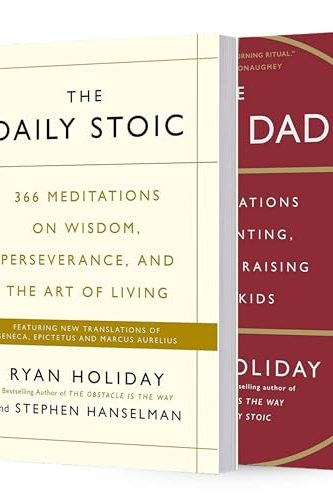
366 meditations on wisdom, perseverance, and the art of living — Stoicism as a daily operating system.
📖 OPEN THE FULL INTERACTIVE BREAKDOWN →🌐 Read it in Hindi, Hinglish, Gujarati, Tamil & 22 more languages — free, with audio.
💡 The Big Idea
Stoicism isn't cold detachment — it's the operating system of doers from Marcus Aurelius (emperor) to Epictetus (slave): identical software, opposite hardware, proving circumstances aren't the variable that matters. The Daily Stoic arranges it as practice, not philosophy: a year of daily meditations across three disciplines — PERCEPTION (see events as they are, stripped of the panic-narration: 'we suffer more in imagination than reality'; the DICHOTOMY OF CONTROL sorts everything into yours — judgments, responses, effort — and not-yours: outcomes, others, reputation, weather; misery is mostly category error), ACTION (do the right thing now, with what's in front of you — the obstacle IS the way: every impediment feeds virtue practice; amor fati — love your fate — turns acceptance from resignation into fuel), and WILL (train for adversity before it arrives: premeditatio malorum — rehearsing loss — inoculates against shock and multiplies gratitude; memento mori — you could leave life right now — is the deadline that makes priorities honest). The delivery mechanism matters: one page daily, journaled morning or evening, because Stoicism read once is trivia; Stoicism repeated daily is temperament.
🧠 The 6 Key Lessons
Lesson 1: The Dichotomy of Control: Sort First, Feel Second
Perception (Jan-Apr meditations)
Epictetus's opening move — 'the chief task in life is simply this: to identify and separate matters into what's in my control and what isn't' — is a filing system for anxiety. In your control: your judgments, intentions, effort, responses. Not: outcomes, other people's opinions and actions, markets, traffic, the past. Every wasted emotional hour is spent in the second file; every unit of real power lives in the first. The daily practice: before reacting to anything, run the sort — the stalled deal, the rude message, the delayed flight all decompose into an uncontrollable event plus a fully controllable response, and the response is where your entire quality of life is manufactured. Advanced version: even your reputation is other people's file; your character is yours.
📖 Example: Epictetus himself is the proof-of-concept: born a slave, leg crippled (by one account, deliberately by his master), exiled by an emperor — a man with less external control than almost anyone in history, whose classroom teachings (recorded by students, since… Read the full example →
⚡ Do this: For one week, keep a two-column card: every stressor goes left (mine) or right (not mine). For right-column items, write one sentence: 'my move is only ___.' Review nightly — watch the right column stop billing you.
Lesson 2: Amor Fati: The Obstacle Is Curriculum
Action (May-Aug meditations)
Stoic action rests on a reframe: events aren't obstacles to your training — they ARE the training. The blocked path exercises creativity; the unfair critic exercises equanimity; the failure exercises humility and iteration. Marcus's formula ('the impediment to action advances action') plus Nietzsche's later phrase amor fati (don't merely tolerate fate — love it, the way fire loves fuel: everything thrown on it becomes flame) convert setbacks from interruptions into assignments. This is not positivity theater: the Stoic doesn't call the loss good; they call it MATERIAL. The practical discipline is the response-gap: event → (pause) → 'what does this make possible? which virtue is this rep for?' — asked mechanically, especially when you don't feel like it, because temperament is built during bad weather, not described during good.
📖 Example: Thomas Edison, in Holiday's retelling: age 67, his life's work — factory campus, papers, prototypes — burning in a massive fire chemical-fed into colors too beautiful to look away from. Edison's recorded response: told his son to fetch his mother — 'she'll… Read the full example →
⚡ Do this: Install the two-question gap: next setback, before any complaint, write (1) 'what does this make possible?' and (2) 'which virtue is this a rep for?' (patience, courage, creativity, humility). Do it for every annoyance for 7 days — small reps build the big response.
Lesson 3: Memento Mori: Rehearse Loss, Harvest Gratitude
Will (Sep-Dec meditations)
The Will discipline trains for what can't be controlled at all. PREMEDITATIO MALORUM — the morning rehearsal of what could go wrong (the rude official, the failed pitch, the loss) — isn't pessimism; it's shock-absorption: the rehearsed mind meets adversity as expected weather, and everything that DOESN'T go wrong arrives as bonus (Seneca: 'the unexpected blow lands heaviest'). Its companion, MEMENTO MORI — 'you could leave life right now; let that determine what you do and say and think' (Marcus) — is the ultimate prioritizer: deadlines make projects real, and death is the deadline that makes LIFE real: petty grievances, postponed calls, deferred dreams all re-price instantly against it. The Stoics kept skulls on desks not from morbidity but accounting. Paired with the evening REVIEW (Seneca's nightly audit: what did I do badly? what well? what's left undone?), the practice compounds: rehearse in the morning, act in the day, audit at night — a full-loop operating system in twenty minutes of margins.
📖 Example: Seneca's letters practice what they preach: history's richest philosopher periodically lived days of deliberate poverty — coarse bread, hard bed, worst clothes — asking 'is this what I feared?' The rehearsal shrank the fear of losing his fortune to a known,… Read the full example →
⚡ Do this: Adopt the 3-part daily loop for 30 days: morning — 60 seconds of premeditatio (today's likely frictions, pre-accepted); anytime — one memento-mori check before saying yes/no to something ('does this matter against the real deadline?'); evening — Seneca's three questions in a journal. Twenty minutes total; temperament included.
Lesson 4: The Inner Citadel: Journaling and the View From Above
The Practice Layer: How Stoics Actually Trained
Stoicism survived 2,000 years not as doctrine but as EXERCISES — and two carry most of the weight. THE JOURNAL: Marcus Aurelius' 'Meditations' was never meant for readers; it's a private training log — the emperor drilling himself, repeating fundamentals, catching his own vanity ('take care not to be Caesarified'). The Stoic journal is not a diary of events but a rehearsal space: morning pages anticipate the day's frictions, evening pages audit responses against principles (Seneca: 'I examine my entire day and go back over what I've done and said, hiding nothing') — the loop converts philosophy from reading material into reflex. THE VIEW FROM ABOVE: Marcus' perspective drill — zoom out mentally until you see your city, then the earth, then your problem's true size at that altitude; anger and anxiety are altitude problems, sized for a room, dissolving at scale. Add the MORNING PREPARATION (his famous opening: 'today I will meet the meddling, the ungrateful, the arrogant... and none of them can harm me') and you have the complete daily kit: rehearse at dawn, zoom out at noon, audit at night — the citadel isn't built in crises; it's built in margins, one unglamorous page at a time.
📖 Example: The book's own origin proves the method: 'Meditations' exists because the most powerful man on earth — commanding armies through plague and betrayal — sat in a war tent on the Danube frontier writing notes to himself like 'be tolerant with others and strict… Read the full example →
⚡ Do this: Start the minimum viable citadel: one index card each morning — top half, today's likely friction and your pre-decided response; bottom half (filled at night), Seneca's audit: what did I do well, what poorly, what's left? When overwhelmed mid-day, run 30 seconds of the View From Above: your building, your city, the continent, the century. Then return to the only thing that was ever yours: the next response.
Lesson 5: Premeditatio Malorum: Rehearse the Worst to Conquer It
Part 3: The Discipline of Action
The Stoics rehearsed disaster before it happened — imagining the loss of a job, a relationship, even their own life — not to be pessimistic but to be prepared. Seneca wrote: 'What is quite unlooked for is more crushing in its effect; unexpectedness adds to the weight of a disaster.' By visualizing the worst case calmly, you strip it of its power to shock you and you pre-plan your response. The person who has already mentally survived losing everything cannot be destabilized by losing something. This is not worry; worry is passive, this is active — you walk through the disaster as a drill, not as a victim.
📖 Example: Holiday recounts how the Stoics practiced 'negative visualization' daily: Marcus Aurelius reminding himself that the people he loved were mortal, so that every day with them was a gift, not an entitlement — and grief, when it came, was already processed. Read the full example →
⚡ Do this: Pick one thing you dread losing. Spend 5 minutes writing how you would respond if it happened tomorrow — then spend the rest of the day grateful it hasn't.
Lesson 6: The Bookends: A Stoic Morning and Evening Routine
Part 4: The Daily Practice
The Stoics framed each day with two deliberate rituals. Morning: pre-commit to the day's character — 'What do I want to be today? Patient. Honest. Unbothered by what's not mine.' Evening: review — 'What did I do well? What did I do badly? What can I do better tomorrow?' This bookend structure turns philosophy from an abstract idea into a daily feedback loop. The morning frame sets your standard before the world sets it for you; the evening review catches drift before it becomes a habit. Twenty minutes a day of intentional self-examination is the entire secret of 'wise' people — they are just running the loop.
📖 Example: Holiday shows how Marcus Aurelius wrote his Meditations as exactly this practice — morning resolves and evening reviews, scribbled at dawn and dusk. The most powerful man in the world ran the same daily loop a student runs: set the standard, audit the day. Read the full example →
⚡ Do this: For 7 days: every morning write one sentence about the character you'll keep, and every night write one line on what you'd do differently. That's the whole practice.
✅ 5-Step Action Plan
- Sort every stressor into controllable/uncontrollable — respond only where you own the file.
- Treat obstacles as assigned reps: name the virtue each one trains.
- Rehearse the day's frictions each morning; audit with Seneca's three questions each night.
- Run one memento-mori priority check daily — the real deadline reprices everything.
- One page of Stoicism daily beats a hundred read once — repetition is the philosophy.
⚠️ When This Doesn't Work
Holiday's daily Stoic practice is the best discipline builder in self-help — and Bunker Hunt is the reminder that discipline without humility is just organised arrogance: the Hunt brothers were the most disciplined commodity traders of their era — meticulous, patient, principled — and their disciplined conviction that silver would rise led them to corner the market, destroy their fortune, and bankrupt themselves against forces bigger than their certainty. The Stoics' core lesson is the one their most devoted students forget: keep your beliefs small enough to be wrong.
💀 The Graveyard Proves It
🥈 Bunker Hunt — The Richest Men in America Try to Corner Silver — and Lose Everything. Burn: The Hunt brothers lost ~$1.5B of their own fortune. Read the full case study →
💬 Best Quotes from The Daily Stoic
- “You have power over your mind — not outside events. Realize this, and you will find strength.”
- “We suffer more often in imagination than in reality.”
- “The impediment to action advances action. What stands in the way becomes the way.”
Interactive version: mark lessons as read, listen in your language, share quote cards.