Library › Self-Improvement
Celebrating Silence — Summary & Key Lessons
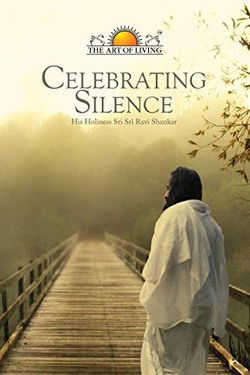
The Art of Living founder on why silence is not the absence of thought but its source.
📖 OPEN THE FULL INTERACTIVE BREAKDOWN →🌐 Read it in Hindi, Hinglish, Gujarati, Tamil & 22 more languages — free, with audio.
💡 The Big Idea
Sri Sri Ravi Shankar's talks and Q&As cover the whole path in simple language: meditation as rest for the mind, breath as the anchor, doubt as friend, love as native state. His central idea is that the mind is like the sky — thoughts are clouds; the sky is always there. You are the sky, not the clouds. Silence is not emptiness; it is the space where clarity and creativity originate.
🧠 The 9 Key Lessons
Lesson 1: You Are the Sky, Not the Clouds
Talk 1: The Mind
The core image of the book: thoughts are clouds passing across the sky of awareness. You are the sky — the ever-present space — not the clouds. The practice is therefore not to fight thoughts but to disidentify: notice the storm, and watch it from the space that is never disturbed.
📖 Example: An anxious thought at 3 am is a cloud; the witness of it is the sky — the real you. Read the full example →
⚡ Do this: Whenever a strong thought appears, silently repeat: 'cloud' — and return to the sky (breath).
Lesson 2: Breath Is the Door
Talk 2: Pranayama
Sri Sri teaches breath as the most direct switch: emotions change the breath, and breath changes emotions. Angry people breathe shallow and fast; calm people breathe long and slow. Regulate the breath, and you regulate the mood — no need for a storm of analysis. The 'Sudarshan Kriya' breathing exercises are his signature; the general principle is universal.
📖 Example: Before a hard conversation, five extended breaths change your tone more than any rehearsal. Read the full example →
⚡ Do this: Twice daily: 5 minutes of slow, long breathing — and one pause before each difficult interaction.
Lesson 3: Doubt Is a Friend
Talk 3: Doubt
Unusually, the book defends doubt: blind belief is stagnation, and honest inquiry is what ripens understanding. The seeker who questions is closer to the truth than the follower who never asks. At the same time, a doubt that is never acted on becomes noise — the answer to a doubt is not more doubt, but one experiment.
📖 Example: 'Does meditation work?' — the answer is not in debate but in twice-daily practice for a month. Read the full example →
⚡ Do this: Pick one live doubt and design a one-month experiment to settle it by experience, not argument.
Lesson 4: Love Is Not an Achievement
Talk 4: Love
Sri Sri distinguishes love from attachment: love expands, attachment contracts. Love does not need to be manufactured — it is the natural state of a mind not cluttered by fear and demand. The practical instruction is disarming: drop the expectation, and the feeling returns. You cannot force love; you can only remove what blocks it.
📖 Example: Parents who 'sacrifice' with resentment communicate the resentment, not the love — the block, not the flow. Read the full example →
⚡ Do this: One interaction today with zero expectation of return — and notice what happens to your warmth.
Lesson 5: Silence Is the Source
Talk 5: Silence
The book's name is its thesis: silence is not the absence of speech but the presence of depth — the state before thought, where decisions align and creativity is born. Regular silence (meditation, or even one quiet hour) is refuelling, not idleness. The loudest ideas and the deepest answers both come from quiet.
📖 Example: Master inventors and artists describe answers arriving in showers, walks, stillness — not in the busy grind. Read the full example →
⚡ Do this: Claim one hour of silence this week — no input, no output — then bring one question into it.
Lesson 6: The Question That Opens Everything
Chapter 1: The Question
Sri Sri Ravi Shankar opens with a question he insists is more valuable than any answer: 'Who am I?' The book's premise is that this question, held sincerely, turns life from a collection of events into an investigation. He is careful to say the question is not escapism — it is the search for the silent background before which all events appear, and finding it changes how events are lived.
📖 Example: A crisis looks completely different once you ask who is experiencing it: the storm and the sky are not the same thing. Read the full example →
⚡ Do this: Before any decision this week, ask the question for 30 seconds: 'Who is the one deciding?' Let the answer settle before you choose.
Lesson 7: The World Is a Mirror
Chapter 3: The Mirror of the World
The book's central psychological teaching: what annoys you in others is what you have not resolved in yourself — the world is a mirror that shows you your own unfinished business. This is not self-blame; it is leverage. Every irritation becomes a pointer toward your own growth, which is why the sage 'celebrates' even difficult people: they are free teachers.
📖 Example: The colleague who 'always interrupts' is a mirror of your own impatience; the one who 'never listens' mirrors how little you listen to yourself. Read the full example →
⚡ Do this: Tonight, take the day's biggest irritation and translate it: 'What does this say about me?' One sentence. No blame.
Lesson 8: The Dentist Chair: Pain as Pointer
Chapter 4: Pain and Transformation
Sri Sri's analogy: pain is like the dentist's drill — it signals precisely where the real work is needed. Without the pain signal, we would never treat the cavity; with it and only with it, we can. The book extends this to emotional pain: it is unpleasant, but it is also an accurate diagnostic, and the fastest way out of suffering is not to numb the signal but to follow it honestly.
📖 Example: The heartbreak that the person 'gets over' by wine returns; the heartbreak examined honestly becomes understanding, then compassion, then freedom. Read the full example →
⚡ Do this: Next time pain arises, don't ask 'how do I make it stop?' Ask 'what is this pointing to?' Follow the pointer before you reach for the anaesthetic.
Lesson 9: Celebration as the Highest Discipline
Chapter 6: The Art of Celebration
The book's most radical claim is that celebration — genuine joy, not forced cheer — is the highest spiritual discipline, harder than austerity. A mind that can be happy in ordinary moments is a mind that has stopped bargaining with life. Celebration is the proof of freedom: if happiness depends on conditions, you are a slave; if it survives ordinary days, you are free.
📖 Example: The person who can celebrate a quiet Tuesday evening with tea has achieved more than the ascetic who celebrates nothing but his own discipline. Read the full example →
⚡ Do this: Tonight, create one small celebration for no reason: a song, a walk, a good meal noticed fully. No occasion required.
✅ 5-Step Action Plan
- Label thoughts as clouds; return to the sky-breath.
- Practise 5 minutes of slow breathing twice daily.
- Convert one doubt into a one-month experiment.
- Give one zero-expectation interaction today.
- Take one silent hour weekly with a question in it.
⚠️ When This Doesn't Work
The talks are devotional, with metaphysical claims about energy and a guru-led path that not everyone needs or wants. The practices (breath, doubt, silence) work independently of the belief system.
💀 The Graveyard Proves It
🛩️ Howard Hughes — The Billionaire in a Darkened Room. Burn: Everything money can't buy Read the full case study →
💬 Best Quotes from Celebrating Silence
- “The quieter you become, the more you can hear.”
- “Doubt is the beginning of wisdom — it is the first step to the truth.”
- “You cannot learn to be free from someone who is not free.”
Interactive version: mark lessons as read, listen in your language, share quote cards.