Library › Self-Improvement
The 5 Second Rule — Summary & Key Lessons
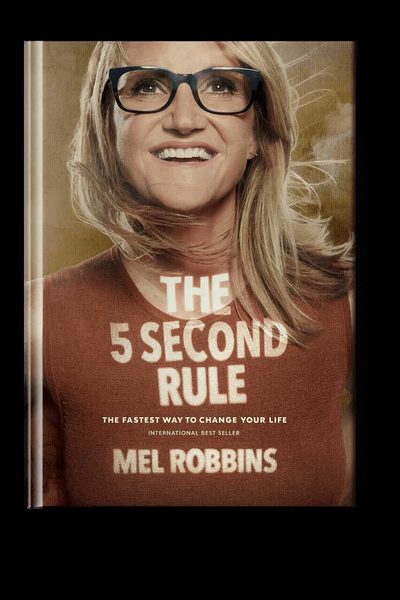
Transform your life, work, and confidence with everyday courage — 5-4-3-2-1-GO.
📖 OPEN THE FULL INTERACTIVE BREAKDOWN →🌐 Read it in Hindi, Hinglish, Gujarati, Tamil & 22 more languages — free, with audio.
💡 The Big Idea
The gap between knowing and doing has a precise width: about five seconds. When instinct says 'speak up / get up / start now,' the brain needs roughly that long to manufacture the excuses that kill it. Robbins' rule — the moment you feel an instinct to act on a goal, count backwards 5-4-3-2-1 and physically MOVE — works as a 'starting ritual' with real neuroscience underneath: counting backward interrupts rumination (you can't count and catastrophize simultaneously), shifts control from the habit-looping basal ganglia to the prefrontal cortex, and the physical movement beats the 'activation energy' hump. Its deeper premises: motivation is garbage (you will never FEEL ready — feelings are the problem, not the fuel), confidence is not a personality trait but a SKILL built by acts of everyday courage, and anxiety can be flipped into excitement because physiologically they're twins (reframe 'I'm nervous' as 'I'm excited' — the body agrees). Five seconds of courage, compounded daily, is the whole self-improvement industry in a countdown.
🧠 The 6 Key Lessons
Lesson 1: The Activation Energy Problem: Why You Freeze
Parts 1-2
Every goal dies the same death: instinct fires ('raise your hand,' 'go talk to them,' 'start the workout') → brain detects effort/risk → in ~5 seconds it deploys protection (overthinking, 'later,' phone-checking) → the moment passes. This isn't weakness; it's design — the brain is an energy-conserving, risk-avoiding machine that treats new and uncomfortable as threats. Waiting to 'feel ready' is therefore structurally hopeless: the feeling arrives AFTER action, not before. The rule attacks the gap mechanically: 5-4-3-2-1 is short enough to beat the excuse factory, weird enough to interrupt the loop, and ends in mandatory physical movement — because motion changes state where thought cannot.
📖 Example: Robbins invented it at rock bottom: 41, unemployed, marriage and finances collapsing, hitting snooze for hours every morning. One night she saw a rocket launch on TV and made a deal: tomorrow, launch out of bed like NASA — 5-4-3-2-1, feet on floor, no… Read the full example →
⚡ Do this: Tonight, set tomorrow's alarm across the room. When it rings: 5-4-3-2-1, feet on the floor, no snooze, no phone for 30 minutes. Run this one launch for 7 straight days before adding any other use of the rule.
Lesson 2: Everyday Courage: Confidence Is a Rep Count
Parts 3-4
We treat confidence as a prerequisite ('once I'm confident, I'll speak up'); Robbins inverts it: confidence is the RESIDUE of courageous reps — each 5-second act (asking the question, sending the pitch, introducing yourself) deposits proof that you act despite fear, and identity updates to match the evidence. The highest-leverage reps: SPEAK (say the idea in the meeting within 5 seconds of thinking it — hesitation lets the inner censor win and teaches the room you're furniture), START (begin the intimidating project for just 5 minutes; starting is the skill, finishing follows), and SHOW UP (the gym, the event, the difficult conversation — attendance is 80% of transformation). Fear doesn't shrink first; your action shrinks it afterward.
📖 Example: Her signature workplace case: the woman who'd spent YEARS silent in meetings — brilliant in hallways, invisible at the table — used the rule to speak within 5 seconds of forming a thought, before self-editing could engage. Within months: known, promoted, and… Read the full example →
⚡ Do this: In your next three meetings, apply the speak-rule: the moment you have a relevant thought, 5-4-3-2-1 and voice it — imperfectly phrased is fine. Track the count. The goal is reps, not eloquence.
Lesson 3: Flip Anxiety, Beat Worry, Guard the Morning
Part 5
Three power applications. FLIP ANXIETY: nerves and excitement are physiologically identical (racing heart, cortisol) — the label is the lever; Harvard research shows saying 'I am excited' before performance beats 'calm down' (you can't sedate arousal, but you can redirect it — pair it with a 5-4-3-2-1 launch into the task). BEAT WORRY: worry is default-mode drift; catch it with the countdown, then re-anchor ('what am I grateful for right now? what do I actually control?') — Robbins pairs the rule with deliberate thought-replacement because a stopped thought needs a successor. GUARD THE MORNING: the first hour sets the brain's momentum — her stack: no snooze (the rule), no phone for 30 minutes (someone else's agenda can wait), one 5-second brave act before 9 AM. The rule is a hinge: tiny door, whole rooms open.
📖 Example: The public-speaking flip: Robbins — who now speaks to arenas — still gets the full fear cascade backstage. Her protocol isn't calm; it's conversion: 'I'm excited' said out loud, 5-4-3-2-1, walk to the mic. She cites Alison Wood Brooks' Harvard studies:… Read the full example →
⚡ Do this: Before your next high-stakes moment: say 'I'm excited' out loud three times, then 5-4-3-2-1 into the first action (dial, walk in, hit send). Afterward, note what the fear did once you were moving — build your own evidence file.
Lesson 4: The Rule at Work: Procrastination, Ideas, and the Talk You Keep Postponing
Part 4: Courage Changes Everything
Robbins' deeper research chapter reframes procrastination: it is NOT laziness or poor time management — it's a STRESS-RELIEF habit (avoiding the task relieves the anxiety the task triggers, which rewards the avoidance, which builds the loop). That's why plans and apps fail: they treat a scheduling problem when the real event is an emotional flinch — and the 5-second countdown works precisely because it interrupts the flinch before the relief-seeking kicks in: feel the dread, 5-4-3-2-1, start ANY 5-minute version of the task (research shows starting dissolves the anxiety that avoiding feeds). Same mechanics rescue IDEAS (the window between 'I should build that' and self-censorship is seconds wide — capture or launch within it: write it down, send the first email, register the domain) and HARD CONVERSATIONS (the feedback, the apology, the ask for a raise — each has a 5-second doorway when the impulse is hot; miss it and the rationalization machine wins for another month). The compounding math is Robbins' closer: five seconds of courage, three times a day, is a thousand brave actions a year — an entirely different life, built from moments too small to resist.
📖 Example: The case Robbins retells from her own career: the idea for her TEDx talk pitch — she acted within seconds of the impulse, sending the rough email before doubt loaded; that talk (28 million views) built everything that followed. Against it she stacks the… Read the full example →
⚡ Do this: Identify your single most avoided task and your single most postponed conversation. For the task: tomorrow, 5-4-3-2-1 into a timed 5-minute start — nothing more owed. For the conversation: the next time the thought arises, count down and send only the scheduling message ('got 15 minutes this week?'). Let the calendar do the courage after that.
Lesson 5: The 5-Second Countdown: The Hack That Bypasses Your Overthinking Brain
Part 1: The Rule
Robbins' discovery, born from a desperate moment: when you have an instinct to act (raise your hand, say something, start the task), you have about five seconds before your brain's defense mechanisms talk you out of it. The rule: count 5-4-3-2-1 and physically move before the countdown ends. The countdown isn't magic — it's a 'starting ritual' that shifts your brain from the thinking mode (prefrontal cortex, the great deliberator) to the acting mode, interrupting the hesitation loop. The science: counting distracts the overthinking circuits just long enough for action to begin. Every great habit starts with one five-second window; the rule is how you stop letting them all slip away.
📖 Example: Robbins describes the morning she couldn't get out of bed after a financial crisis — and invented the countdown as a way to launch herself upright before despair could pin her down again. The tiny ritual became the lever she used to rebuild everything. Read the full example →
⚡ Do this: Pick one action you've been hesitating on. Tomorrow, the moment you think of it, count 5-4-3-2-1 and move within the count. Repeat every time hesitation appears.
Lesson 6: The Courage Habit: Bravery Is a Repetition, Not a Personality
Part 3: The Practice
Robbins' reframe of courage: it's not a trait you're born with — it's a muscle built by reps, and the 5-second rule is how you get the reps in. Every time you act within the countdown, you strengthen the neural pathway for courage; every time you hesitate past it, you strengthen the pathway for fear. Over weeks, the person who uses the rule in small moments (speaking up, asking, starting) becomes 'the brave one' — not because they changed personalities, but because they accumulated hundreds of micro-acts of courage. The compounding works both ways: fear is also a habit, built one avoidance at a time. The question isn't 'am I brave?' but 'how many reps did I get this week?'
📖 Example: Robbins tells of a woman who used the rule to speak in meetings, then to ask for a raise, then to change careers — each act making the next easier until the pattern flipped. The identity 'I'm not brave' didn't change; the rep count did, and the identity… Read the full example →
⚡ Do this: Aim for five courage reps this week: five moments where you act within five seconds on something you'd normally hesitate over. Track them — the streak is the transformation.
✅ 5-Step Action Plan
- Use the rule on one anchor habit first: 5-4-3-2-1 out of bed, 7 days straight.
- Speak within 5 seconds of having the thought — reps over eloquence.
- Start dreaded tasks for just 5 minutes; let momentum handle the rest.
- Relabel nerves as excitement out loud before every performance.
- Protect the first 30 phone-free minutes — win the morning's momentum.
⚠️ When This Doesn't Work
Mel Robbins' countdown-to-action works — and its shadow is impulsive action without thinking. Mike Tyson never lacked the 5-second trigger: he acted on every impulse instantly, in the ring and out, and the same instinct that made him champion made him a cautionary tale of fines, bites and bankruptcy. The rule is for starting things you've already decided; it is poison for decisions you haven't made. Count down to action, not to reaction.
💀 The Graveyard Proves It
🥊 Evander Holyfield's Ear Aside — Tyson's Entourage — $400M Earned; Bankrupt With 200 People on Payroll. Burn: $400M career → $23M in debt. Read the full case study →
💬 Best Quotes from The 5 Second Rule
- “You are never going to feel like it.”
- “Hesitation is the kiss of death. You hesitate, you lose.”
- “Courage is just moving before your brain talks you out of it.”
Interactive version: mark lessons as read, listen in your language, share quote cards.