Library › Authors › R. M. Lala
Books by R. M. Lala
R. M. Lala has one book in the library. Every book here is read down to the big idea, the lessons, the lines worth keeping and the actions worth taking. Start with the summary, then buy the full book if it earns a place on your shelf.
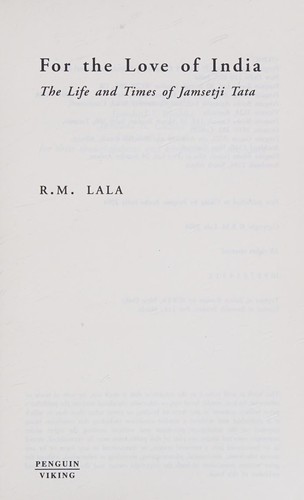
For the Love of India: The Life and Times of Jamsetji Tata
2004 · 11 min · 8 lessons
The biography of Jamsetji Tata, the founder who planned a nation's industry a century ahead, and whose successors finished what he started because he built institutions, not just businesses.
R.M. Lala (chronicler of the Tatas) tells the life of Jamsetji Nusserwanji Tata (1839-1904): a trading firm at 29, the swadeshi cotton mill (Empress Mills, Nagpur, 1877), the Taj Mahal Hotel (1903) built after a whites-only hotel refused him entry, the steel plant experts said India could never run (Sakchi, approved 1907, after his death), the hydroelectric power scheme and the Indian Institute of Science, funded by his personal wealth. The deeper theme: Jamsetji's projects were designed as nation-building...
Lessons in the summary
- Swadeshi as Strategy, Not Slogan
- Bet Against the Experts When They Weigh Prestige, Not Physics
- Insults Are Data: Build What Refuses You
- Fund the Institution, Not Just the Venture
- Succession Is the Founder's Final Product
- Welfare Is a Productivity System
- Build Where the Nation Will Grow, Not Where the Market Is
- The Brand Outlives the State's Stewardship
Lines worth keeping
- We do not claim to be more unselfish than other people. But we think we started on sound and straightforward business principles.
- Be sure to lay wide streets planted with shady trees, every other of a quick-growing variety from a distance affording a shady drive near the township.
- In free enterprises, the community is not just another stakeholder in business, but the very purpose of its existence.
Questions R. M. Lala helps answer
Read nearby authors next
- Bill Bryson 2 books
- David Grann 2 books
- Isabel Wilkerson 2 books
- Ramachandra Guha 2 books
- Siddhartha Mukherjee 2 books
- Walter Isaacson 2 books
- William Dalrymple 2 books
- A.L. Basham 1 book